
From Disposal to Dispatch
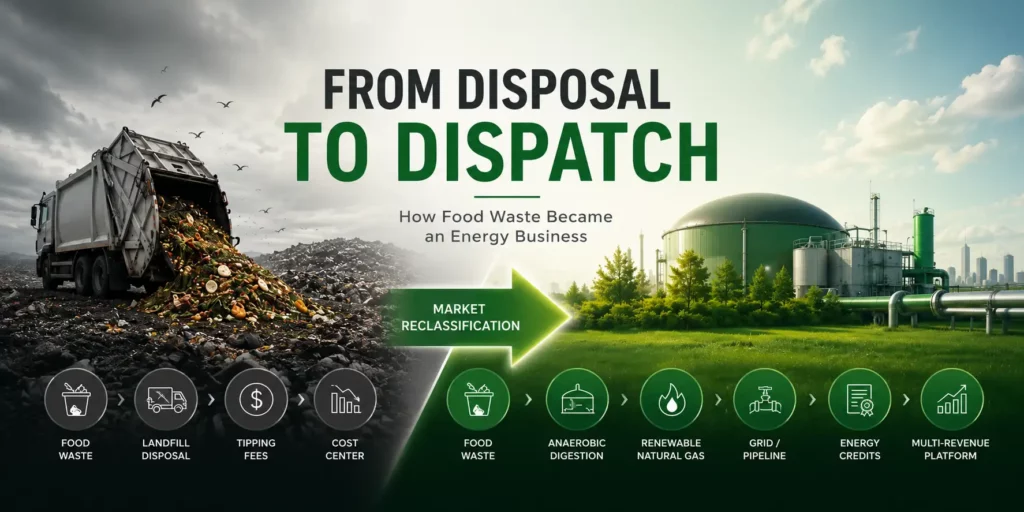
How Food Waste Became an Energy Business The shift from landfill default to energy feedstock is not a sustainability trend. It is a structural market transition — and the operators positioned ahead of it are rewriting the economics of organics processing in the United States. For most of its commercial history, food waste had one destination: the landfill. The economics were simple. Disposal was cheap, tipping fees were predictable, and the operational model required nothing more sophisticated than a truck, a route, and a licensed site. Organic material was a liability to be removed, not a resource to be managed. That model is breaking down across the United States — and not gradually. It is breaking down under simultaneous pressure from regulation, landfill economics, energy markets, and the changing composition of the commercial food sector itself. Twelve states have now enacted food waste disposal bans or organics diversion mandates — up from two a decade ago. California’s SB 1383, the most consequential state-level organics mandate in the country, has created compliance obligations for commercial food generators at a scale that existing landfill-based disposal chains cannot satisfy. Massachusetts, New York, New Jersey, and Washington are enforcing equivalent frameworks, and the generator thresholds within existing laws are ratcheting down on fixed statutory dates. The regulatory tide is directional, and it is accelerating. At the same time, landfill economics have shifted. Tipping fees at municipal solid waste landfills have risen sharply across high-density markets. Organics, once accepted at standard MSW rates, are increasingly subject to surcharges or outright rejection as landfill operators respond to methane obligations under Clean Air Act landfill gas rules and state greenhouse gas programs. The path of least resistance — putting food waste in the same truck as everything else — is narrowing. Meanwhile, the energy value embedded in organic material has become visible to a new class of infrastructure investor. Anaerobic digestion, long commercially mature in Europe, has reached economic viability at meaningful scale in the United States. The combination of renewable natural gas offtake agreements, Renewable Identification Number credits, Low Carbon Fuel Standard premiums, and IRA-era clean energy incentives has created an entirely different return profile for food waste processing than existed five years ago. The result is a market in transition. Food waste processors — composters, digesters, rendering facilities, and the haulers who feed them — are operating inside a structural shift that is changing who the buyers are, what the product is, and where the value lives. The operators who understand that transition are building durable competitive positions. The operators still running the old model are experiencing margin compression they cannot explain through the lens of their historical cost structures. The industry is not becoming more sustainable. It is becoming a different business — one where organic material is an energy input, not a waste output. The single most important shift in food waste is this: the market has moved from a disposal orientation to an energy orientation. That transition is not complete, and it is not evenly distributed across the country. But its direction is clear and its momentum is structural, not cyclical. Disposal businesses optimize for throughput and tipping fee capture. Energy businesses optimize for feedstock quality, gate pricing, and offtake economics. Those are different businesses — different commercial models, different capital structures, different relationships with counterparties, and different definitions of what a competitive advantage looks like. Food waste is no longer measured by the ton at the gate. It is increasingly measured by its BTU content, its methane yield, its RIN value, and its LCFS contribution. Operators who have not made this translation are pricing their product in the wrong currency. The implication for processors, haulers, and investors is direct. The competitive dynamics of this market are not being reshaped by new entrants competing on tipping fee. They are being reshaped by a fundamental reclassification of what the product is. Understanding where that reclassification is most advanced — and where it is still arriving — is the basis of commercial strategy in organics today. 1. Regulation is forcing the transition, not enabling it California’s SB 1383 is the template. Signed into law in 2016 and fully in effect since 2022, it requires jurisdictions to achieve a 75 percent reduction in organic waste disposal by 2025, relative to 2014 levels. Commercial food generators above defined thresholds — grocery stores, food service operators, food manufacturers, hospitality groups — are required to arrange for organic waste collection. Jurisdictions that fail to provide compliant infrastructure are subject to enforcement. The immediate commercial effect has been substantial. Demand for organics processing capacity in California has outpaced permitted infrastructure in several regions. Tipping fees at anaerobic digesters and composting facilities in high-compliance markets have risen sharply — not because of energy economics, but because of simple supply-demand imbalance. Compliance is not optional, and the alternative — landfill disposal — carries regulatory exposure that commercial food generators cannot absorb. Massachusetts’ commercial food material disposal ban, tightened progressively since 2014 and now covering any entity generating more than half a ton of food waste per week, has produced equivalent dynamics in the Northeast. New York’s statewide food donation and food scraps recycling law expanded on January 1, 2026 to cover generators of one ton per week — supermarkets, restaurants, hotels, universities, stadiums — and ratchets down to half a ton per week in 2028. These are not pilot programs. They are enforceable mandates with material noncompliance risk. 12 US states with enacted food waste disposal bans or diversion mandates — up from two a decade ago: The build-out is directional, not reversible — and it compounds from within. Washington’s threshold drops to a quarter cubic yard per week in 2027; Illinois extends to generators of 96 gallons per week in 2026; New York reaches half-ton generators in 2028. Each ratchet creates immediate incremental demand for permitted processing capacity that the existing infrastructure base cannot satisfy without new investment or network reconfiguration. 2. The energy transition changed the investment case
Systems, Not Slogans
Private equity’s harder era rewards firms that turn sector specialization into an always-on operating model — one that sources years ahead and underwrites value creation and exit at entry. The consulting consensus on private equity has rarely been so unanimous, or so blunt. The conditions that manufactured a decade of returns — falling rates, expanding multiples, cheap leverage — are gone. What replaces them is harder to come by and harder to fake. As McKinsey frames it, alpha must now be made rather than assumed. The question for every general partner is no longer whether that is true, but what system actually produces it. The consensus: alpha must be made The numbers behind the slogans are sobering. StepStone analysis cited by McKinsey finds that leverage and multiple expansion drove roughly 59 percent of private equity returns on deals done between 2010 and 2022 — the very levers that have now largely run dry. Bain frames the new math as “12 is the new 5”: where a deal once needed about 5 percent annual EBITDA growth to pencil, today’s pricing and financing demand closer to 12. Distributions tell the same story. McKinsey reports that five-year rolling DPI as a share of assets fell to its lowest recorded level in 2025, even as more than half of buyout-backed companies have now been held longer than four years. The prescriptions converge. McKinsey argues that operational value creation must move from a late-stage acceleration tactic to an early, sustained discipline underwritten in the thesis itself. Bain is more pointed still: winning firms will secure advantage by proactively identifying targets years ahead of any deal, and will turn differentiation — through scale, specialization, or execution — into a repeatable, data-backed system rather than a marketing claim. The prescription is clear and nearly unanimous. The infrastructure to follow it is what the market still lacks. Three gaps between prescription and practice The advice is right. The difficulty is that almost no one is equipped to follow it. A scan of the literature surfaces three gaps. First, sourcing. Everyone now agrees origination should be proactive and years ahead. Yet sourcing remains overwhelmingly relationship-led and intermediated, and the coverage data is humbling: one widely used benchmark found that private equity firms see, on average, fewer than one in five of the relevant transactions in their own target markets. You cannot source years ahead in a sector you only watch one deal at a time. Second, value creation. The consensus says to underwrite the operational thesis — adjacencies, add-ons, margin levers — at entry. But the sector knowledge required to do that credibly is typically rebuilt from scratch for each deal, by a new team, under time pressure. The add-on pipeline that justifies a platform is rarely maintained as a living asset. Third, exit. With DPI under pressure, firms are told to underwrite the exit at entry. In practice the buyer universe is assembled at exit — two to five years too late to shape the thesis it should have informed. Beneath all three sits a quieter gap. AI in private equity is still mostly a point solution — faster diligence, quicker screening — bolted onto a workflow that remains episodic. The tooling improved; the operating model did not. The always-on operating model Closing these gaps requires treating a sector, not a deal, as the unit of analysis — and watching it continuously. That rests on four capabilities. A living industry taxonomy that resolves a sector into its real segments, sub-segments, and adjacencies, and stays current as it consolidates. Coverage of both sides at once — who is acquiring and why, who is consolidating, where capital is concentrating, and which assets are quietly coming into play. Every company linked to that taxonomy and to its own strategic priorities, not only the names in a current process. And predicted transaction likelihood, for buyers and sellers alike, before anyone is at the table. For a general partner, that is not abstract. It is a proprietary origination engine that flags likely sellers years early; a standing, ranked add-on pipeline for every platform; an operational and competitive map that lets a thesis be underwritten with conviction at entry; and a forward view of the exit buyer universe at the moment of purchase rather than the moment of sale. Why now The consultants have written the prescription with unusual clarity: specialize, systematize, source ahead, create value early, and back it all with data. What the market still lacks is the infrastructure to live up to it. That is the gap Espalier was built to close — an always-on decision intelligence system that knows a sector continuously, so origination, value creation, and exit are underwritten from a single view. In an era where alpha must be made, the firms that win will not be those with the best slogans about it. They will be the ones that built the system.
The Always-On Deal Engine

Why the next edge in investment banking is a system that never stops watching the market — and what the consulting consensus still misses. The major consulting firms have reached a rare consensus: artificial intelligence is remaking the deal business. Yet most banks are bolting that intelligence onto a workflow that remains fundamentally episodic. The larger prize is a system that is always on — one that maps an industry in granular detail, tracks it from both the demand and supply sides, links every company to its strategic priorities, and predicts where the next transaction will form. Where the consultants agree The direction of travel is settled. McKinsey estimates that generative AI could create $200 billion to $340 billion in annual value for banking, and now frames AI-enabled origination as a strategic prerequisite rather than a productivity play — surfacing risk and capital insight to the front line in near-real time. Bain describes AI as the lifeblood of M&A, reporting that adoption among dealmakers more than doubled in 2025, with roughly 45 percent of more than 300 executives surveyed now using it, most heavily in sourcing, screening, and diligence. BCG’s 2025 M&A report calls embedded AI and advanced analytics a critical edge, beginning with the identification of high-potential targets. Deloitte finds that about 86 percent of deal organizations have integrated generative AI, two-thirds of them within the past year. The infrastructure is following the thesis. Bain acquired — and later divested — Sutton Place Strategies specifically for its granular industry taxonomy and its ability to map the relevant buyer universe and unify an otherwise fragmented sourcing environment. The gap the consensus hides Here is the uncomfortable part. For all that adoption, AI in most banks is still a point solution — a faster way to read a data room, draft a memo, or screen a list once a process is already live. The workflow beneath it has not changed. It remains episodic: the bank mobilizes around a deal, runs its analysis, and stands down until the next mandate appears. The cost of that posture shows up in coverage. Sutton Place Strategies’ origination benchmark found that private equity firms saw, on average, fewer than one in five of the relevant transactions in their own target markets. Even disciplined originators miss the large majority of what is happening in their sectors. No one wins a mandate on a deal they never saw forming. The next edge is not a better tool inside the deal. It is a different unit of analysis: the market, watched continuously. From watching deals to watching markets An always-on system rests on four capabilities. The first is a detailed, living industry taxonomy. Generic sector codes flatten the very distinctions that drive deals; a real map resolves an industry into its segments, sub-segments, and adjacencies, and stays current as the sector moves. The second is coverage of both sides at once. Demand and supply are tracked together — who is acquiring and why, who is consolidating, where capital is concentrating, and which assets are quietly coming into play. A view of one side is half a thesis. The third is linkage: every company tied to the taxonomy and to its own strategic priorities, not just the names in a current process. When each operator, sponsor, and strategic is positioned against the map and its stated intentions, the question of who would logically buy or sell an asset becomes a query rather than a week of analyst work. The fourth is prediction. The system scores which companies are most likely to transact — as sellers and as buyers — before a banker is in the room, turning origination from reactive to anticipatory and handing execution a buyer universe that already carries its strategic rationale. Why it matters now The consultants have described the destination; few have operationalized the road to it. Bain’s taxonomy assets, Deloitte’s adoption curve, and McKinsey’s framing of origination as a strategic prerequisite all point the same way — toward continuous, predictive, full-market intelligence. What the market still lacks is a workflow rebuilt around that idea rather than decorated with it. That is the principle behind Espalier. We treat origination and execution as one continuous system rather than two separate events. The same always-on intelligence that anticipates where a transaction will form also equips the banker who runs it: the full universe of logical counterparties, ranked by strategic fit, and a narrative grounded in how the sector truly creates value. The banks that win the next cycle will not be those with the fastest tools inside a live deal. They will be the ones that never stopped watching the market.
The Deck Has a Half-Life
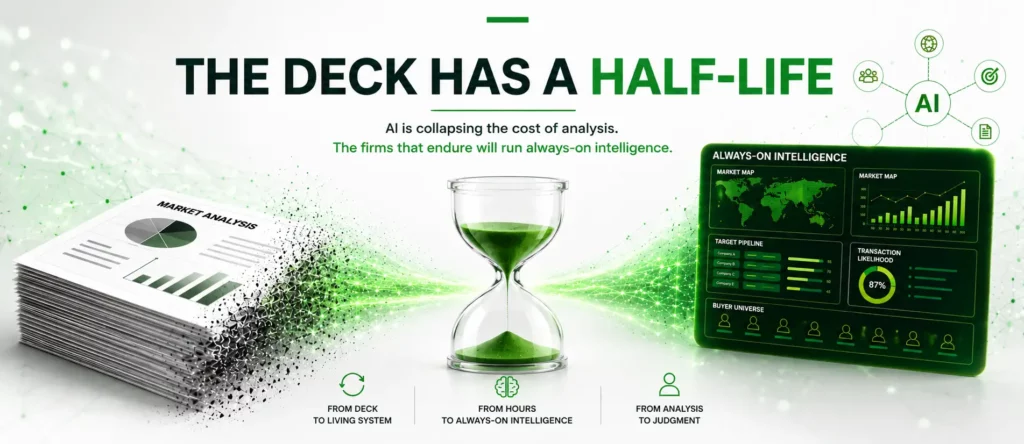
AI is collapsing the cost of the analysis that strategy and M&A advisory was built to sell. The firms that endure will stop shipping one-time decks and start running always-on intelligence — reserving their people for the judgment clients actually pay for. Strategy and M&A advisory rests on a quiet premise: that rigorous market analysis is expensive and slow to produce, and therefore worth paying handsomely for. A growth question — where to expand, what to buy, who might buy us — once meant weeks of market reports, expert calls, and modeling, synthesized by a leveraged team into a hundred-slide deck and a seven-figure invoice. That premise is now under direct assault, and with it the economics of an entire profession. What the analysis used to cost The value was always tied to the cost of producing insight. Commercial due-diligence reports from leading firms routinely run into the hundreds of thousands of dollars and take weeks to deliver; the price reflected the labor required as much as the conclusions reached. Generative AI compresses that labor dramatically, turning weeks of research, synthesis, and drafting into hours. The Financial Times has reported that the resulting pressure is forcing McKinsey and its peers to rethink the billable-hour pricing that has underpinned consulting for decades. When the analysis becomes cheap to produce, the deliverable that was the analysis loses its scarcity — and a deck built on a point-in-time market read begins aging the moment it is bound. The productivity paradox Here the industry meets an uncomfortable bind. The same efficiency AI offers also cannibalizes the billable hours on which firm economics, leverage ratios, and partner compensation depend. The rational response has been to adopt the technology visibly while deploying it carefully — investing to look innovative while protecting the pyramid underneath. Firms are spending heavily on the future they are slow to fully embrace: standing up proprietary analytics units such as McKinsey’s Quantum Black, committing billions to AI partnerships, and, in Bain’s case, acquiring a deal-data business built around a living industry taxonomy before later divesting it. The direction of travel is clear; the operating model has not caught up. Meanwhile, AI-native challengers — several founded by former diligence leads at the major firms — are unbundling the most repeatable analytical work and selling it faster and cheaper. When the analysis is cheap to produce, the advantage shifts to whoever maintains it continuously — and to the judgment laid on top. From deck to living system The resolution is not a better deck produced faster. It is a different artifact altogether. The repeatable analytical core of strategy and M&A work — the market map, the company landscape, the target screen, the buyer universe — should not be rebuilt from scratch for each engagement and discarded at its close. It should be a living system, maintained continuously and drawn upon on demand. Such a system rests on four capabilities. A detailed, living industry taxonomy that resolves a sector into its real segments, sub-segments, and adjacencies, and stays current as it evolves. Coverage of both the demand and supply sides at once — who is acquiring and why, who is consolidating, where capital concentrates, and which assets are coming into play. Every company linked to that taxonomy and to its own strategic priorities, not just the names in a current mandate. And predicted transaction likelihood, on both the buy- and sell-side, before anyone is at the table. On that substrate, a commercial diligence is refreshed rather than reconstructed; a market map is a query rather than a project; a target screen or buyer universe is standing and ranked. The bespoke deck becomes a view into a system that was already current — and the advisor’s time shifts from assembling the analysis to interpreting it, which is the work clients were always paying a premium for in the first place. Why now This is the more durable version of the shift the consulting industry is already gesturing toward: from pyramid to platform, from selling hours to maintaining intelligence, from recommendations to decisions. What separates the two futures is where the analytical work lives. Firms that keep rebuilding it by hand will find themselves competing on cost against tools that never tire. Firms that run it as an always-on asset will compete on judgment — and reserve their most expensive people for the part no model can supply. That is the layer Espalier provides: an always-on decision intelligence system that keeps an industry continuously mapped, so the analytical foundation of strategy and M&A advisory is maintained rather than manufactured. The deck will always have a half-life. The intelligence beneath it does not have to.
Biosolids Infrastructure Is Shifting Toward Distributed Processing and Capacity Intelligence
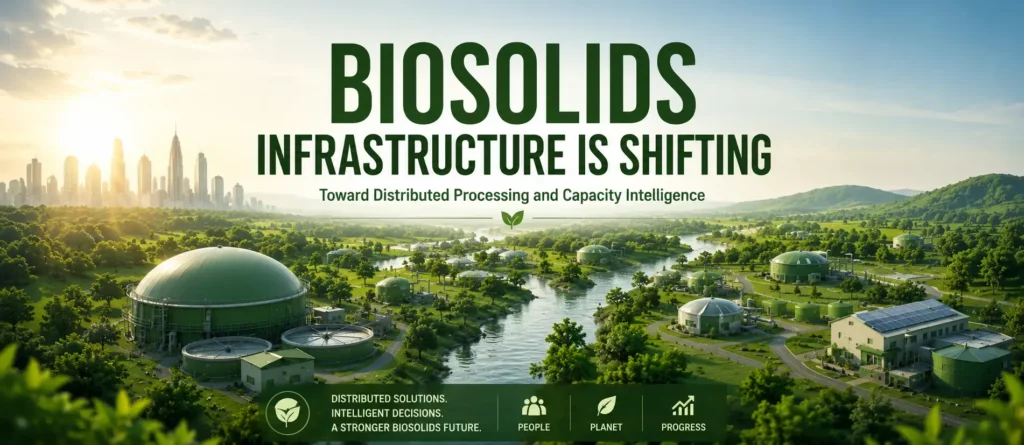
For decades, the U.S. biosolids industry operated as a relatively legible system. Wastewater treatment plants generated sludge. That sludge was dewatered, hauled, and moved through one of four well-established pathways: land application, landfill, incineration, or composting. The competitive logic was straightforward — manage volume efficiently, maintain regulatory compliance, and secure disposal contracts. Scale mattered. Geography mattered in a relatively simple way. The business functioned largely as a linear pipeline with a limited number of endpoints. That model no longer reflects operational reality. The endpoints still exist, but the system around them has changed enough to fundamentally alter how the market functions. More than 15,000 publicly owned treatment works (POTWs) operate across the United States. Roughly 60% of U.S. biosolids were still land-applied as of 2023, according to the EPA, making it the dominant outlet despite increasing pressure. At the same time, Bay Area biosolids hauling and tipping costs rose by more than 50% between 2020 and 2023, according to BACWA’s 2024 Biosolids Trends Report. BACWA’s survey of 32 Bay Area wastewater agencies revealed more than rising unit costs. It showed a broader operational shift underway. Agencies are hauling biosolids farther, relying on additional offsite treatment, and moving away from disposal pathways that no longer function the way they once did. Nearly all Bay Area agencies had stopped using landfill alternative daily cover (ADC) by 2015, partly in response to California’s SB 1383 organic waste diversion mandates. Yet 57% of biosolids still ended up in landfills in 2023. The implication is important: constraining disposal pathways without creating scalable alternatives does not eliminate landfill dependency. It simply increases the cost of maintaining it. That dynamic — tightening disposal options, rising costs, and no obvious replacement — is not unique to California. It increasingly defines the U.S. biosolids market. In some regions, operators and investors are responding by building new infrastructure and recovery capacity. In others, operators are still running the legacy disposal model while absorbing escalating costs. From Pipeline to Network The traditional biosolids model treated the industry as a linear value chain. Generators produced volume. Haulers transported it. Processors treated it. End markets absorbed it. Each stage operated relatively independently. Under that model, the economics of a hauling company were not materially affected by downstream processing constraints several counties away. Likewise, a processing facility’s economics were not closely tied to changing regulatory conditions affecting generators in neighboring states. Operators competed largely on cost-per-ton efficiency within a specific stage of the chain. The emerging network model functions differently. A regulatory change that restricts land application in one state does not remain localized. It redirects volume flows, pressures hauling capacity across regions, alters disposal pricing, and changes feedstock availability for digestion and recovery facilities upstream. Technology decisions are increasingly interconnected with market conditions as well. Higher energy values and stronger RNG economics can shift a facility from a disposal-oriented model toward a resource recovery model centered on biogas, electricity generation, or renewable natural gas production. The system is now interconnected, and regulatory, commercial, and operational decisions propagate through it. This distinction matters because competitive advantage changes fundamentally between the two models. In a linear value chain, the lowest-cost operator at a specific step often wins. In a networked system, operational efficiency alone becomes insufficient. Durable advantage comes from the ability to optimize the system as a whole — understanding where outlet capacity exists, which regulatory environments are tightening, which generator relationships are exposed to future constraints, and which routing and recovery configurations maximize margin across the broader network. Why Traditional Disposal Pathways Are Becoming Less Viable PFAS regulation is now reshaping the economics of traditional biosolids disposal. As recently as 2023, roughly 60% of U.S. biosolids were land-applied. For decades, land application represented the dominant and lowest-cost disposal route. That assumption is becoming increasingly unstable. Maine has implemented a complete ban on land application of biosolids. Minnesota now requires PFAS testing for biosolids intended for land application, including mandatory response actions above concentration thresholds. Maryland established PFAS concentration limits for PFOS and PFOA in sewage sludge used for land application. Connecticut banned biosolids sales containing PFAS for land application, while Rhode Island mandates quarterly PFAS sampling and state reporting requirements. The EPA’s January 2025 Draft Sewage Sludge Risk Assessment for PFOA and PFOS identified potential health risks at concentrations as low as 1 part per billion under common land application scenarios. Although federal standards remain unfinished, the broader direction is increasingly clear: policy is moving toward tighter restrictions, not looser ones. States are already advancing ahead of federal action, creating a fragmented regulatory environment that operators must navigate without long-term certainty regarding future compliance obligations. Landfill pathways face pressure for different reasons. California’s SB 1383 mandated a 75% reduction in landfill organic waste disposal by 2025, limiting both landfill ADC usage and conventional disposal practices. BACWA’s 2024 survey illustrates the operational consequences. Agencies that stopped using ADC did not discover a seamless alternative. Instead, they encountered higher transportation costs, more constrained outlet access, and rising disposal expenses. This is the structural force accelerating interest in energy recovery and advanced processing infrastructure. Not because those technologies are ideologically preferred, but because legacy disposal pathways are simultaneously becoming more constrained and more expensive. Recovery Capacity Is Becoming Strategic Infrastructure The movement toward energy recovery is not solely regulatory. The economics themselves have shifted. Between 2020 and 2024, U.S. RNG capacity grew by approximately 170%, with operational facilities increasing from 338 to 914 by mid-2025. Biogas infrastructure investment exceeded $2 billion in 2025, driven partly by corporations sourcing RNG from wastewater treatment systems to meet sustainability targets. Programs such as the federal Renewable Fuel Standard and California’s Low Carbon Fuel Standard have transformed biogas-to-RNG conversion into a meaningful revenue stream rather than an operational byproduct. Research from the American Society of Civil Engineers has demonstrated the economic impact of co-digestion. Combining biosolids with food waste or FOG produces substantially greater energy output at lower overall energy costs compared to biosolids digestion alone. While co-substrate systems
Practical AI Tools for Everyday Leadership in Waste Management

Most waste management leaders do not need to be convinced that AI is important. They need to know what to do with it. The conversation in most boardrooms and leadership meetings has already moved past “Should we pay attention to AI?” The question now is more specific — and more urgent: Which tools are worth deploying? Where do they fit in the operation? And what does good look like? This article is an attempt to answer those questions practically. It is written for operators, regional managers, PE-backed platform leaders, and executives running waste management businesses across collection, liquid waste, hazardous, and environmental services. Not for technology teams. Not for academics. For the people who must make decisions about running and growing these businesses every day. The goal is not to describe AI in the abstract. It is to describe what AI can do specifically inside a waste management business — and where the leverage is highest. The Starting Point: Why Waste Management Is Ready for This Waste management is a data-rich industry that has historically been information-poor. Every route generates data. Every service call generates data. Every regulatory submission, every customer contract, every equipment maintenance cycle, every acquisition — all of it generates data. Most of it disappears into spreadsheets, siloed software systems, email threads, and the institutional memory of individual managers. The problem is not that waste operators lack information. The problem is that the information is fragmented, disconnected, and reviewed too infrequently to drive decisions in real time. AI changes that — not by replacing operational expertise, but by compressing the time between data and decision. The leaders who will move fastest are not those who understand AI the most deeply. They are the ones who identify the highest-leverage operational problems and deploy the right tools against them. Five problem areas stand out as the most important for waste management leaders right now. 1. Regulatory and Compliance Intelligence The problem Waste management operators — particularly those with multi-state footprints — face a regulatory environment that is tightening on multiple fronts simultaneously. PFAS standards are evolving differently in every state. Land application restrictions are tightening in some jurisdictions and stable in others. Permitting requirements vary by county. Greenhouse gas reporting obligations are expanding. A regional operator in five states is effectively tracking fifty separate regulatory environments simultaneously. Most compliance teams are doing this manually — reading bulletins, subscribing to regulatory updates, attending industry association briefings, and relying on legal counsel to flag material changes. What AI can do AI-powered regulatory monitoring tools can continuously track regulatory developments across every jurisdiction relevant to an operator’s footprint — federal EPA updates, state environmental agency rulings, proposed rule changes, enforcement actions, and permit modifications — and surface them in structured, actionable formats. The leverage is not just speed. It is completeness. A compliance team that previously reviewed what they had time to review can now operate against a complete picture of the regulatory landscape. What to look for in a regulatory intelligence tool: The most important capability is waste-sector specificity — a tool that filters for environmental and waste-relevant rule changes rather than broad regulatory feeds requiring manual curation. The best solutions combine automated monitoring across federal and state sources with the ability to map regulatory changes to your specific operational footprint: which facilities are affected, which permits are implicated, and what action is required. Regulatory complexity is not going away. The operators who systematize their intelligence will absorb compliance costs more efficiently than those who manage it reactively. 2. Route Optimization and Operational Efficiency The problem Routing is one of the highest-leverage operational variables in a collection business. A five percent improvement in route efficiency across a fleet of 100 trucks is not a marginal gain — it is a material improvement in labor costs, fuel costs, vehicle wear, and customer service quality. Most collection operations still rely on routes that were designed years ago and are updated infrequently. Drivers know the territory. Dispatchers know the patterns. But that knowledge lives in people’s heads, not in systems that can continuously adapt to changes in volume, customer mix, traffic, and equipment availability. What AI can do AI-driven routing platforms optimize collection schedules dynamically — adjusting for service frequency, container fill levels (where smart sensors exist), vehicle capacity, driver schedules, and traffic patterns. Some platforms can predict missed pickups before they happen and reroute proactively. Others model the impact of adding new customers or service lines to existing routes before changes are implemented. Large-scale logistics operations have documented savings of over 100 million miles per year through AI-driven routing at fleet scale. The underlying principle applies equally to residential and commercial waste collection What to look for in a routing and optimization tool: Waste-native routing platforms are meaningfully different from general logistics software — built around the specific constraints of collection operations: split loads, route sequencing for different container types, regulatory drive-time limits, and integration with customer service and billing workflows. When evaluating, look for demonstrated deployment at similar operational scale, integration with your existing dispatch and billing systems, and the ability to model what-if scenarios before committing to route changes. The highest-performing waste operators are running route efficiency as a continuous improvement program, not a one-time exercise. 3. Predictive Maintenance and Fleet Intelligence The problem Equipment downtime is expensive in ways that go beyond the repair cost. A compactor failure at a transfer station delays processing across multiple routes. A truck breakdown mid-shift creates service failures, overtime costs, and customer complaints. In liquid waste and hazardous services, equipment failures carry regulatory and liability dimensions as well. Most maintenance programs in waste are either reactive (fix it when it breaks) or calendar-based (service every X miles or X weeks regardless of actual condition). Both approaches miss the window between “working fine” and “about to fail” — which is precisely where AI-powered predictive maintenance operates. What AI can do Predictive maintenance systems analyze data from vehicle telematics, engine diagnostics, equipment sensors, and maintenance
Biosolids Is Moving Beyond Disposal and Rewriting the Economics of Environmental Infrastructure
The U.S. biosolids market sits at the intersection of wastewater infrastructure, environmental regulation, organics processing, renewable energy, and circular economy systems. Roughly 15,000+ publicly owned treatment works (POTWs) across the United States process more than 34 billion gallons of wastewater per day, generating millions of dry metric tons of biosolids annually. The market spans a broad ecosystem of wastewater utilities, biosolids processors, land application networks, organics platforms, engineering firms, equipment manufacturers, and emerging resource recovery technologies. Historically, the industry has relied on four primary downstream pathways: Land application remains the dominant outlet, accounting for more than half of U.S. biosolids management volumes, while landfill disposal and incineration continue to represent significant portions of the market. At the same time, advanced treatment technologies such as anaerobic digestion, thermal hydrolysis, pyrolysis, nutrient recovery, and Supercritical Water Oxidation (SCWO) are beginning to reshape the economics and strategic positioning of the sector. At a high level, the market appears relatively stable. But underneath, the economics of the industry are being fundamentally rewritten. The combination of: …is transforming biosolids from a downstream disposal market into a strategic infrastructure and resource recovery system. That shift is creating a structurally different industry — one where competitive advantage increasingly depends not simply on disposal access or processing scale, but on infrastructure positioning, technology integration, network optimization, and decision intelligence. The market is not disappearing. But the part of the market that operators and investors have historically relied on is changing rapidly. For decades, biosolids were viewed primarily as a downstream waste management activity — defined by hauling, dewatering, land application, landfill disposal, and incineration. Scale, disposal access, and regulatory compliance were the primary drivers of advantage. That framing is now incomplete. What is emerging instead is a structurally different system — one where value is increasingly created through: The industry is shifting from: “How do we dispose of biosolids?” To: “How do we optimize biosolids as an infrastructure, energy, and resource platform?” That shift is rewriting the economics of the industry. 1. A Structural Shift: From Disposal to Resource Recovery At the center of the transition is a fundamental change: Biosolids are increasingly being treated as a recoverable resource rather than a disposal stream. Historically, economics were driven by: Now the value pools are increasingly shifting toward: This is accelerating investment in: The implication is fundamental: The future winners in biosolids will not simply be the lowest-cost disposers. They will be the operators that maximize: 2. A Market That Appears Stable — but Is Being Reconfigured At a high level, biosolids generation appears stable and growing modestly. Population growth, urbanization, and expanding wastewater infrastructure continue to generate large volumes of biosolids. But underneath the surface, the market is changing rapidly. The industry is seeing: The result: The economics of biosolids are becoming more infrastructure-dependent and system-dependent. What appears to be a stable utility byproduct market is increasingly becoming a dynamic infrastructure optimization market. 3. PFAS and Regulation Are Reshaping the Industry One of the largest structural changes underway is the tightening of the regulatory environment. The industry is facing increasing scrutiny around: States including Maine, California, Maryland, Minnesota, Virginia, Rhode Island, and Illinois are either implementing or evaluating stricter standards around biosolids management. At the same time, the EPA’s PFAS Strategic Roadmap is accelerating focus on: The implications are significant. Traditional disposal pathways are becoming constrained. This is increasing the strategic importance of: 4. The Industry Is Converging with Organics and Energy One of the most important developments in biosolids is the convergence with: Co-digestion is becoming increasingly attractive because it improves: This is changing the competitive landscape. Biosolids operators are no longer competing only against sludge handlers. They are increasingly competing alongside: The industry is evolving from isolated waste streams toward integrated resource recovery ecosystems. 5. Geography Is Becoming Strategic Biosolids economics are increasingly regional. The industry is seeing growing importance in: Certain regions are becoming structurally advantaged due to: This creates: As PFAS regulation tightens, geography will become even more important. 6. The Biosolids Business Model Is Being Rewritten The combined effect of: …is creating a market that is: This is not cyclical. It is a structural reallocation of value pools across the biosolids ecosystem. Implications for Operators 1. Growth will not come only from tonnage Future growth will increasingly come from: 2. Outlet access becomes strategic Control over: …becomes a core competitive advantage. 3. The network becomes the business Operators are evolving into: 4. Complexity becomes the margin driver Winning operators will increasingly differentiate through: Network coordination Implications for Financial Sponsors The changing biosolids market is also reshaping investment strategy. 1. Infrastructure quality matters more than simple scale Future winners will be defined by: 2. Technology is becoming strategic Advanced processing technologies are increasingly becoming: 3. Platform strategies must evolve The next generation of platforms will likely combine: 4. Value creation is moving system-wide Returns will increasingly come from: A Shift from Industry to Infrastructure System Biosolids are no longer a linear disposal value chain. It is becoming: A dynamic system of generators, processing facilities, transportation networks, disposal outlets, regulations, and energy recovery infrastructure. In such a system: The Need for a Decision Intelligence Layer Most operators — and many investors — are still structured for a world where: That world is changing rapidly. The next phase of the industry will not be defined by who can process the most biosolids. It will be defined by: Who can best understand — and optimize — the system behind the biosolids network. This is where Decision Intelligence becomes critical. Modern biosolids platforms increasingly require: The future leaders in biosolids will likely operate with continuously updated intelligence systems that optimize: Closing Perspective The biosolids market is entering a decade of transformation. The industry is moving: From: To: This is no longer simply a waste market. It is becoming: And increasingly, competitive advantage will come not simply from owning assets — But from owning the intelligence system behind those assets.
From Routes to Networks: How Liquid Waste Analytics USA Is Reshaping Value Creation
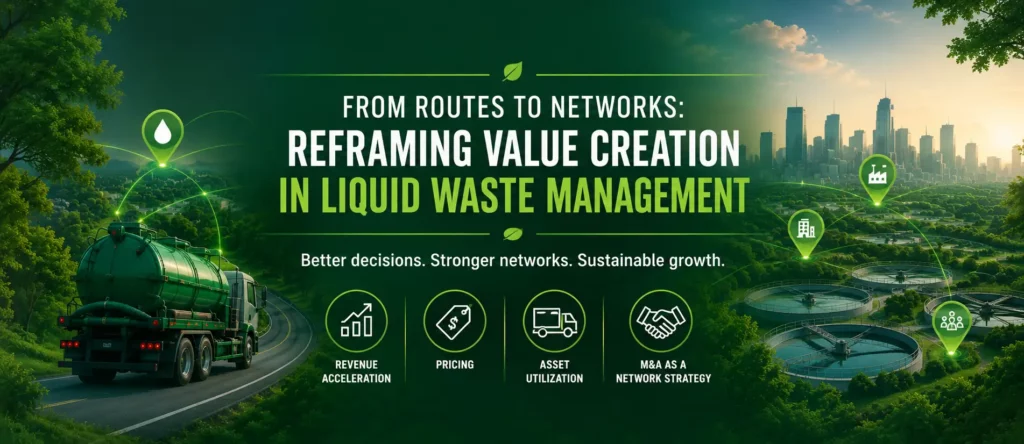
The next frontier in liquid waste is not operational, it is systemic The liquid waste management industry spans UCO, grease traps, grit traps, jetting, plumbing, oily water, and industrial wastewater. Historically, operators have managed it as a route-based services business. They optimized trucks, routes, depots, and customer contracts at the local level. That model is now reaching its limits. Across the US, the sector is undergoing a structural shift driven by three forces: The implication is clear: Value is no longer created at the route level—it is created at the network level. Yet most operators still manage the business through disconnected levers: sales, pricing, operations, and M&A. Without a unified decision system, growth becomes inefficient, margins leak, and capital is misallocated. The result: suboptimal growth, margin leakage and misallocated capital. The four strategic engines of value creation Leading operators are now reorganizing their businesses around four integrated value engines: Together, these engines shift the business from local route management to network-driven value creation. 1. Revenue Acceleration: From reactive service to demand capture Core issue: Growth is constrained not by market size but by visibility into demand and conversion ability. What differentiates leaders: Impact: 10–15% revenue uplift without adding assets—purely from better demand capture. 2. Pricing: From static rates to market-aligned yield optimization Core issue: Pricing remains blunt—often cost-plus or legacy-based—while the market is highly dynamic. What differentiates leaders: Impact: 5–10% pricing uplift with minimal churn, and improved margin consistency 3. Asset Utilization: From fleet efficiency to network efficiency Core issue: Operators optimize trucks—but not the system. What differentiates leaders: Impact: 20–30% improvement in route efficiency and asset productivity 4. M&A: From opportunistic deals to network design This is where the industry is most misunderstood—and where the largest value pools exist. Deep Dive: M&A as a Network Strategy, Not a Deal Strategy The problem with traditional M&A in liquid waste Most M&A strategies in the sector follow a familiar pattern: This approach consistently misses value because it ignores the core economic driver of the business: network effects. What the data actually shows From our analysis, for a major operator: This creates a structural opportunity: Selective acquisitions can disproportionately improve coverage, density, and pricing power. In fact, targeted M&A can increase coverage from 33% → 51% with a limited set of acquisitions Reframing M&A: From “Which company?” to “What network outcome?” The right starting point is not the target—it is the network gap. Step 1: Build full market visibility (Example: 370K+ generators mapped in Texas with volume and location granularity ) Step 2: Overlay supply and infrastructure This creates a unified view of demand × supply × infrastructure Step 3: Apply network filters (the real drivers of value) From the LES framework (page 13): ~90% of M&A value is driven by network economics Key drivers: This fundamentally changes how targets are evaluated. The three types of high-value acquisitions Every target should be classified based on its role in the network: 1. Density Plays (route economics) Outcome: Immediate cost and margin improvement 2. Outlet Plays (margin control) Outcome: Structural margin expansion 3. Capability Plays (service expansion) Outcome: Revenue growth + wallet share expansion From long list to actionable targets A systematic approach narrows the universe: Why this approach wins Traditional M&A answers: “Is this a good company?” Network-driven M&A answers: “Does this asset improve our system?” That distinction is decisive. Because in liquid waste: The integration advantage (where most value is lost) Even when deals are well-selected, value is often lost post-close. A network-driven approach solves this upfront: From episodic M&A to a continuous system The end-state is not a better pipeline—it is a different operating model. As outlined in the LES framework: This transforms M&A from a periodic activity into a core growth engine. What this means for operators and sponsors For operators For private equity For management teams What comes next This is the first in a series. If M&A is the structural lever, then: Each will be explored in depth in subsequent articles. Bottom line The liquid waste industry is not a services business—it is a network optimization problem. Those who continue to operate locally will remain subscale. Those who build decision systems across demand, pricing, assets, and M&A will define the next generation of leaders.
Hazardous Waste Is Moving Upstream — and Rewriting the Economics of the Industry

The market is not disappearing. But the part of the market that operators and investors have historically relied on is. For decades, hazardous waste has been understood as a downstream services industry, defined by collection, transportation, treatment, and disposal. Scale, asset ownership, and regulatory compliance were the primary drivers of advantage. That framing is now incomplete. What is emerging instead is a structurally different system—one where value is increasingly created upstream, complexity is shifting downstream, and control is migrating to those who can manage the network—not just operate within it. 1. A Structural Shift: From Externalization to Internalization At the core of this transition is a clear shift: Hazardous waste is increasingly being managed at the point of generation rather than through the external market. Across chemicals and petroleum, waste is being redesigned into production systems through: The implication is fundamental: The most predictable and economically valuable waste streams are no longer entering the external market. Understanding this shift requires more than operational visibility—it demands analytics that track how value is retained and how flows evolve. 2. A Market That Appears Stable — but Is Not At an aggregate level, hazardous waste volumes appear stable. But underneath: For operators, this distinction is critical. Only the third-party market is monetizable—and that market is structurally shrinking. 3. The Residual Market Is More Complex—and Less Forgiving Historically: Increasingly: This marks a structural shift: From scale-driven processing to capability-driven complexity management 4. Where Leading Players Are Moving Leading players are already repositioning—though not uniformly. Integrated Players: Moving Upstream Clean Harbors and Reworld are: Reworld’s expansion beyond waste-to-energy signals a clear shift: Own the waste stream earlier—not just process it later Clean Harbors continues to: Broker Models: Being Reshaped Players such as Clean Earth and Arcwood Environmental are navigating a different reality: In response, they are: 5. Geography Is Becoming Strategy Processing capacity is increasingly concentrated in: These regions benefit from: This creates: These are no longer just operational realities—they are strategic signals surfaced through Waste Industry Data Intelligence. 6. The 3rd Party Model Is Being Rewritten The combined effect of: Is producing a market that is: This is not cyclical. It is a structural reallocation of value across the system. Implications for Operators 1. Growth will not come from volume: Pricing, mix, and efficiency will drive outcomes 2. Disposal access becomes strategic: Control over capacity defines positioning 3. The network becomes the business: Operators are evolving into system orchestrators 4. Complexity becomes the margin driver: Handling difficult streams is the new advantage In this environment, operators are shifting toward data-driven models where AI-Powered Analytics for Waste Management supports pricing optimization, routing efficiency, and capacity utilization. 7. Implications for Financial Sponsors This shift challenges traditional investment models. 1. Volume-led growth is fragile Future growth is: 2. Asset ownership is necessary—but insufficient Winning requires: 3. Platform strategies must evolve From: To: 4. Value creation is moving upstream and system-wide Returns will increasingly come from: A Shift from Industry to System Hazardous waste is no longer a linear value chain. It is becoming a dynamic system of generators, facilities, routes, regulations, and pricing interactions. In such a system: Closing Perspective Most operators—and many investors—are still structured for a world where: That world is gone. The next phase of the industry will not be defined by who can process the most waste. It will be defined by: Who can understand—and optimize—the system behind the waste
The Next Decade of Waste Management: From Asset Operators to Decision Engines
Executive Summary The waste management industry is entering a structural transition. For decades, competitive advantage has been defined by: These fundamentals remain important. But they are no longer sufficient. A new layer of competition is emerging—one that sits above assets and operations: The ability to continuously make better decisions across the network, enabled by a Decision Intelligence Platform for Waste Management. This shift is being driven by: As a result, the industry is bifurcating into two distinct models: Over the next decade, it is the latter that will define industry leadership, powered by a Decision Intelligence Platform for Waste Management. 1. The traditional model is reaching its limits The waste management industry has historically scaled through a well-understood playbook: This model created significant value. However, structural constraints are now becoming visible, highlighting the need for a Decision Intelligence Platform for Waste Management. 1.1 Diminishing returns to scale In many markets, incremental gains from density and scale are harder to achieve. Marginal routes are less profitable, and expansion often introduces complexity—challenges better addressed through a Decision Intelligence Platform for Waste Management. 1.2 Pricing opacity Despite long-term contracts, pricing remains inconsistent across customers, geographies, and waste streams—limiting margin realization without a Decision Intelligence Platform for Waste Management. 1.3 Increasing operational complexity Operators are now managing: These inefficiencies are often missed without a Waste Management Analytics Platform. 1.4 M&A fatigue While consolidation continues, many deals fail to fully realize synergies due to limited integration at the network level. The result is a plateauing of traditional levers: Scale alone is no longer a sufficient driver of outperformance. 2. A new layer of competition is emerging As traditional advantages plateau, a new differentiator is taking shape: Decision quality at scale. Operators are increasingly required to make decisions that are: Examples include: Individually, these decisions are manageable. Collectively, they define performance within a Decision Intelligence Platform for Waste Management. Yet most organizations still manage them independently without a Decision Intelligence Platform for Waste Management, a gap increasingly addressed by AI-Powered Analytics for Waste Management. 3. The rise of the Decision-Driven Operator Leading companies are beginning to evolve beyond traditional operating models. They are building capabilities to: This creates a new type of organization powered by a Decision Intelligence Platform for Waste Management: The Decision-Driven Operator This model does not replace assets—it enhances their value through a Decision Intelligence Platform for Waste Management, while also enabling AI-Driven M&A in Environmental Services. 4. Five shifts that will define the next decade The transition to decision-driven operations will manifest across five structural shifts: 4.1 From volume growth to yield optimization Growth will increasingly come from: Rather than pure volume expansion. 4.2 From route efficiency to route economics Operators will move beyond: To: Incorporating: 4.3 From static pricing to dynamic pricing systems Pricing will evolve from: To: Based on: 4.4 From episodic M&A to continuous network design M&A will shift from: To: Where each deal is evaluated based on: 4.5 From internal data to integrated intelligence Operators will expand beyond: To: Creating a more complete view of the ecosystem. 5. Technology as an enabler—not the answer AI and data platforms are often positioned as the solution. In reality, they are enablers of a broader shift. The critical change is not: It is: The ability to embed intelligence into everyday decisions without this, technology investments remain underutilized. 6. Implications for leadership teams This shift has direct implications for CEOs, CFOs, and operating leaders: CEOs: Must redefine competitive advantage beyond assets CFOs: Gain new levers for EBITDA expansion through pricing, yield, and capital efficiency COOs: Move from execution optimization to decision optimization Strategy / M&A leaders Transition to continuous network design 7. The winners of the next decade The defining characteristic of leading operators will not be: It will be: Who consistently makes the best decisions across the system? These organizations will: 8. Conclusion Waste management is transitioning from an asset-driven industry to a decision-driven one. Assets will remain necessary but they will no longer be sufficient. The next phase of value creation will be defined by: The organizations that recognize and act on this shift early will define the next generation of industry leaders. The future of waste management will not be determined by who owns the network.It will be determined by who understands—and optimizes—it best.