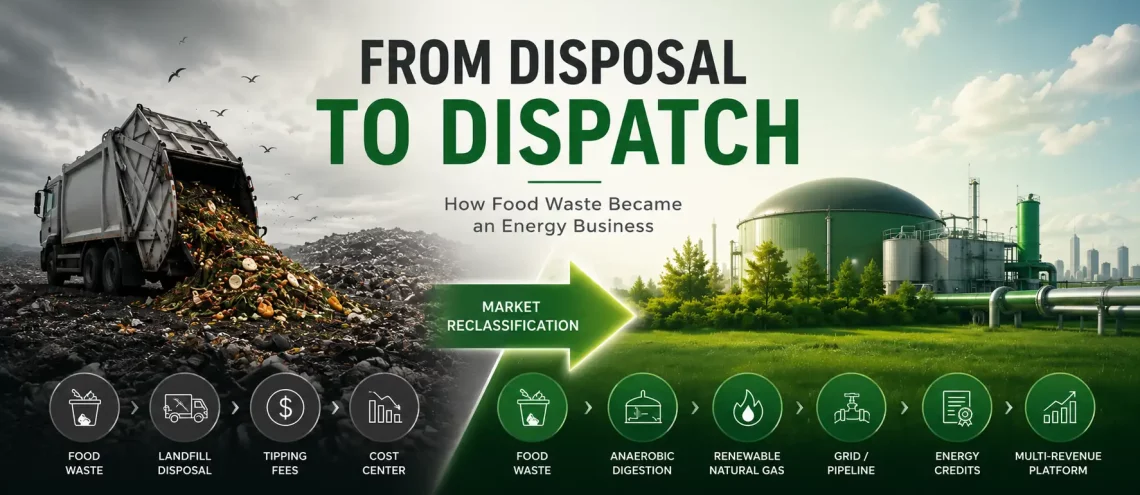
How Food Waste Became an Energy Business
The shift from landfill default to energy feedstock is not a sustainability trend. It is a structural market transition — and the operators positioned ahead of it are rewriting the economics of organics processing in the United States.
For most of its commercial history, food waste had one destination: the landfill. The economics were simple. Disposal was cheap, tipping fees were predictable, and the operational model required nothing more sophisticated than a truck, a route, and a licensed site. Organic material was a liability to be removed, not a resource to be managed.
That model is breaking down across the United States — and not gradually. It is breaking down under simultaneous pressure from regulation, landfill economics, energy markets, and the changing composition of the commercial food sector itself.
Twelve states have now enacted food waste disposal bans or organics diversion mandates — up from two a decade ago. California’s SB 1383, the most consequential state-level organics mandate in the country, has created compliance obligations for commercial food generators at a scale that existing landfill-based disposal chains cannot satisfy. Massachusetts, New York, New Jersey, and Washington are enforcing equivalent frameworks, and the generator thresholds within existing laws are ratcheting down on fixed statutory dates. The regulatory tide is directional, and it is accelerating.
At the same time, landfill economics have shifted. Tipping fees at municipal solid waste landfills have risen sharply across high-density markets. Organics, once accepted at standard MSW rates, are increasingly subject to surcharges or outright rejection as landfill operators respond to methane obligations under Clean Air Act landfill gas rules and state greenhouse gas programs. The path of least resistance — putting food waste in the same truck as everything else — is narrowing.
Meanwhile, the energy value embedded in organic material has become visible to a new class of infrastructure investor. Anaerobic digestion, long commercially mature in Europe, has reached economic viability at meaningful scale in the United States. The combination of renewable natural gas offtake agreements, Renewable Identification Number credits, Low Carbon Fuel Standard premiums, and IRA-era clean energy incentives has created an entirely different return profile for food waste processing than existed five years ago.
The result is a market in transition. Food waste processors — composters, digesters, rendering facilities, and the haulers who feed them — are operating inside a structural shift that is changing who the buyers are, what the product is, and where the value lives. The operators who understand that transition are building durable competitive positions. The operators still running the old model are experiencing margin compression they cannot explain through the lens of their historical cost structures.
The industry is not becoming more sustainable. It is becoming a different business — one where organic material is an energy input, not a waste output.
The single most important shift in food waste is this: the market has moved from a disposal orientation to an energy orientation. That transition is not complete, and it is not evenly distributed across the country. But its direction is clear and its momentum is structural, not cyclical.
Disposal businesses optimize for throughput and tipping fee capture. Energy businesses optimize for feedstock quality, gate pricing, and offtake economics. Those are different businesses — different commercial models, different capital structures, different relationships with counterparties, and different definitions of what a competitive advantage looks like.
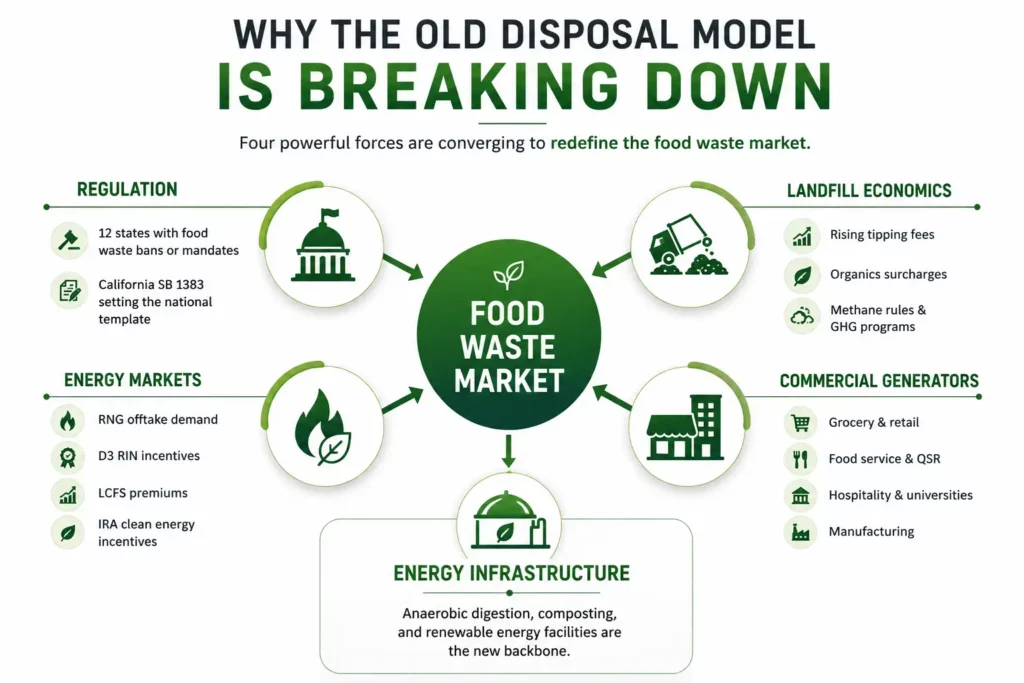
Food waste is no longer measured by the ton at the gate. It is increasingly measured by its BTU content, its methane yield, its RIN value, and its LCFS contribution. Operators who have not made this translation are pricing their product in the wrong currency.
The implication for processors, haulers, and investors is direct. The competitive dynamics of this market are not being reshaped by new entrants competing on tipping fee. They are being reshaped by a fundamental reclassification of what the product is. Understanding where that reclassification is most advanced — and where it is still arriving — is the basis of commercial strategy in organics today.
1. Regulation is forcing the transition, not enabling it
California’s SB 1383 is the template. Signed into law in 2016 and fully in effect since 2022, it requires jurisdictions to achieve a 75 percent reduction in organic waste disposal by 2025, relative to 2014 levels. Commercial food generators above defined thresholds — grocery stores, food service operators, food manufacturers, hospitality groups — are required to arrange for organic waste collection. Jurisdictions that fail to provide compliant infrastructure are subject to enforcement.
The immediate commercial effect has been substantial. Demand for organics processing capacity in California has outpaced permitted infrastructure in several regions. Tipping fees at anaerobic digesters and composting facilities in high-compliance markets have risen sharply — not because of energy economics, but because of simple supply-demand imbalance. Compliance is not optional, and the alternative — landfill disposal — carries regulatory exposure that commercial food generators cannot absorb.
Massachusetts’ commercial food material disposal ban, tightened progressively since 2014 and now covering any entity generating more than half a ton of food waste per week, has produced equivalent dynamics in the Northeast. New York’s statewide food donation and food scraps recycling law expanded on January 1, 2026 to cover generators of one ton per week — supermarkets, restaurants, hotels, universities, stadiums — and ratchets down to half a ton per week in 2028. These are not pilot programs. They are enforceable mandates with material noncompliance risk.
12 US states with enacted food waste disposal bans or diversion mandates — up from two a decade ago: The build-out is directional, not reversible — and it compounds from within. Washington’s threshold drops to a quarter cubic yard per week in 2027; Illinois extends to generators of 96 gallons per week in 2026; New York reaches half-ton generators in 2028. Each ratchet creates immediate incremental demand for permitted processing capacity that the existing infrastructure base cannot satisfy without new investment or network reconfiguration.
2. The energy transition changed the investment case
Anaerobic digestion — the biological breakdown of organic material in an oxygen-free environment — has been commercially deployed in European food and agricultural waste markets for three decades. In the United States, the technology existed but the investment case was marginal. Gate fee income covered operating costs. The energy output — primarily biogas — was often flared or used for on-site heat, with limited commercial value.
Three regulatory and market developments transformed that calculus.
First, the Renewable Fuel Standard’s D3 category — cellulosic biofuel — covers RNG derived from food waste and other organic feedstocks processed through anaerobic digestion. Because cellulosic production continues to lag statutory volumes, D3 RINs trade at a structural premium to every other RIN category. For a processor with a well-contracted RIN monetization pathway, the energy output of an anaerobic digester is no longer a byproduct — it is a primary revenue stream.
Second, the California Low Carbon Fuel Standard has created an additional premium pathway for food waste-derived RNG injected into the natural gas grid. LCFS credits, priced per metric ton of CO2-equivalent reduction, layer on top of RIN income. A processor with California LCFS access and a clean feedstock supply chain operates at a materially different margin profile than one selling biomethane at spot gas prices.
Third, the Inflation Reduction Act’s clean energy provisions — the Section 45Z clean fuel production credit and the investment tax credit frameworks applicable to biogas upgrading infrastructure — have compressed the capital payback timeline for new AD projects. PE-backed platforms are moving quickly, and significant new facilities have broken ground in the past two years targeting precisely the compliance-driven feedstock volumes that SB 1383 and equivalent state programs are generating.
The IRA did not create the food waste energy market. It made it investable at institutional scale. That is a different — and more durable — inflection.
$2.00–$3.40 per D3 RIN, approximate trading range, 2023–2025: One D3 RIN corresponds to one ethanol-equivalent gallon — roughly 77,000 BTU. At these prices, the RIN value of a unit of RNG has run at a multiple of the commodity price of the gas itself. This inverts the traditional economics of food waste processing: the energy output is worth more than the gate fee.
3. The commercial food sector is generating at scale
The feedstock pipeline for a viable food waste energy market requires consistent, high-volume supply of organic material with predictable composition. That supply exists. It is concentrated in a relatively small number of generator categories, and it is growing.
Grocery retail, food service distribution, institutional food service — hospitals, universities, sports venues, airport concessions — and quick-service restaurant chains collectively generate organic waste volumes sufficient to sustain industrial-scale anaerobic digestion at regional density. The largest generators are already subject to diversion mandates in compliance states. In non-mandate states, ESG reporting obligations and internal sustainability commitments are driving voluntary diversion programs.
The commercial structure of this generator base matters. Grocery chains and QSR operators have national procurement functions that can contract for organics diversion at portfolio scale. A processor that can demonstrate compliant, data-verified diversion across a multi-state footprint has a competitive advantage that a locally oriented composter cannot replicate. The ability to issue diversion reports, track tonnage by site, and provide audit-ready documentation for ESG and regulatory purposes is becoming a qualification criterion for access to the largest generator accounts.
~1% of the 66 million tons of food waste generated annually by US food retail, food service, and residential sectors reaches anaerobic digestion (EPA): Roughly three-quarters of this material is still landfilled or incinerated. The contrast with food manufacturing is instructive: of the 40 million tons that sector generates, 43 percent already goes to AD — because homogeneous, contracted feedstock made the model work. The retail and food service opportunity is not hypothetical. It is the same model, waiting on aggregation infrastructure and generator-level intelligence.
The new operating model
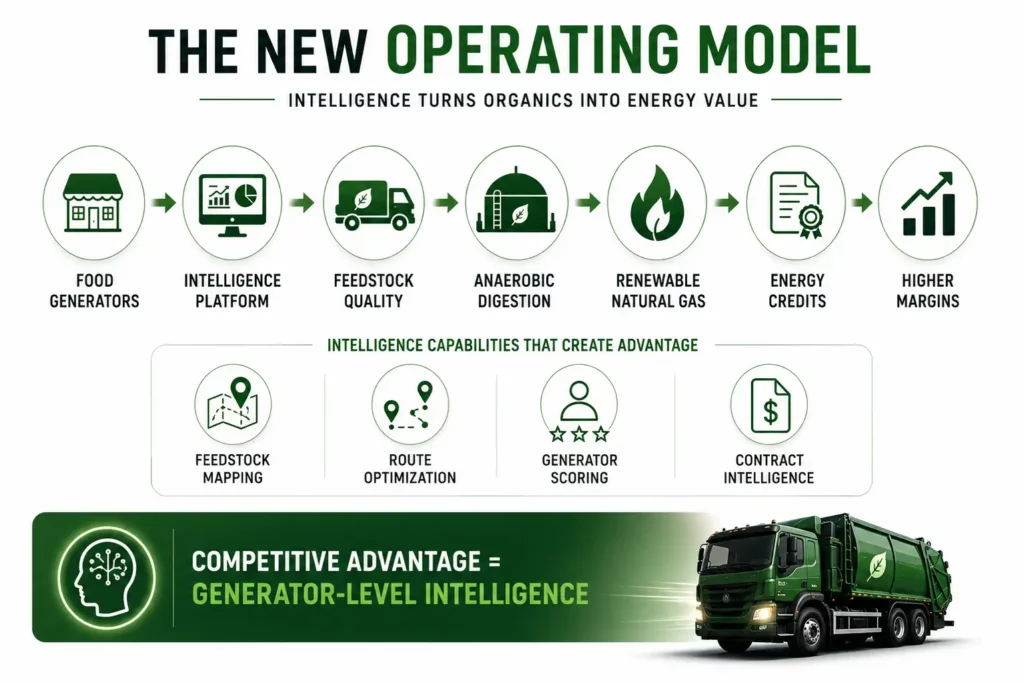
The operators and investors building durable positions in the food waste energy market are not competing on tipping fees. They are constructing infrastructure-and-intelligence systems that integrate feedstock sourcing, processing economics, energy monetization, and regulatory compliance into a single commercial architecture.
Three transitions define the new model.
From disposal logistics to energy feedstock management
The traditional food waste hauler optimizes route density and minimizes collection cost per ton. The new model optimizes feedstock quality, predictability, and alignment with processing facility specifications. An anaerobic digester processing commercial food waste has a throughput economics model that depends on the BTU content, moisture level, and contamination rate of incoming material. Haulers and processors who understand their generator base at this level of resolution — who know which accounts generate high-methane-yield organics versus contaminated mixed waste — are operating a materially different and more valuable business than those treating all organic volume as equivalent.
From local networks to regional infrastructure platforms
The economics of anaerobic digestion and advanced composting require scale. A facility sized to process 50,000 tons per year cannot be economically fed by a single municipality or a handful of local accounts. The commercial model requires a regional feedstock aggregation network — a set of contracted generators, hauler relationships, and logistics arrangements that can deliver consistent volume to the processing facility across seasonal and economic cycles.
Building that network requires market intelligence: which generators exist in the service area, what volumes they produce, whether they are currently contracted or accessible, and how their feedstock quality aligns with the facility’s processing specifications. Operators who have mapped this at generator-level granularity — not aggregate EPA estimates, but account-by-account sourcing visibility — can build feedstock contracts and logistics networks with a precision others cannot match.
From tipping fee dependence to multi-revenue-stream architecture
The fully developed food waste energy model generates revenue across three categories: gate fees charged to generators for compliant diversion; energy revenue from RNG sales with RIN and LCFS value layered on top; and, in some configurations, revenue from digestate — the nutrient-rich byproduct of digestion — sold as soil amendment or fertilizer replacement. Each revenue layer has different counterparties, different contract structures, and different exposure to market and regulatory risk.
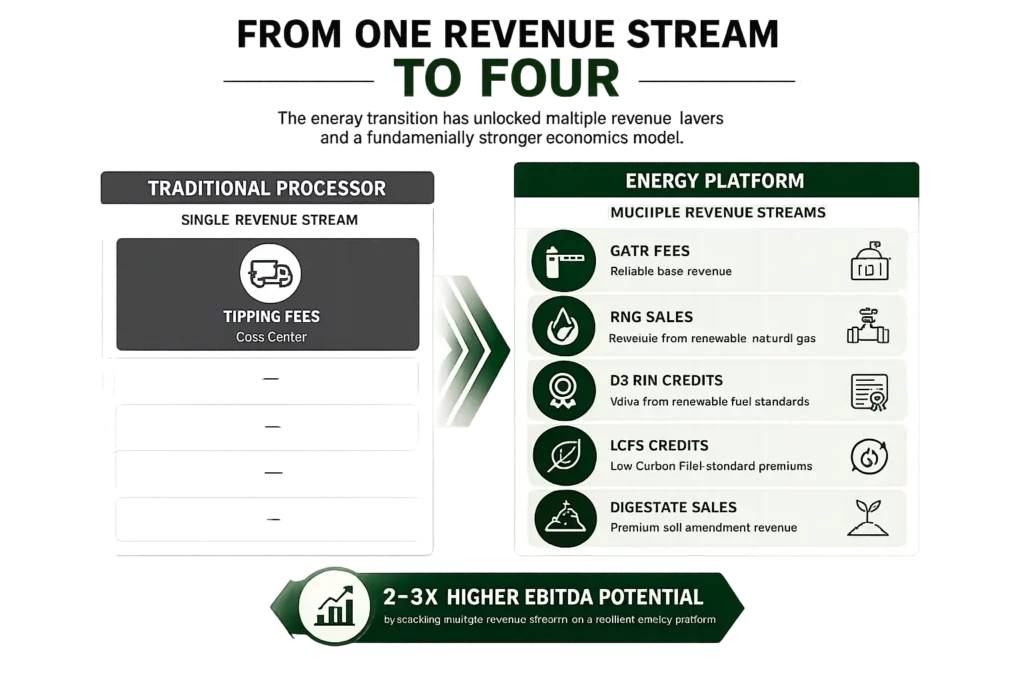
Operators who have optimized this revenue stack — securing long-duration RIN monetization agreements, establishing LCFS pathways for California-eligible volumes, and developing digestate offtake channels — carry a structurally different margin profile than facilities still dependent on tipping fee as their primary revenue source. In our analysis, the difference is not incremental: a fully optimized stack can represent a two-to-three-times improvement in EBITDA per ton of material processed.
The gap between tipping-fee-dependent operators and fully optimized energy platforms is widening. It will not close through operational improvement alone. It requires a different commercial architecture.
What could slow the transition — and what it rewards
A credible investment thesis names its risks. Three are worth taking seriously.
Credit markets are volatile and policy-exposed. When the EPA proposed a partial waiver of the 2024 cellulosic volume requirement in December 2024, D3 RIN prices fell from roughly $3.40 to $2.08 in short order. Guidance on the Section 45Z credit has developed unevenly, and annual RVO rulemaking will keep injecting headline risk into RNG project economics. Platforms whose returns depend on peak credit pricing are carrying more regulatory exposure than their models acknowledge.
Feedstock contamination is an operating cost, not a footnote. Commercial food waste arrives packaged, mixed, and inconsistent. Depackaging and preprocessing economics can erode the margin advantage of high-value feedstock if the generator base is not selected and managed for quality.
Infrastructure moves slower than mandates. Permitting, interconnection, and construction timelines for AD facilities run years, while compliance obligations take effect on fixed statutory dates. The mismatch is the source of today’s pricing power — and of tomorrow’s execution risk for platforms that commit capital ahead of secured feedstock.
What is notable is that each of these risks rewards the same capability. Diversified, quality-screened, contractually secured feedstock is the hedge against credit volatility, the control on contamination cost, and the de-risking mechanism for new capacity. In every scenario, generator-level feedstock intelligence is the asset that holds its value.
Intelligence in practice
Two recent engagements illustrate how infrastructure intelligence is creating commercial advantages that feedstock volume alone cannot replicate.
For a PE-backed organics processing platform pursuing regional expansion in the Southeast, a structured generator mapping exercise identified over 340 commercial food waste generators within optimal logistics distance of a planned facility site — grocery distribution centers, QSR chain commissaries, institutional food service operators, and food manufacturing facilities — none of which were contracted to any compliant diversion program. The analysis quantified available feedstock tonnage by generator tier, estimated composition by waste type, and mapped the competitive landscape for hauling services in the corridor. The deliverable was not a market overview. It was a feedstock contract pipeline, sequenced by volume priority and logistics feasibility, that the commercial team could execute against immediately.
In a second engagement, a national food waste hauler seeking to optimize its routing economics across a multi-state operation used generator-level manifest analysis to identify accounts where collection frequency was misaligned with actual generation rates — routes running underloaded or overloaded relative to contracted service levels. Rebalancing those routes with data-driven scheduling reduced per-ton collection cost while improving service reliability for the largest commercial accounts. The improvement in unit economics created capacity to compete for new generator contracts at pricing the legacy route structure could not have supported.
The most significant opportunities in food waste are not in finding new markets. They are in seeing the existing market more clearly than competitors.
The next five years
The food waste energy market is early. The infrastructure is insufficient relative to the regulatory and commercial demand building above it. The investment is accelerating but has not caught up. That gap — between what the mandates require, what the energy economics support, and what the existing processing network can deliver — is the defining commercial condition of the next five to ten years in organics.
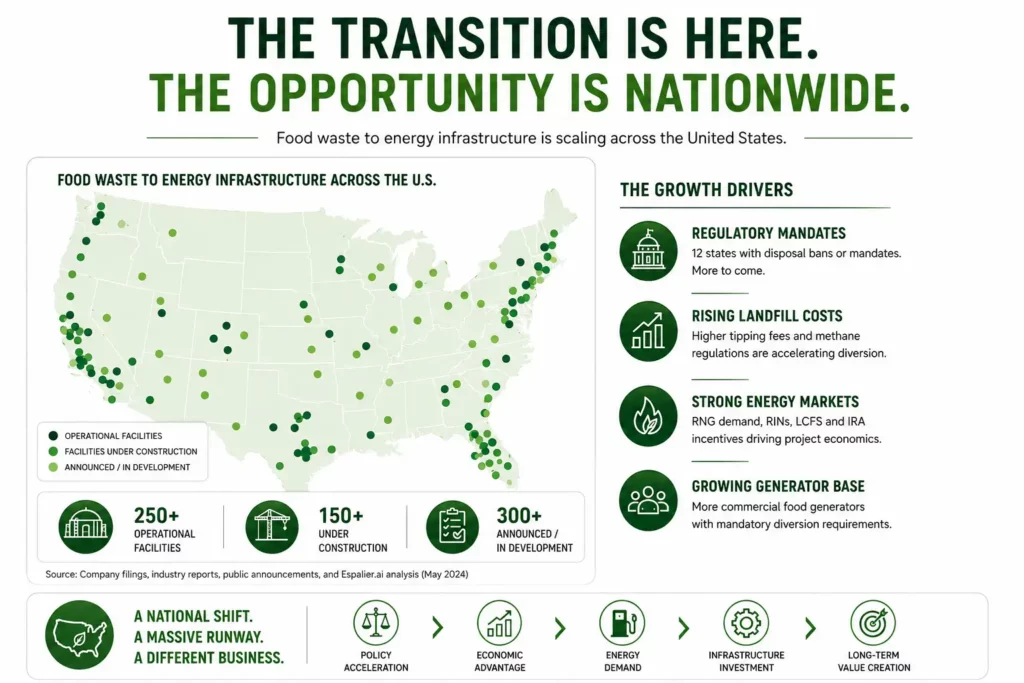
The processors and haulers that capture this transition will be defined less by how many trucks they operate than by the intelligence systems behind those trucks: who their generators are, what those generators produce, how that material is best processed, and how the output is most efficiently monetized. Route density still matters. But in a market where feedstock composition determines energy yield, energy yield determines credit value, and credit value determines margin, knowing your feedstock at generator-level resolution is the most durable competitive advantage available.
State mandates will continue to expand, and the thresholds within existing mandates will continue to ratchet down. Clean Air Act landfill methane rules and the Renewable Fuel Standard will continue to favor compliant diversion over landfill disposal. The energy markets for biogas and RNG will remain volatile — but they are not going backward. The structural forces driving this transition are legislative, technological, and demographic. They are going to compound.
For operators considering capital deployment, for haulers evaluating whether to build or partner their way into processing, and for investors assessing platform potential, the question is not whether this market is changing. The question is how quickly your commercial infrastructure can be repositioned to capture what is already in motion.
The future leaders in food waste will be defined not by the volume of material they move, but by the intelligence systems they deploy to know what that material is worth, where it comes from, and who needs it next.