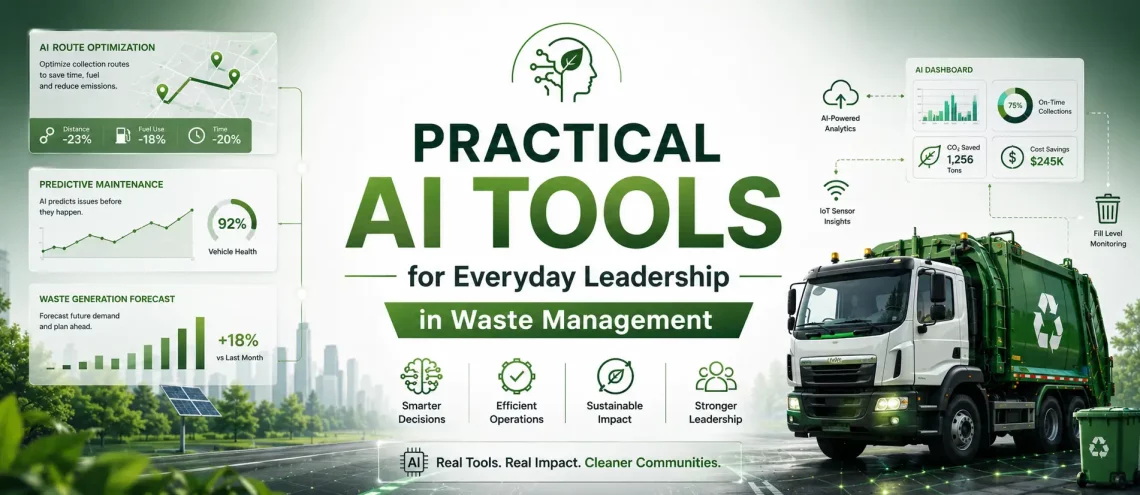
Most waste management leaders do not need to be convinced that AI is important.
They need to know what to do with it.
The conversation in most boardrooms and leadership meetings has already moved past “Should we pay attention to AI?” The question now is more specific — and more urgent: Which tools are worth deploying? Where do they fit in the operation? And what does good look like?
This article is an attempt to answer those questions practically. It is written for operators, regional managers, PE-backed platform leaders, and executives running waste management businesses across collection, liquid waste, hazardous, and environmental services. Not for technology teams. Not for academics. For the people who must make decisions about running and growing these businesses every day.
The goal is not to describe AI in the abstract. It is to describe what AI can do specifically inside a waste management business — and where the leverage is highest.
The Starting Point: Why Waste Management Is Ready for This
Waste management is a data-rich industry that has historically been information-poor.
Every route generates data. Every service call generates data. Every regulatory submission, every customer contract, every equipment maintenance cycle, every acquisition — all of it generates data. Most of it disappears into spreadsheets, siloed software systems, email threads, and the institutional memory of individual managers.
The problem is not that waste operators lack information.
The problem is that the information is fragmented, disconnected, and reviewed too infrequently to drive decisions in real time.
AI changes that — not by replacing operational expertise, but by compressing the time between data and decision. The leaders who will move fastest are not those who understand AI the most deeply. They are the ones who identify the highest-leverage operational problems and deploy the right tools against them.
Five problem areas stand out as the most important for waste management leaders right now.
1. Regulatory and Compliance Intelligence
The problem
Waste management operators — particularly those with multi-state footprints — face a regulatory environment that is tightening on multiple fronts simultaneously. PFAS standards are evolving differently in every state. Land application restrictions are tightening in some jurisdictions and stable in others. Permitting requirements vary by county. Greenhouse gas reporting obligations are expanding.
A regional operator in five states is effectively tracking fifty separate regulatory environments simultaneously. Most compliance teams are doing this manually — reading bulletins, subscribing to regulatory updates, attending industry association briefings, and relying on legal counsel to flag material changes.
What AI can do
AI-powered regulatory monitoring tools can continuously track regulatory developments across every jurisdiction relevant to an operator’s footprint — federal EPA updates, state environmental agency rulings, proposed rule changes, enforcement actions, and permit modifications — and surface them in structured, actionable formats.
The leverage is not just speed. It is completeness. A compliance team that previously reviewed what they had time to review can now operate against a complete picture of the regulatory landscape.
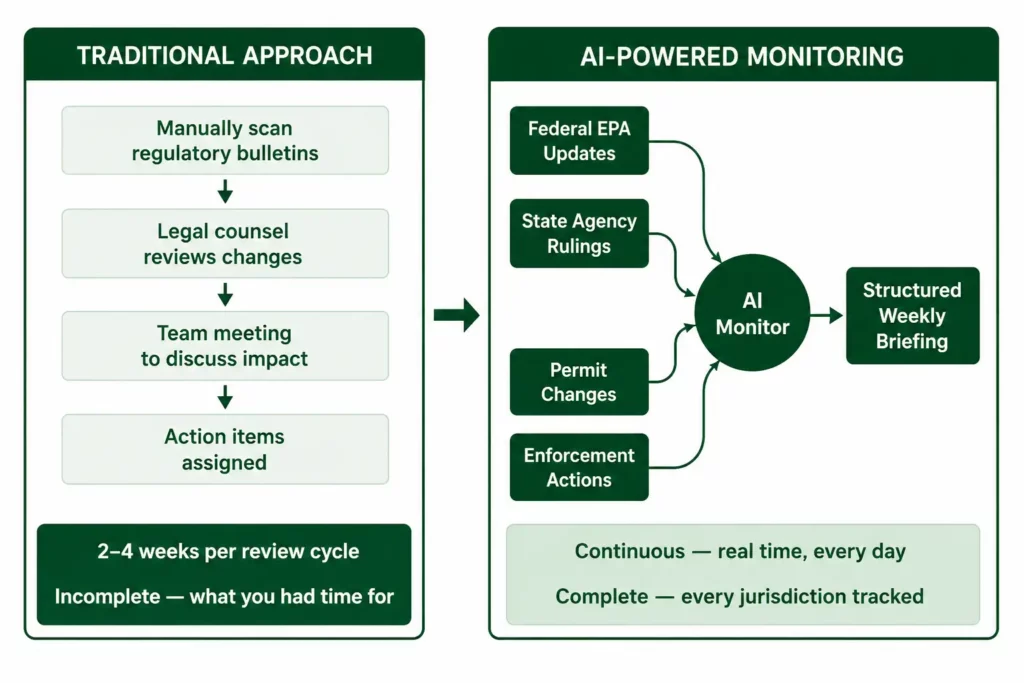
What to look for in a regulatory intelligence tool:
The most important capability is waste-sector specificity — a tool that filters for environmental and waste-relevant rule changes rather than broad regulatory feeds requiring manual curation. The best solutions combine automated monitoring across federal and state sources with the ability to map regulatory changes to your specific operational footprint: which facilities are affected, which permits are implicated, and what action is required.
Regulatory complexity is not going away. The operators who systematize their intelligence will absorb compliance costs more efficiently than those who manage it reactively.
2. Route Optimization and Operational Efficiency
The problem
Routing is one of the highest-leverage operational variables in a collection business. A five percent improvement in route efficiency across a fleet of 100 trucks is not a marginal gain — it is a material improvement in labor costs, fuel costs, vehicle wear, and customer service quality.
Most collection operations still rely on routes that were designed years ago and are updated infrequently. Drivers know the territory. Dispatchers know the patterns. But that knowledge lives in people’s heads, not in systems that can continuously adapt to changes in volume, customer mix, traffic, and equipment availability.
What AI can do
AI-driven routing platforms optimize collection schedules dynamically — adjusting for service frequency, container fill levels (where smart sensors exist), vehicle capacity, driver schedules, and traffic patterns. Some platforms can predict missed pickups before they happen and reroute proactively. Others model the impact of adding new customers or service lines to existing routes before changes are implemented.
Large-scale logistics operations have documented savings of over 100 million miles per year through AI-driven routing at fleet scale. The underlying principle applies equally to residential and commercial waste collection
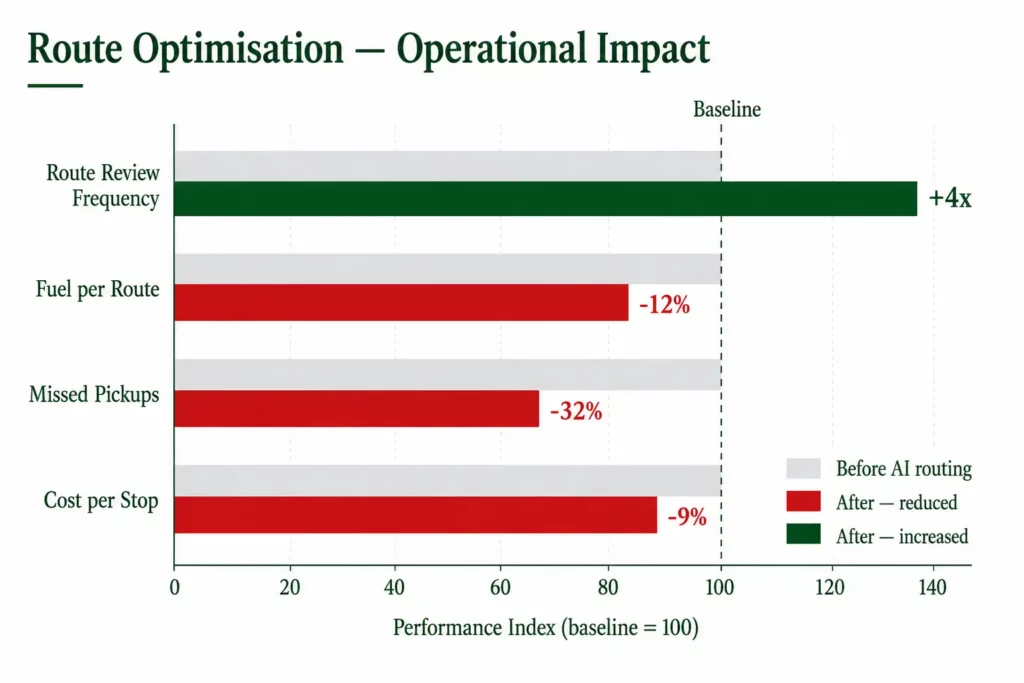
What to look for in a routing and optimization tool:
Waste-native routing platforms are meaningfully different from general logistics software — built around the specific constraints of collection operations: split loads, route sequencing for different container types, regulatory drive-time limits, and integration with customer service and billing workflows. When evaluating, look for demonstrated deployment at similar operational scale, integration with your existing dispatch and billing systems, and the ability to model what-if scenarios before committing to route changes.
The highest-performing waste operators are running route efficiency as a continuous improvement program, not a one-time exercise.
3. Predictive Maintenance and Fleet Intelligence
The problem
Equipment downtime is expensive in ways that go beyond the repair cost. A compactor failure at a transfer station delays processing across multiple routes. A truck breakdown mid-shift creates service failures, overtime costs, and customer complaints. In liquid waste and hazardous services, equipment failures carry regulatory and liability dimensions as well.
Most maintenance programs in waste are either reactive (fix it when it breaks) or calendar-based (service every X miles or X weeks regardless of actual condition). Both approaches miss the window between “working fine” and “about to fail” — which is precisely where AI-powered predictive maintenance operates.
What AI can do
Predictive maintenance systems analyze data from vehicle telematics, engine diagnostics, equipment sensors, and maintenance history to identify failure patterns before they occur. The system flags specific vehicles, components, or equipment for inspection before failure — shifting maintenance from reactive to predictive.
Research from leading management consultancies has documented reductions in machine downtime of 30–50% in industrial environments through predictive maintenance deployment. In waste operations, that translates directly to improved route completion rates, reduced emergency repair costs, and longer asset life.
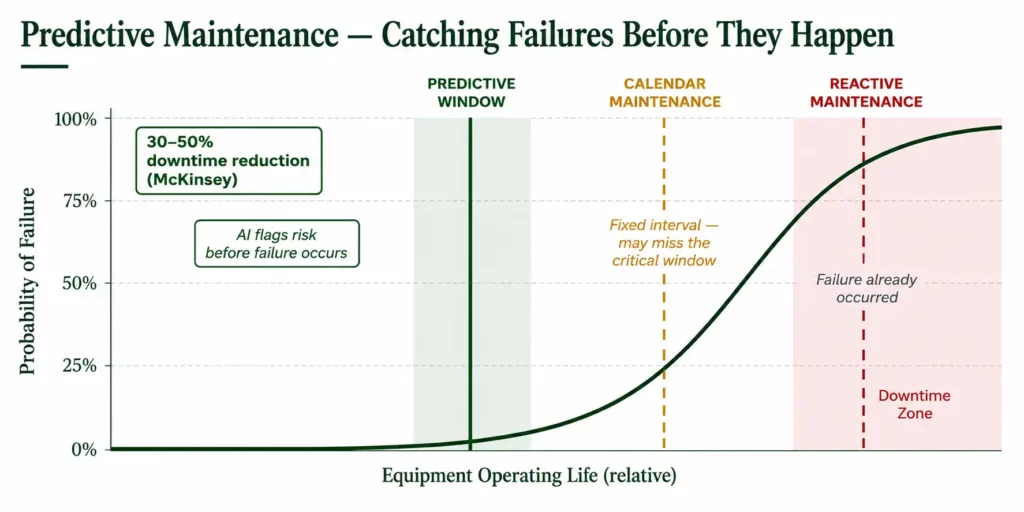
What to look for in a fleet intelligence tool:
The foundation is telematics — every vehicle transmitting real-time data on location, engine performance, and fault codes. The most valuable predictive maintenance capabilities analyze fault code patterns historically to identify which signals predict failures before they are severe, and surface prioritized maintenance recommendations rather than raw data feeds. Evaluate whether a third-party analytics layer adds enough incremental value over your vehicle manufacturers’ native diagnostic platforms.
The transition from reactive to predictive maintenance is one of the highest-ROI technology investments available to a waste operator today.
4. M&A Intelligence and Deal Sourcing
The problem
The waste management industry is in the middle of a consolidation decade. Between 2020 and Q1 2026, more than 2,500 transactions were completed across the U.S. waste sector. The most active acquirers are not succeeding because they have better instincts. They are succeeding because they have better systems.
Deal sourcing in waste has traditionally been reactive, and relationship-driven. Operators hear about acquisitions through brokers, industry contacts, and word of mouth. By the time a target is formally marketed, competition is intense and pricing reflects it. The operators and PE firms building the most dominant positions are finding targets before they are marketed — through systematic intelligence.
What AI can do
AI-powered M&A intelligence platforms continuously monitor signals across the target universe — company registrations, ownership changes, regulatory filings, permit activity, workforce trends, and market signals — to identify operators most likely to be approaching a transaction. This compresses the time between signal and outreach, allowing deal teams to engage with targets before a formal process begins.
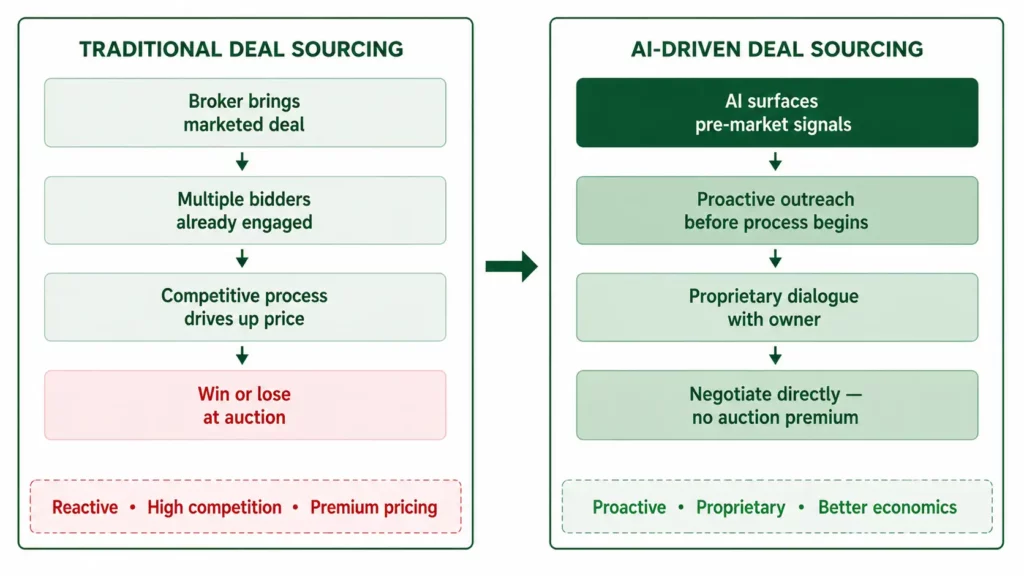
What to look for in an M&A intelligence tool:
General-purpose deal databases provide broad coverage but are largely reactive — they record transactions that have already occurred rather than surface signals of upcoming ones. The most differentiated capability is proprietary signal detection: systems that synthesize unstructured data alongside structured sources to identify pre-market indicators. For waste specifically, look for platforms with deep coverage of the environmental services ecosystem — not just top-line deal tracking, but target company profiles, geographic market mapping, and the ability to filter by sub-sector, geography, and operator characteristics relevant to your acquisition thesis.
The operators winning the consolidation race are not running harder. They are running with better intelligence.
5. Customer and Contract Intelligence
The problem
Customer retention is one of the most under-managed performance levers in collection and liquid waste businesses. Retaining an existing customer is far cheaper than replacing one. But most waste operators have limited systematic visibility into which customers are at risk, which contracts are approaching renewal, and which service issues are creating churn signals before a customer leaves.
The same gap exists on the growth side. Identifying which new customers to pursue, in which geographies, and with which service offerings is typically done through sales team intuition and periodic market review — not through continuous intelligence.
What AI can do
AI-powered customer intelligence tools can analyze service history, payment patterns, complaint frequency, contract tenure, and engagement signals to identify customers most likely to be approaching a churn decision — and flag them for proactive account management intervention before the customer calls to cancel.
On the growth side, AI tools can analyze geographic market data, business density, competitor footprints, and service gap analysis to identify the highest-probability new customer targets in any given area — effectively prioritizing the sales pipeline with data rather than gut feel.
Post-acquisition, customer intelligence becomes even more important. Understanding the acquired book of business — which accounts are at risk during the transition, which are over-serviced, which are underpriced — is one of the fastest ways to protect and improve acquisition economics.
What to look for in a customer intelligence tool:
The baseline is a clean, integrated customer record — contract terms, service history, billing, and communication in a single system. On top of that foundation, the most valuable AI capabilities are churn prediction and new-customer targeting. Waste-native customer management platforms offer operational workflows that general CRM systems do not, but general CRM platforms with AI scoring capabilities can serve operators whose primary need is commercial account management.
Customer intelligence is the difference between managing a book of business and actively growing it.
What Separates Leaders from Laggards
The waste management operators building durable competitive positions are not necessarily the ones with the largest technology budgets or the most sophisticated IT organizations.
They are the ones who have done three things:
- First, they have identified the highest-leverage problems — the operational areas where better intelligence directly translates to better financial outcomes. Regulatory compliance, route efficiency, equipment uptime, deal sourcing, and customer retention are those areas.
- Second, they have chosen tools that fit the operational context — purpose-built for waste where possible, general-purpose where appropriate. They are not implementing enterprise software for its own sake. They are solving specific problems.
- Third, they have built systems, not one-off projects — recurring processes that keep intelligence flowing continuously rather than periodic analytical exercises that are forgotten between cycles.
The gap between operators who are doing this and operators who are not is widening. The tools exist. The data exists. The question is whether the leadership team is building the systems to use them.
A Note on AI Readiness
Not every waste management business is in the same position to deploy these tools. A 20-truck regional collection operator is in a different place than a PE-backed platform running 400 trucks across eight states. The right tools, the right sequence, and the right investment level differ significantly.
But there is a baseline that every operator above a certain scale should be working toward:
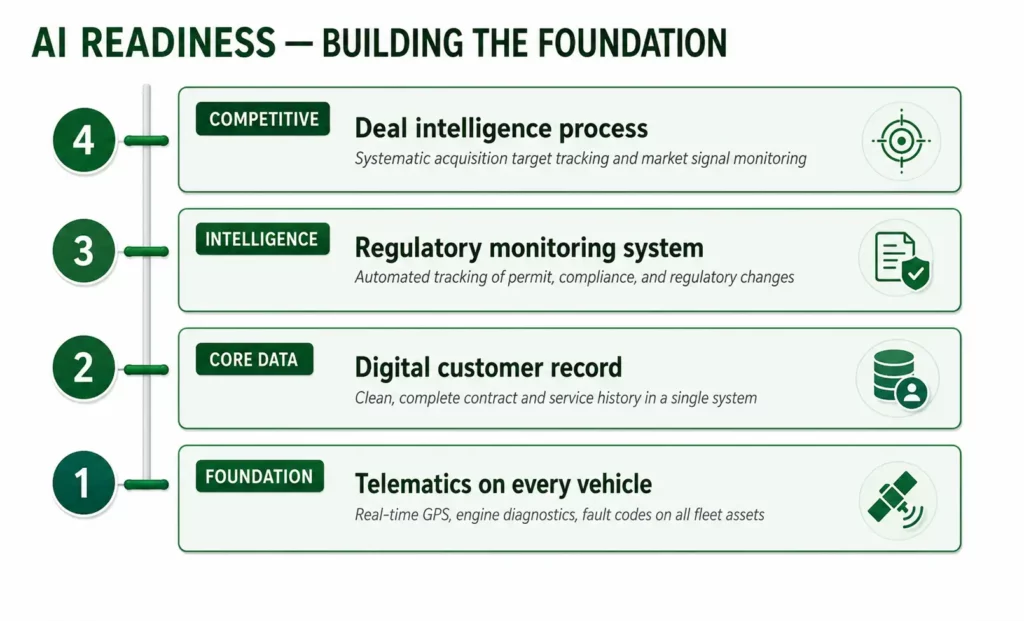
- Telematics on every vehicle — the foundation for both route optimization and predictive maintenance
- A digital customer record — clean, complete contract and service history for every account
- A regulatory monitoring system — even a structured process using general-purpose AI tools is better than no system at all
- A deal intelligence process — for operators with acquisition ambitions, systematic target tracking is a competitive necessity, not a luxury
Start with the foundation. Build the systems. The operators who build this infrastructure now will have a compounding advantage over those who build it later — because the intelligence gets better the longer it runs.
Closing Perspective
The waste management industry does not need AI evangelism.
It needs practical guidance.
The tools are real. The use cases are proven. The ROI is measurable.
Regulatory intelligence saves compliance teams weeks of manual work. Route optimization delivers margin improvement on every route, every day. Predictive maintenance keeps fleets running and assets lasting longer. M&A intelligence finds targets before they are marketed. Customer intelligence protects revenue and focuses growth.
None of this requires a technology transformation program or a chief AI officer. It requires identifying the right problems, deploying the right tools, and building the habit of running the business on intelligence rather than intuition.
The operators who are doing that today are not just more efficient. They are more defensible — and harder to compete against.