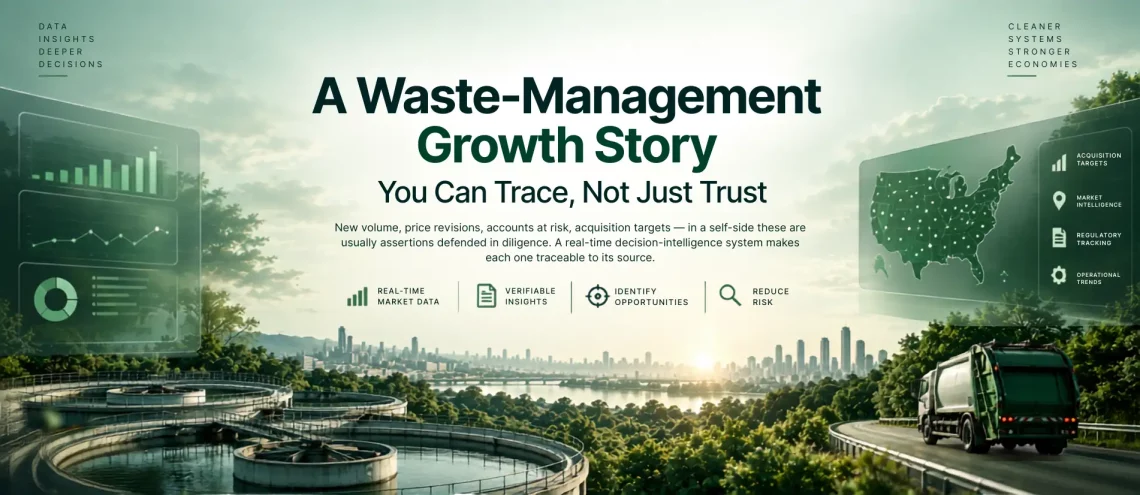
New volume, price revisions, accounts at risk, acquisition targets — in a sell-side these are usually assertions defended in diligence. A real-time decision-intelligence system makes each one traceable to its source.
M&A is being rebuilt around real-time data. Origination, underwriting, and execution are all moving from periodic, assumption-driven analysis toward systems that read the market continuously — and that shift will reshape every stage of a transaction. It shows up first, and most visibly, in the document where a deal begins: the sell-side Confidential Information Memorandum, and specifically its growth story.
A growth forecast in a waste-management CIM is, underneath the model, a set of claims: more tons, better price, retained and new accounts, a few well-chosen acquisitions. Historically each claim is a static assumption — built once at the start of the process and defended, question by question, through diligence. Buyers know this, so they discount the growth bridge; it is routinely the most heavily repriced page in the book. But waste management is an unusual industry. The data that would prove those claims is largely a matter of public record, even if it is scattered rather than centralized — manifests and shipment records, facility permits, biennial reports, generator and discharge data, procurement and contract records, technology patents, and transaction filings. Assembled and connected, that data can turn the growth story from something a buyer must trust into something a buyer can trace — giving every point of growth an address.
You no longer have to assert where growth comes from. You can point to it. A ton of new volume traces to a specific generator, a new plant, or a regulation. A price increase traces to a capacity or permit constraint you can see. An account at risk traces to a contract clock or a lost outlet. A target traces to a scarce permit. The growth bridge stops being a forecast to trust and becomes a map to inspect.
What a decision-intelligence system changes
This is where a decision-intelligence system changes the sell-side. It turns the growth bridge from a static forecast into a traceable, continuously current view of where growth comes from — powered by a real-time knowledge graph, a real-time model of the industry that connects six data layers so any claim about volume, price, an account, or a target can be followed back to the signal behind it. The datasets exist elsewhere in fragments; the system’s advantage is that they are joined and live.
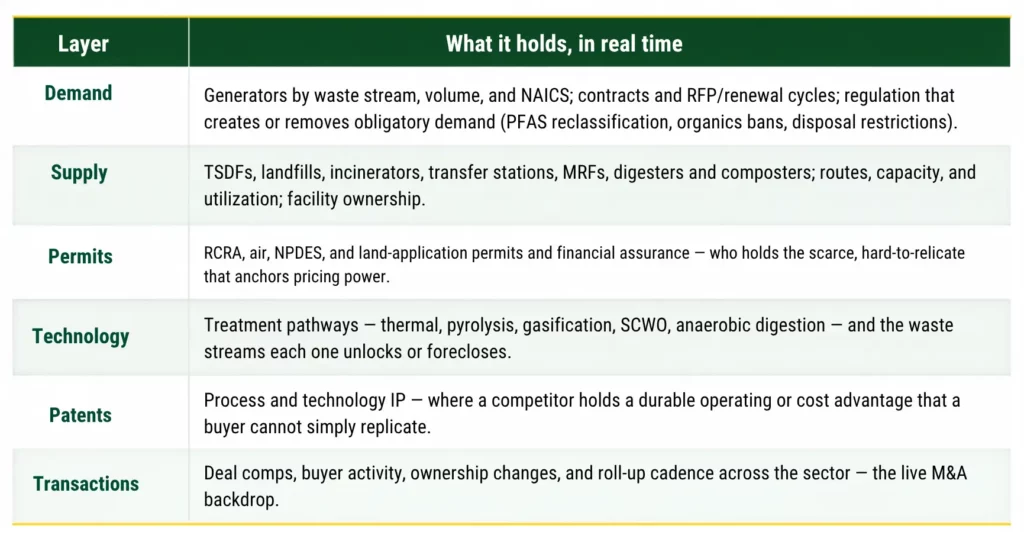
Exhibit 1 — What powers the system: a knowledge graph’s six real-time layers
Because these layers are connected, a single change propagates through the system as a chain a buyer can follow: a state PFAS rule (demand) restricts a land-application outlet (permits), which reroutes tonnage to a more distant incinerator (supply), lifting gate rates (price) and raising the value of whoever holds that permitted capacity (transactions). That chain is the growth story — made explicit.
Every growth decision, traced
The organic-to-inorganic discipline that buyers already expect — start with what the business delivers today, then what current initiatives add, then what acquisitions contribute — is sound; McKinsey’s large-deal research found 72% of successful deals maintained organic growth in year one against just 33% of unsuccessful ones. The system makes that discipline executable rather than asserted, because it can trace each moving part of the forecast to its source.
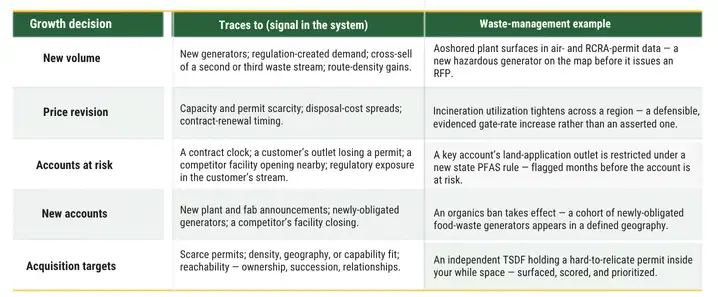
Exhibit 2 — In waste management, each growth decision traces to a specific signal in the system
The same traceability disciplines the acquisition case. Showing that hundreds of operators exist demonstrates fragmentation; showing which of them hold scarce permits, fit the density or geography the platform needs, and are actually reachable demonstrates a pipeline. That distinction is where value compounds — McKinsey’s programmatic-M&A research found companies completing one to two acquisitions a year grew roughly twice as fast as those doing none. The system turns the target universe from a static list into a funnel that narrows continuously as the thesis sharpens.
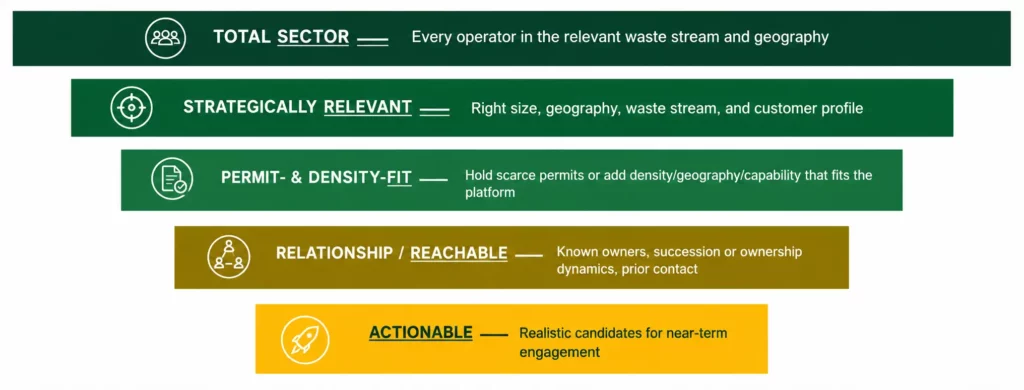
Exhibit 3 — The target universe narrows — and becomes actionable — inside the system
Why waste management — and why “public” doesn’t mean easy
This approach works in waste management for a reason that also explains why few can execute it. The industry runs on a public record: shipment manifests, facility permits, biennial and discharge reports, financial-assurance filings, procurement and contract records, technology patents, and transaction disclosures are all, in principle, observable. In most industries demand and supply must be inferred from private data; here, the regulatory record is the demand-and-supply signal.
The catch is that the signal is scattered. It sits across thousands of separate sources — federal databases, fifty state agencies, county health departments, municipal procurement portals, and individual facility permits — in inconsistent formats, on different update cadences, rarely joined and never in one place. Access is not the barrier; assembly is. Turning that fragmented record into a connected, continuously current view of generators, outlets, permits, technology, and transactions is a substantial and ongoing undertaking — which is exactly why it is a source of advantage rather than a commodity. The data is available to anyone; the system that makes it traceable is not. The static growth projection can be replaced now, not eventually — but only by whoever has already done the work of connecting the record.
Transparency raises value — it doesn’t leak it
The instinct that a traceable growth bridge gives too much away runs backward. In an analysis of 1,640 transactions, McKinsey found that acquirers who disclosed the sources of expected deal value drew a more positive market response and about six percentage points more two-year excess shareholder return than those who did not. A CIM is not a public announcement, but the principle holds: capital pays more for growth it can see. Buyers will separate organic from acquired growth, test capacity and permit assumptions, and scrutinize the pipeline regardless. A CIM built on the system anticipates those questions — and answers them with the same data the buyer would otherwise spend diligence trying to assemble.
THE ESPALIER VIEW
In waste management, the growth bridge in a CIM is becoming a live view of the system. The banker’s edge shifts from crafting the narrative to opening the system that proves it — where every ton of new volume, every dollar of price, every account at risk, and every target is traceable to real-time demand, supply, permit, technology, patent, and transaction data.
The static growth projection is ending. In this industry it can be replaced today — not because the data is easy, but because the scattered public record has been assembled into a system that reads it in real time. The processes that adopt that system will clear at better value, because conviction follows what a buyer can trace.
The CIM is only where this surfaces first. The same shift — from periodic analysis to a market read in real time — is moving into buy-side diligence and deal origination.
THE BOTTOM LINE
The strongest waste-management growth story is not the most aggressive forecast or the longest target list. It is the one where every ton of new volume, every price revision, every account at risk, and every acquisition target traces to a live decision-intelligence system the buyer can inspect. A story you can trace beats a story you have to trust.