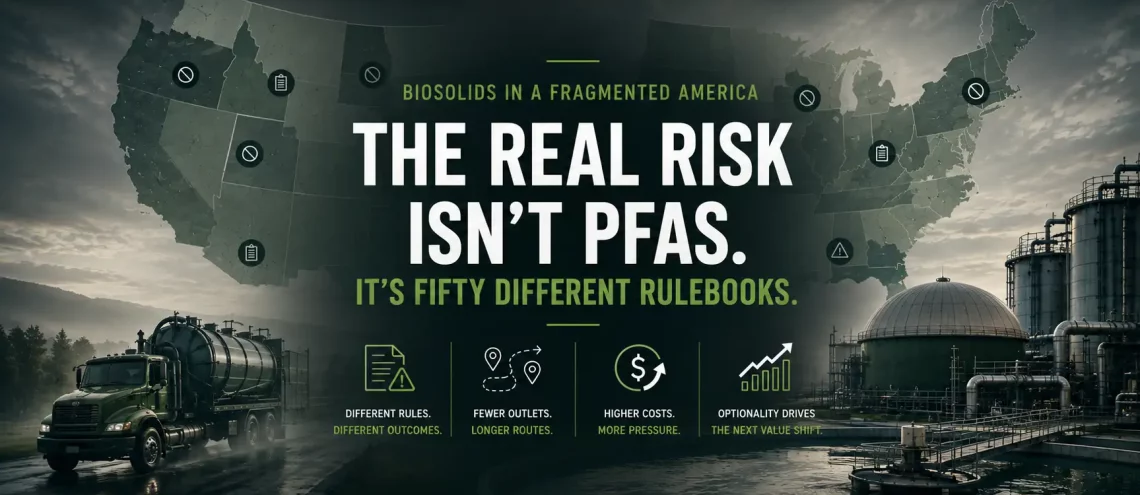
In July 2026 the federal government effectively declined to set a national standard for PFAS in biosolids. That decision hands the rulebook to the states — and turns regulatory geography into the industry’s most important economic variable.
THE FRAGMENTATION, IN THREE NUMBERS
20 to 100 ppb — the range of state prohibition thresholds for PFOA and PFOS in land-applied biosolids. Identical material is unrestricted in one state, rate-capped in the second and banned outright in the third.
~60% — the share of U.S. sewage sludge that is land-applied, per EPA. It is the lowest-cost outlet in the system, and it is the one the states are closing state by state.
$110.91 vs $62.28 — average landfill tip fee per ton in Maine against the national average. Four years after Maine banned land application, its disposal costs are the second highest in the country.
THE PROBLEM
Washington just declined to write the rulebook
For most of the last two years, the biosolids industry has been waiting on a federal number. In January 2025 EPA published its Draft Sewage Sludge Risk Assessment for PFOA and PFOS, and the sector read it as the opening move toward a national standard. More than 25,000 comments followed. Utilities budgeted against it. State regulators cited it. Operators deferred capital decisions until they could see where the federal line would fall.
That line is not coming, at least not soon. On July 1, 2026, EPA released Draft Guidance for Reducing Risk from PFOA and PFOS in Biosolids — a memorandum of non-binding, voluntary recommendations, published for comment through September 4, 2026. In releasing it, the agency distanced itself from its own draft risk assessment, concluding that the earlier work rested on assumptions too disconnected from real-world conditions to give the public actionable information. The guidance sets no federal concentration limit. It recommends source identification, industrial pretreatment and pollution prevention, and it states plainly that it does not have the force of law and cannot be relied on in litigation.
The industry has largely filed this as a deregulatory event — federal pressure easing, one more reason to wait. That reading is exactly backwards. A federal standard, whatever its number, would have been a single rulebook. Declining to set one does not remove the rule. It delegates it. And the states have already written their versions.
THE INSIGHT
Regulatory geography has overtaken treatment technology as the primary economic variable
The instinct across the sector is to treat PFAS in biosolids as a technical problem: measure the concentration, select the treatment, price the tonnage. That framing is not wrong, but it is answering a question that has stopped being decisive. Concentration is measurable and treatment is engineerable. What is neither is the fact that the same measured concentration produces a different legal outcome, a different disposal option and a different cost in every state the material can reach.
The United States is no longer a single biosolids market operating under a federal framework. It is a set of state markets in which the boundary conditions — what can be applied, where, at what rate, and what has to be trucked somewhere else instead — are set locally and are diverging. For operators and their investors, that shifts the analytical burden. The question is no longer what the material contains. It is where the material is, where it can legally go, and what the route between those two points costs.
THE STRUCTURAL SHIFT
1 · What fragmentation actually looks like
Descriptions of this market usually stop at “Maine banned it and other states are considering rules. That understates the position considerably. Seven states now have specific, published numeric or categorical positions on PFOA and PFOS in land-applied biosolids, and the numbers do not agree with one another.
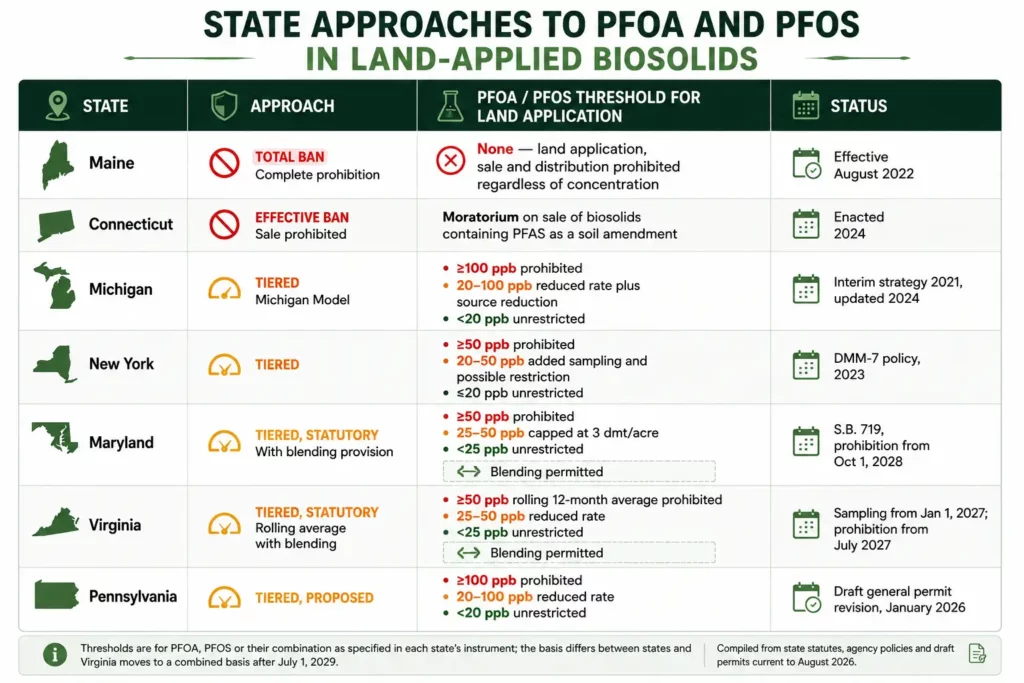
Read the table as an operator would. A batch of biosolids testing at 60 ppb combined PFOA and PFOS can be land-applied at a reduced rate in Pennsylvania under the proposed general permit. The same material cannot be land-applied at all in Maryland, Virginia or New York. In Michigan it is applied at a reduced rate with source-reduction obligations attached. In Maine it is irrelevant what the number is, because the pathway is closed regardless. One material, one laboratory result, five different commercial outcomes.
Note also what the states have converged on structurally even as they diverge numerically. Six have adopted some version of the tiered framework Michigan built in 2021 — prohibit above a ceiling, restrict in a middle band, permit freely below a floor. What they have not adopted is Michigan’s numbers. Michigan prohibits at 100 ppb and Pennsylvania proposes the same; Maryland, Virginia and New York prohibit at half that. A five-fold spread in the effective floor sits between states that all believe they are following the same model.
Two features of the newer statutes deserve more attention than they have had. Both Maryland and Virginia explicitly permit blending material from different treatment works to bring combined concentrations under the threshold. That is a legal arbitrage, and it is available only to operators with enough throughput across enough sources to blend. And Virginia’s prohibition runs on a rolling twelve-month average rather than a single sample, which converts compliance from a testing event into a portfolio management problem. Neither provision is a technicality. Each rewards scale and data, and neither has anything to do with treatment performance.
2 · Maine is the natural experiment, and it has now run for four years
The value of Maine is that it removes the speculation. The state banned the land application, sale and distribution of sludge and sludge-derived products in August 2022, regardless of PFAS concentration. Four years of consequences are now on the record, and they follow a sequence that any state tightening its rules should expect to repeat in compressed form.
The first effect was the collapse of optionality. Maine POTWs were left with landfilling as the only in-state pathway, and in practice with one landfill: the state-owned Juniper Ridge, operated by a Casella subsidiary, which has taken roughly 80 to 90 percent of the state’s biosolids since the ban. A market with several outlets became a market with one.
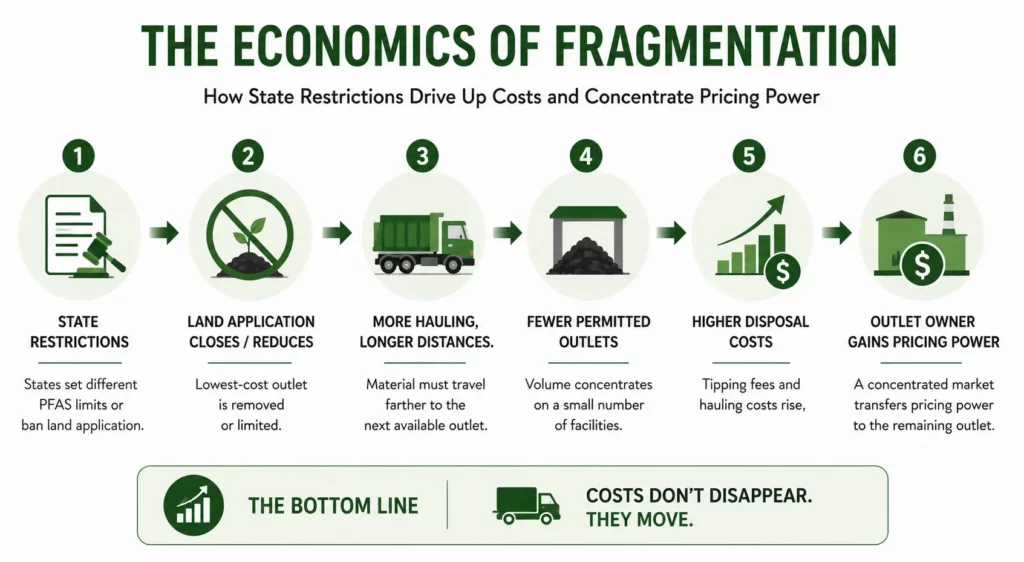
The second was price. Maine’s average landfill tip fee now runs about $110.91 per ton against a national average of $62.28 — the second-highest in the country. Utilities absorbed it through rates, and some began trucking material to Canada because the cross-border haul priced better than the domestic alternative. When a state closes its lowest-cost outlet, the cost does not disappear; it relocates into transportation and into a chokepoint asset whose owner now has pricing power.
The third effect is the one still unfolding, and it is the one operators should watch. Juniper Ridge is projected to reach permitted capacity around 2028; a proposed expansion would extend it toward 2040 but remains subject to permitting, litigation and a public-benefit determination. The ban also collided with a separate Maine law restricting out-of-state waste imports, which reduced the supply of bulky material the landfill needs to blend with wet sludge. Regulatory decisions taken independently interacted to constrain the same asset. Meanwhile the state’s own consultants have recommended reconsidering the total ban in favor of concentration-based limits — which would make Maine, four years on, a candidate to move toward the tiered model rather than away from it.
WHAT MAINE DEMONSTRATES
A single state’s rule change does not stay within that state. It redirects material across borders, concentrates volume onto whichever permitted asset remains open, transfers pricing power to that asset’s owner, and surfaces first in hauling costs rather than in treatment costs. The operators positioned to benefit were those who already held the permitted outlet. The utilities exposed were those who had built their economics around a pathway that was legal when they built it.
3 · Scale has not stopped mattering — it has changed character
A common reading of this market is that fragmentation penalizes scale: each additional state adds permitting teams, laboratory relationships, sampling protocols and legal frameworks, so compliance overhead grows faster than operating leverage. There is something to that, and multi-state operators are certainly carrying more regulatory cost per ton than they were five years ago.
But the conclusion that scale is now a liability does not survive contact with what the statutes actually permit. Blending provisions in Maryland and Virginia reward operators who can source across many treatment works. Rolling-average compliance in Virginia rewards operators who can sequence material over time. Divergent thresholds between neighboring states create routing value for anyone with outlets on both sides of the line. Every one of those advantages is available only at scale, and none is available to a single-site operator with one permit and one destination.
The accurate statement is that scale has changed character rather than lost value. Historically it delivered operational leverage: route density, equipment utilization, procurement. Increasingly it delivers regulatory optionality — the ability to place a given load where it is worth the most under the rules that apply this quarter. That is a different capability, and it is built on information rather than on trucks. The operators who will struggle are not the large ones. They are the ones large enough to carry multi-state compliance cost but not systematic enough to convert multi-state presence into routing advantage.
4 · Why this is a valuation question, not a compliance question
Biosolids assets have historically been underwritten on processing capacity, contracted municipal volume, customer relationships and infrastructure condition. Those variables still matter. What has changed is that they no longer determine the cash flow profile on their own, because the pathway the asset depends on is set by an authority the asset does not control and can be revised on a legislative calendar.
Consider two facilities with identical capacity, identical contracts and identical technology, one in Pennsylvania and one in Maryland. Under the rules now in force or proposed, the Pennsylvania asset can place material up to 100 ppb; the Maryland asset loses the land-application pathway at 50 ppb from October 2028. Their contracted volumes are the same and their addressable outlets are not. That gap shows up as different hauling distances, different processing requirements, different contingency arrangements and ultimately different margins on the same nominal tonnage.
Three implications follow for anyone allocating capital in this sector. Regulatory concentration now belongs alongside customer concentration on the risk register: a platform with most of its volume in one state carries a single-legislature exposure that no operational excellence offsets. Long-lived processing assets — thermal drying, composting, digestion, dewatering — are typically underwritten over twenty to forty years, a horizon across which every state in this table will revisit its rules more than once, which argues for valuing pathway flexibility explicitly rather than assuming it. And diligence has to become forward-looking: what matters is not only which rules apply today but which legislatures have bills in committee, since at least six states have introduced complete land-application bans since January 2025 without passing them, and those bills tend to return.
THE NEW MODEL
From “can we treat it?” to “where can it legally go, and what is that route worth?”
The capability this market now rewards is not a treatment technology. It is a systematic, current view of the regulatory and infrastructure map across every jurisdiction an operator touches — and the discipline to act on it before the map moves
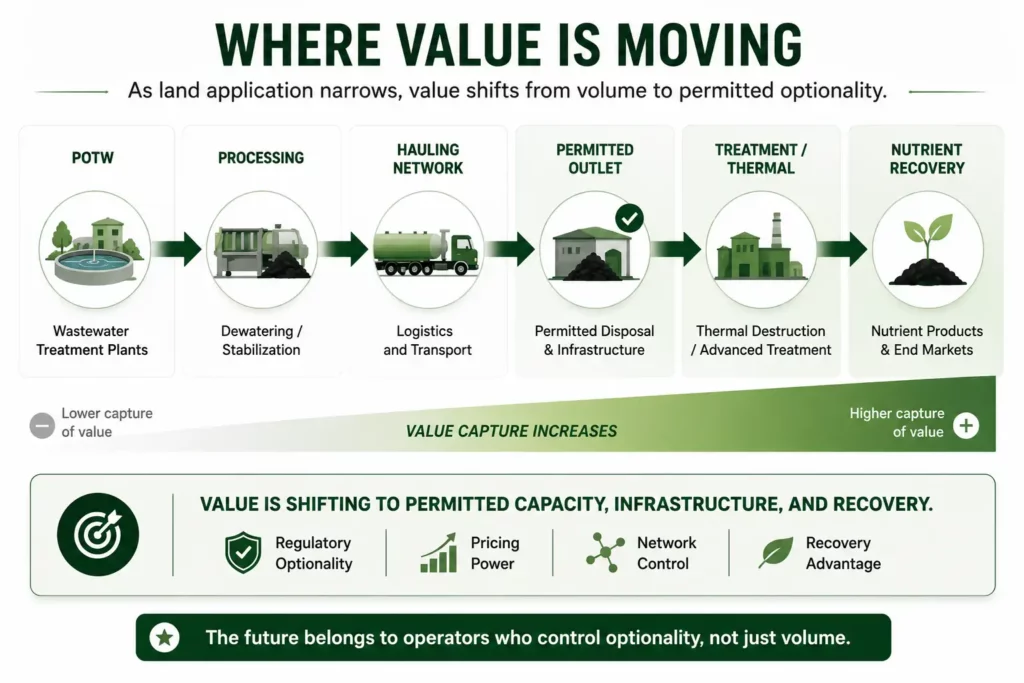
In practice that resolves into a handful of functions.
- Regulatory intelligence — tracking enacted rules, proposed permits and pending legislation across states as a live dataset rather than a periodic legal update, because the commercially valuable moment is before a threshold takes effect, not after.
- Infrastructure intelligence — knowing where permitted outlets sit, who owns them, how close to capacity they are, and which ones become chokepoints if a neighboring state tightens.
- Flow and routing optimization — placing each stream where it is worth the most under current rules, including blending and timing strategies the newer statutes expressly allow.
- Pathway portfolio design — maintaining redundancy across land application, composting, drying, digestion and disposal so that no single rule change strands a facility.
- Asset and EBITDA intelligence — quantifying how a threshold, a permit or an acquisition changes the value of the network, not just the margin on a load.
This is closer to infrastructure portfolio management than to plant operations, and it is the discipline the sector has historically been thinnest on. It is also, not incidentally, the same capability set that determines who wins in a consolidating market: the buyer who can price regulatory geography accurately will systematically outbid or underbid correctly against one who cannot.
What this looks like on the ground
For a utility, the practical question is no longer whether to test but what the test result implies about optionality. A plant consistently reading in the 25 to 50 ppb band in Virginia or Maryland is not out of compliance, but it has moved into the restricted tier — reduced application rates, added reporting, and a shrinking margin of error against a threshold that could be revised downward. The value of a source-reduction program in that position is not environmental performance; it is the preservation of a disposal pathway, and it should be underwritten on that basis.
For a private-equity-backed platform, the analysis runs across the map rather than down the P&L. Overlaying enacted and proposed state thresholds against permitted outlet capacity and projected volumes surfaces two things at once: the corridors where diverted material will outrun local disposal capacity within the next thirty-six months, and the states where an existing footprint is carrying an unpriced single-legislature exposure. The first is acquisition whitespace. The second is a repricing or divestment question. Both are visible only if regulatory geography is treated as data rather than as a compliance obligation, which is the work Espalier does.
CLOSING INSIGHT
The material has not changed; the map has
PFAS is the catalyst, and it is a real one. But the enduring change in this market is not what is in the sludge. It is that Washington has declined to write one rulebook, fifty jurisdictions are writing their own, and the resulting map now determines what a facility is worth, where a truck goes, and whether a twenty-year capital decision made last year still holds. Treatment performance remains necessary. It has simply stopped being the thing that separates the winners from everyone else.