Client Overview
A leading private equity firm was evaluating entry into the biosolids management sector, a market being reshaped by tightening PFAS regulations, increasing restrictions on land application, rising wastewater volumes, and growing demand for beneficial reuse and energy recovery solutions.
The opportunity was attractive, but difficult to assess. The market included 160+ companies operating across treatment technologies, hauling, disposal, equipment, operations, consulting, and beneficial reuse. Emerging technologies such as anaerobic digestion, pyrolysis, thermal hydrolysis, and supercritical water oxidation were also beginning to change the competitive landscape.
The firm needed a clearer view of where value was concentrating, which business models could scale, and which platforms were best positioned for private equity investment.
The Challenge
Biosolids management was not a single, easily defined market. It spanned 30+ interconnected sub-segments across treatment, logistics, equipment, services, and end-use pathways.
The PE firm needed to evaluate companies with very different business models, including municipal operators, pure-play processors, waste platforms, OEM providers, and service firms. However, there was no consistent framework to compare targets by strategic fit, scalability, technology positioning, geographic density, ownership structure, or transaction potential.
At the same time, major market themes such as PFAS regulation, circular economy infrastructure, renewable natural gas, co-digestion, and beneficial reuse were gaining momentum. The challenge was translating these broad trends into a practical investment strategy and a prioritized list of actionable targets.
Espalier’s Approach
Espalier used its AI-powered Decision Intelligence platform to structure the biosolids market into a clear investment framework.
The engagement began with a granular market taxonomy covering 30+ segments across treatment technologies, disposal pathways, logistics, services, equipment, and beneficial reuse. Espalier mapped key technologies including anaerobic digestion, thermal hydrolysis, pyrolysis, and supercritical water oxidation, along with end-use pathways such as land application, composting, landfill, incineration, and beneficial reuse.
Espalier then classified the market into six scalable business model archetypes:
- Vertical integration across wastewater treatment and biosolids
- Horizontal integration through broader waste platforms
- Pure-play biosolids processors
- OEM and equipment providers
- Design, engineering, and O&M service providers
- Consumables providers, including chemicals and related inputs
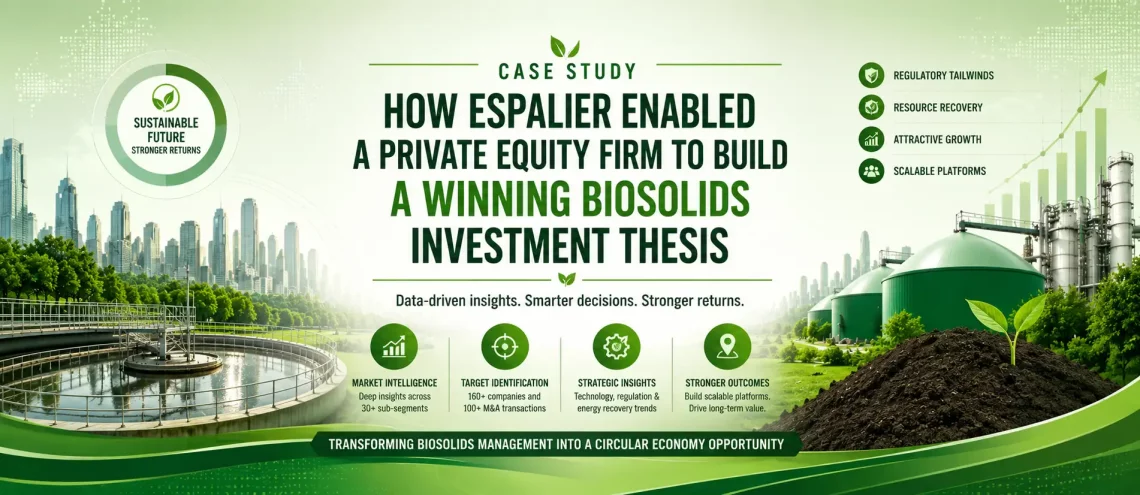
To support target identification, Espalier built a knowledge graph connecting 160+ companies, processing facilities, geographies, generator relationships, technology capabilities, and 100+ M&A transactions. This enabled the client to evaluate competitive positioning, regional density, strategic adjacency, and acquisition pathways with greater precision.
The analysis also surfaced several investment-relevant insights. Biosolids was increasingly shifting from a disposal market to an energy and resource recovery market. PFAS regulation and land application restrictions were creating consolidation pressure. Anaerobic digestion and co-digestion represented meaningful whitespace opportunities, especially where biosolids could be integrated with food waste and FOG streams. Beneficial reuse also continued to expand as municipalities prioritized sustainability, fertilizer replacement, and circular economy outcomes.
Client Impact
Espalier helped the PE firm move from broad market interest to a focused biosolids investment thesis.
The client was able to identify the most attractive value pools, prioritize scalable business models, and develop a platform-plus-bolt-on acquisition roadmap. The firm also gained a clearer view of which companies were best aligned with regulatory tailwinds, energy recovery economics, and long-term circular infrastructure demand.
The engagement enabled the client to:
- Define a focused investment thesis around biosolids, organics, and energy recovery
- Identify high-quality acquisition targets across a fragmented market
- Prioritize companies by scalability, technology positioning, and geographic fit
- Build a platform-plus-bolt-on roadmap
- Accelerate sourcing and diligence with greater conviction
Most importantly, Espalier shifted the investment discussion from whether biosolids was an attractive market to which platforms, technologies, and geographies could create outsized returns.