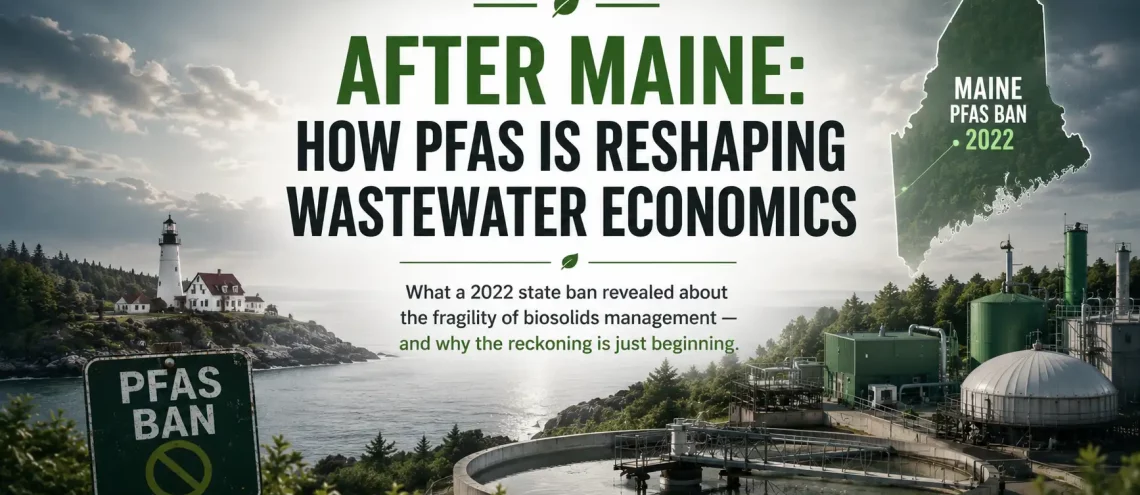
What a 2022 state ban revealed about the fragility of biosolids management — and why the reckoning is just beginning
On a July morning in 2022, a truck carrying sewage sludge from a Maine wastewater plant pulled up to the Juniper Ridge landfill — and was told it would have to wait. Biosolids require mixing with dry bulking material at a 5-to-1 ratio or greater before they are stable enough for landfill cells, and the facility needed time to ensure that material was ready. The Portland Water District eventually secured a disposal arrangement, but Scott Firmin, the District’s general manager, told Inside Climate News that his trucks were now “limited to a seven-hour disposal window, six days a week.” That constraint — not a regulation, not a technology gap, but a bulking material logistics problem — became the operational reality for utilities across Maine after the state’s outright ban on land application of biosolids took effect.
What unfolded there is being studied closely by operators and capital allocators in states from Maryland to Minnesota — not because Maine is a large biosolids market, but because it showed exactly how PFAS regulation disrupts: by eliminating the dominant disposal pathway before any viable replacement exists and leaving utilities to absorb the cost difference in real time. Portland sued chemical manufacturers in 2024 citing disposal costs that had doubled — $362 million over three years. The state passed emergency legislation to allow out-of-state bulking material. Biosolids were shipped to Canada. A private operator announced a $37 million drying facility. None of this was coordinated. All of it was expensive.
Maine is not an anomaly. It is a field study in what happens when PFAS regulation moves faster than infrastructure.
More than ten states now actively regulate PFAS in biosolids. The pattern is similar in each: restrictions arrive through legislation, utilities scramble for alternatives, and costs climb while the volume of material keeps arriving at the plant every day.
The Regulatory Map Is Being Redrawn State by State
The absence of a federal PFAS standard for biosolids is not simply an oversight — it reflects how slowly regulatory frameworks move when the science on a contaminant is still developing and the legal mandate to act lacks a hard deadline.
When the EPA finalized the Part 503 rule in 1993, it set limits for nine heavy metals and pathogen controls based on the science available at the time. PFAS were not a regulatory priority anywhere in 1993. What makes the subsequent three decades harder to account for is that the Clean Water Act requires the EPA to conduct a biennial review of biosolids regulations to identify additional toxic pollutants and propose new rules if the evidence warrants it. The agency has conducted nine sewage sludge surveys between 2004 and 2021, and three national surveys going back to 1988. PFAS appeared in the data. The Part 503 rule was not updated.
In 2002, the National Research Council reviewed Part 503 standards at EPA’s own request and found no documented evidence that the rule had failed to protect public health, but noted significant scientific uncertainty remained. No amendments followed. By 2024, that inaction had become the subject of litigation — the advocacy group Public Employees for Environmental Responsibility sued, arguing EPA’s failure to regulate PFAS in biosolids violated the Clean Water Act’s non-discretionary mandate. In October 2025, a federal court dismissed the case, finding that while the biennial review obligation exists, the law does not require the agency to regulate within any timeframe.
It was only in January 2025 that the EPA released a Draft Sewage Sludge Risk Assessment for PFOA and PFOS — the procedural step the Clean Water Act requires before any binding rule can be proposed. The findings were notable: potential health risks modeled at concentrations as low as 1 part per billion under land application scenarios, a level many current biosolids streams already exceed. In June 2026, the agency followed with draft voluntary guidance on managing PFOA and PFOS risk in biosolids — open for public comment through September 4, 2026, but carrying no binding force. That is where the federal process stands. In the meantime, states have been writing their own frameworks.
How states are regulating PFAS in biosolids — a spectrum from monitoring to full ban
Figure 1 REGULATORY Landscape – A spectrum from monitoring to full ban — 10+ states now have active regulations, no two identical
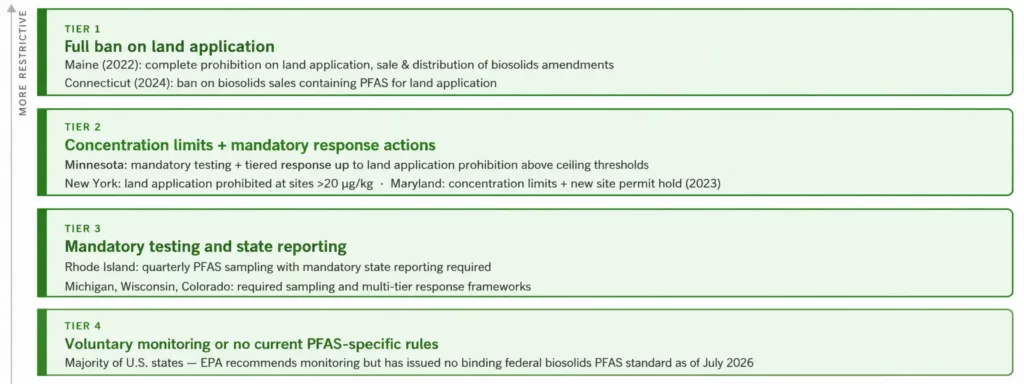
Sources: ECOS State Review (2022); MOST Policy Initiative (2025); Rockefeller Institute PFAS Policy Dashboard (2026). Classifications reflect laws or binding regulations in effect as of July 2026.
This fragmentation creates a specific operational problem. An operator serving generators across multiple states must navigate four different compliance regimes simultaneously — different testing cadences, different thresholds, different required responses when those thresholds are exceeded. And because federal action has been slow to materialize, that fragmentation is likely to deepen before it resolves.
Key milestones in PFAS biosolids regulation — from first state action to current federal process
Figure 2 Regulatory Trajectory – Key milestones in PFAS biosolids regulation — 2019 to 2026

Source: EPA Federal Register; state DEP records; Rockefeller Institute PFAS Dashboard (2026).
What operators are navigating today is not regulatory uncertainty. It is regulatory sequencing — the outcome is increasingly legible, only the timeline is still being negotiated.
A processing facility built today will operate for 20 to 30 years. A long-term hauling contract signed this year extends through a regulatory environment that will look materially different by 2030. The operators making infrastructure bets now are implicitly choosing which side of that transition they want to be on.
Why the Landfill Route Does Not Solve the Problem
When land application becomes restricted, the instinctive fallback is landfill disposal. Maine tested this assumption at scale. The state had to pass emergency legislation to allow imports of out-of-state construction debris just to keep the landfills running — because the shortage of bulking material, not landfill capacity itself, became the binding constraint. That supply chain dependency had never been planned for.
There is a more structural issue: landfill disposal transfers PFAS rather than eliminating it. Studies show PFAS migrates from landfill cells into leachate, and existing leachate treatment systems were not designed with PFAS in mind. The EPA has acknowledged that more than 95% of landfills are sources of PFAS contamination. As regulators turn their attention to landfill leachate — a likely next phase in the regulatory sequence — the cost of depositing PFAS-containing biosolids in municipal facilities will increase further. What looks today like a viable contingency pathway may, within a few regulatory cycles, become either unavailable or prohibitively expensive.
PFAS regulation’s effect on biosolids management costs — by state regulatory tier
Figure 3 Economic Impact – Average cost increase by state regulatory tier — CDM Smith / WEF / NACWA survey of affected facilities

Based on CDM Smith / WEF / NACWA survey. Average across all regulated states: 37% cost increase. Facilities in most heavily regulated states reported 2× or greater increases. Bars represent illustrative ranges derived from survey data; individual facility outcomes vary by management type and geography.
The Gap Between Managing PFAS and Destroying It
Most of what the industry calls “PFAS management” is relocation — moving the chemical from a field to a landfill, or concentrating it for disposal elsewhere. The PFAS does not go away. It moves. And each time it moves, someone pays a tipping fee, a hauling cost, a processing surcharge.
True destruction — breaking the carbon-fluorine bond that gives PFAS its persistence — requires fundamentally different technology. Supercritical water oxidation (SCWO) operates at temperatures above 374°C and pressures above 218 atmospheres and has demonstrated destruction efficiencies above 99.99% in laboratory settings. Pyrolysis and gasification followed by thermal oxidation are the most applicable processes for biosolids as a solid feedstock. Hydrothermal alkaline treatment (HALT) works at lower temperatures but shows uncertainty at scale. Electrochemical oxidation remains largely confined to liquid streams.
None of these technologies are yet deployed at the scale the U.S. market requires. SCWO has shown excellent results in controlled settings — Maine’s York Sewer District has a pilot project planned for 2028, and Aries Clean Technologies is under permit review for a gasification-based approach — but the gap between a pilot project and regional commercial infrastructure is measured in years. Minnesota’s study on PFAS cleanup costs puts the stakes in perspective: estimated costs for treating PFAS in that one state’s wastewater facilities alone ranged from $14 billion to $28 billion over 20 years. The national figure has no credible estimate, in part because the federal regulatory trigger that would define what “treatment” requires has not yet been pulled.
Regulatory timelines and technology deployment timelines are on a collision course. The operators who invest in destruction-capable infrastructure now will control assets with no equivalent substitutes when those timelines converge.
PFAS treatment technologies for biosolids — scale readiness vs. PFAS outcome
Figure 4 Technology Landscape – Management (relocation) vs. destruction — a critical distinction for infrastructure investment decisions
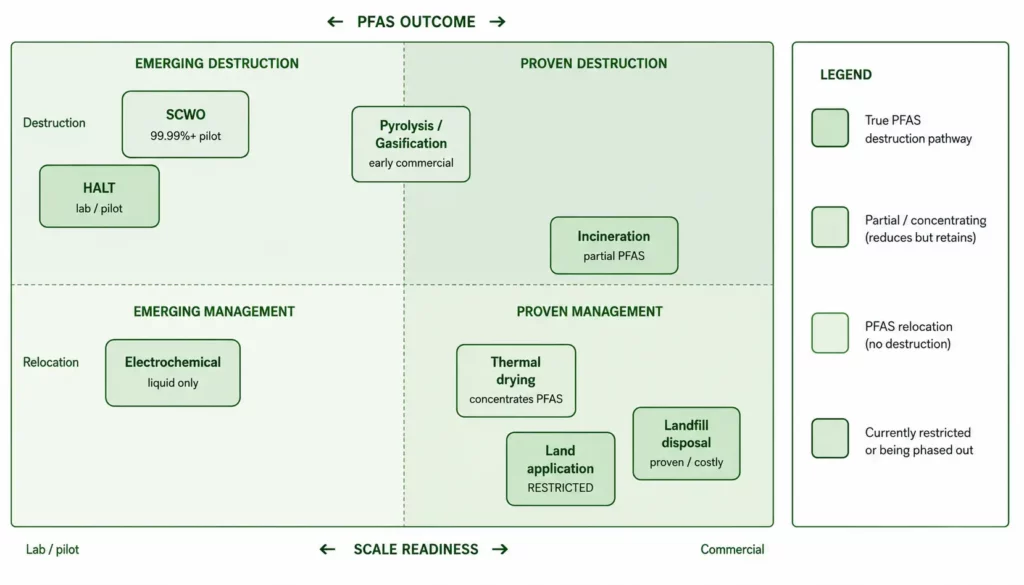
Position is qualitative assessment by Espalier based on published research as of mid-2026.
Sources: Barr Engineering / MPCA cost study (2023); ITRC PFAS Treatment Technologies guide (2025).
A Cost Structure Built on the Wrong Premise
The cost burden falling on wastewater utilities is worth understanding clearly, because it shapes the procurement decisions those utilities are making right now. PFAS enters treatment plants through the broader wastewater stream — household products, industrial discharges, stormwater — and utilities are obligated to treat whatever arrives. The result is that managing PFAS in biosolids becomes a cost borne by the entity at the end of the flow, regardless of where the PFAS originated.
The legal system is working through questions of liability. Maine municipalities have filed ten lawsuits against chemical manufacturers, with Portland’s case citing $362 million in incremental disposal costs over three years. Thousands of similar cases are pending or active nationwide. 3M exited PFAS manufacturing at the end of 2025. How those cases resolve — and how broadly liability is distributed across the supply chain — will take years to determine. In the meantime, disposal costs are real and operational decisions cannot wait for litigation to run its course.
That gap between legal timeline and operational reality is what drives the market dynamic. Utilities facing escalating and unpredictable disposal costs have strong incentive to move away from spot-market hauling relationships toward longer-term contracts that offer price certainty and guarantee outlet access. The operator who can offer that certainty — stable pricing, reliable outlets, demonstrated compliance pathways — holds genuine value in a market where those things are getting harder to find.
PFAS is not just raising the cost of biosolids management. It is restructuring who holds pricing power across the entire service chain.
What Operators and Investors Should Be Doing Differently
In our previous articles in this series, we argued that the biosolids market was shifting from a linear disposal pipeline to a networked system — one where regulatory change propagates across geographies, and where infrastructure positioning matters more than throughput efficiency alone. PFAS regulation accelerates both dynamics simultaneously.
On the network dimension: restrictions in one state have already been shown to redirect volume flows across state lines. Maryland is hauling roughly 56% of its sewage sludge out of state for disposal, primarily to Virginia and Pennsylvania — a cross-border volume flow that will intensify as destination states develop their own PFAS frameworks. Operators with multi-jurisdictional outlet control and routing intelligence are not facing the same market as operators optimizing a single-state footprint.
On the infrastructure dimension: thermal processing technologies — dryers, pyrolysis units, gasification systems — have been worth investing in for their energy recovery characteristics. PFAS regulation adds a second axis of value to the same assets. High-temperature thermal processing either destroys PFAS or concentrates it in ways that reduce downstream liability. An operator who has already invested in thermal infrastructure has, without necessarily framing it this way, been building PFAS resilience ahead of the regulation that will eventually require it of everyone else.
The most important near-term action for operators is outlet mapping — a systematic assessment of which current disposal pathways are exposed to PFAS restrictions within a three-to-five-year horizon, and what alternative capacity exists within economic hauling range. That exercise determines capital allocation priorities more precisely than almost any other single variable.
For investors, PFAS exposure has migrated from a diligence footnote to a central underwriting variable. A platform with 70% of volume routed through land application in states advancing PFAS legislation is a structurally different asset from one with diversified outlet access, thermal processing infrastructure, and the intelligence systems to route material dynamically. The EBITDA multiples may look similar at current disposal costs. The underlying risk profiles are not.
The market created by PFAS disruption is not a smaller market — wastewater generation is not declining, and biosolids volumes are not shrinking. It is a more concentrated one, where platforms with resilient infrastructure capture volume and pricing power that is flowing away from those that cannot adapt.
The question for every operator and investor in this sector is the same: at what point in that transition do you want to be positioned, and are you building now or waiting until the constraint forces your hand?