
How Espalier Enabled a Scaled Biosolids Operator to Grow Without Outrunning Its Disposal Network

Connecting commercial growth to disposal risk, logistics economics, and infrastructure strategy in one decision-intelligence system — across Texas and Georgia. Client Overview A leading U.S. biosolids and environmental-services operator, working at significant scale, set out to accelerate commercial growth without deepening its exposure to disposal and outlet constraints. The problem was structural, not commercial. Growth opportunities, disposal risk, transportation economics, contracts, and infrastructure were all being driven by the same market dynamics — yet each was being managed in a separate silo, never through one integrated view. Espalier built a decision-intelligence system across Texas and Georgia that connects where the operator can win new volume to whether that volume can be disposed of, what it will cost to serve, and how each decision changes the value of the network. The Challenge For a scaled biosolids operator, growth is not a matter of finding more customers. Every new ton of volume has to clear three constraints at the same time: The consequence: in biosolids, revenue that deepens dependence on fragile disposal pathways is not growth — it is risk. The operator had no single way to tell the two apart. Answering that required connecting questions the business had always handled separately: where the best near-term opportunities are, which facilities are approaching contract renewal, where disposal is most fragile, which markets have outlet capacity, what it will cost to serve new volume, where to prioritize capital, and which acquisitions would strengthen the network. Espalier’s Approach Espalier combined external market intelligence with the client’s internal operating data into a single decision layer for sales, capital allocation, and M&A. The Texas and Georgia platform was structured as five integrated intelligence modules — designed not as five databases, but as one connected chain of decisions. 1. Infrastructure Mapping Where is the volume, and where can we serve it? A comprehensive database across POTWs, lagoon systems, anaerobic digestion, industrial wastewater plants, composting and processing facilities, landfills, and land-application sites — capturing generation volumes, treatment profiles, disposal pathways, and proximity to outlets. What it changes: one map of where biosolids are generated, where infrastructure exists, and where the operator’s footprint creates real opportunity. 2. Contract Intelligence When will those opportunities come to market? A centralized repository of biosolids management contracts — providers, scope, service lines, start and expiration dates, procurement cycles, RFP timelines, and competitor presence — assembled from otherwise fragmented public records. What it changes: renewal and rebid windows surface early, so commercial teams engage before the RFP reaches the market, not after. 3. Analytical Qualified Lead (AQL) Pipeline Where should commercial effort actually go? Infrastructure and contract intelligence converted into a ranked pipeline, scored by probability of near-term opportunity, estimated volume, revenue potential, proximity to operations, current outsourcing, and outlet constraints. What it changes: a prioritized, evidence-based view of where effort is most likely to convert — replacing intuition and inbound reaction. 4. Outlet Dependency & Disposal Risk Can the additional volume actually be absorbed? A proprietary Biosolids Disposal Risk Index scoring land-application dependency, landfill availability, tipping-fee exposure, haul distance, watershed and regulatory constraints, and PFAS pressure — producing an Outlet Dependency Score, a disposal-fragility classification, and early-warning signals. What it changes: the operator can distinguish growth that strengthens the network from growth that deepens exposure to fragile outlets. 5. Transportation & Disposal Economics Can it be served profitably? A cost-to-serve model spanning haul distance, tipping fees, land-application capacity and seasonality, nutrient-management requirements, and routing — quantifying the margin impact of logistics on each opportunity. What it changes: pathway and routing decisions are made on true delivered economics, not headline revenue. The five modules operate as one decision chain And it does not go stale. The platform runs as an always-on monitoring layer — tracking commercial signals (RFPs, procurement notices, council approvals, rebids, competitor wins), regulatory signals (PFAS monitoring, nutrient-management limits, county land-application moratoriums, landfill acceptance policies), and market-growth signals (data-center wastewater, industrial expansion, WWTP upgrades, lagoon cleanouts) — so the decision layer updates as the market moves. Client Impact The system moved the operator from reactive market management to proactive, network-aware decision-making across four areas that had never before been evaluated together: For a scaled operator, the operating question was no longer “Where can we win more business?” It became “Where can we grow, where can we dispose, what will it cost to serve, and how does each deal change the value of the network?” Most importantly, Espalier turned biosolids growth from a sales target into a network decision — every opportunity tested against outlet risk, logistics economics, and infrastructure strategy before capital or commercial effort is committed.
How Espalier Enabled a Private Equity Firm to Build a Biosolids Investment Thesis
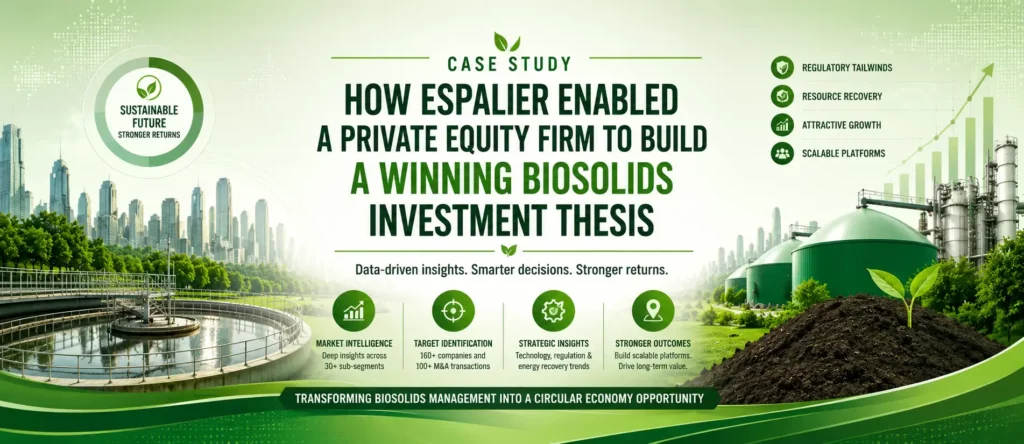
Client Overview A leading private equity firm was evaluating entry into the biosolids management sector, a market being reshaped by tightening PFAS regulations, increasing restrictions on land application, rising wastewater volumes, and growing demand for beneficial reuse and energy recovery solutions. The opportunity was attractive, but difficult to assess. The market included 160+ companies operating across treatment technologies, hauling, disposal, equipment, operations, consulting, and beneficial reuse. Emerging technologies such as anaerobic digestion, pyrolysis, thermal hydrolysis, and supercritical water oxidation were also beginning to change the competitive landscape. The firm needed a clearer view of where value was concentrating, which business models could scale, and which platforms were best positioned for private equity investment. The Challenge Biosolids management was not a single, easily defined market. It spanned 30+ interconnected sub-segments across treatment, logistics, equipment, services, and end-use pathways. The PE firm needed to evaluate companies with very different business models, including municipal operators, pure-play processors, waste platforms, OEM providers, and service firms. However, there was no consistent framework to compare targets by strategic fit, scalability, technology positioning, geographic density, ownership structure, or transaction potential. At the same time, major market themes such as PFAS regulation, circular economy infrastructure, renewable natural gas, co-digestion, and beneficial reuse were gaining momentum. The challenge was translating these broad trends into a practical investment strategy and a prioritized list of actionable targets. Espalier’s Approach Espalier used its AI-powered Decision Intelligence platform to structure the biosolids market into a clear investment framework. The engagement began with a granular market taxonomy covering 30+ segments across treatment technologies, disposal pathways, logistics, services, equipment, and beneficial reuse. Espalier mapped key technologies including anaerobic digestion, thermal hydrolysis, pyrolysis, and supercritical water oxidation, along with end-use pathways such as land application, composting, landfill, incineration, and beneficial reuse. Espalier then classified the market into six scalable business model archetypes: To support target identification, Espalier built a knowledge graph connecting 160+ companies, processing facilities, geographies, generator relationships, technology capabilities, and 100+ M&A transactions. This enabled the client to evaluate competitive positioning, regional density, strategic adjacency, and acquisition pathways with greater precision. The analysis also surfaced several investment-relevant insights. Biosolids was increasingly shifting from a disposal market to an energy and resource recovery market. PFAS regulation and land application restrictions were creating consolidation pressure. Anaerobic digestion and co-digestion represented meaningful whitespace opportunities, especially where biosolids could be integrated with food waste and FOG streams. Beneficial reuse also continued to expand as municipalities prioritized sustainability, fertilizer replacement, and circular economy outcomes. Client Impact Espalier helped the PE firm move from broad market interest to a focused biosolids investment thesis. The client was able to identify the most attractive value pools, prioritize scalable business models, and develop a platform-plus-bolt-on acquisition roadmap. The firm also gained a clearer view of which companies were best aligned with regulatory tailwinds, energy recovery economics, and long-term circular infrastructure demand. The engagement enabled the client to: Most importantly, Espalier shifted the investment discussion from whether biosolids was an attractive market to which platforms, technologies, and geographies could create outsized returns.
Fleet Optimization in Waste Management Using Data-Driven Insights

Client Overview A regional waste management operator in the U.S. evaluated its fleet strategy in the context of rising capital costs, variable route utilization, and increasing service complexity. The operator relied predominantly on owned assets across collection routes but was beginning to question whether ownership remained the most efficient model across all markets. The Challenge Fleet ownership decisions in waste management are typically driven by historical practices rather than data-driven evaluation. The operator faced multiple structural challenges: • Uneven route density across geographies• Under-utilized assets in specific service zones• Rising capital intensity and financing costs• Pricing inconsistencies relative to service complexity However, these issues were not evaluated holistically. The operator lacked a unified framework to: • Assess true asset utilization at a route level• Understand the impact of financing structures on fleet economics• Identify where ownership was no longer optimal• Evaluate rental as a viable alternative As a result, fleet strategy decisions remained static—despite changing operating conditions—highlighting the need for Waste Management Analytics. Espalier’s Approach Espalier deployed its AI-powered Decision Intelligence platform to create a comprehensive view of fleet economics, integrating external market data with operator-level insights through Waste Industry Data Intelligence. The analysis focused on four key dimensions: 1. Asset & Financing Intelligence • Mapped fleet composition, age, and utilization• Integrated UCC lien data to assess financing structures and lender profiles• Evaluated capital intensity and cost of ownership 2. Route & Demand Intelligence • Analyzed generator-level demand and service distribution• Identified route-level density and utilization gaps• Highlighted under-loaded routes with adjacent volume potential 3. Pricing & Service Economics • Benchmarked pricing against service intensity and asset wear• Identified inconsistencies across accounts and routes• Modeled lifecycle economics of owned vs rental assets 4. Ownership vs Rental Qualification Framework Espalier developed a structured model to identify where: • Assets were under-utilized relative to capacity• Financing structures created inefficiencies• Route density did not justify ownership This enabled a clear view of where ownership economics break and rental becomes the superior model. Client Impact The operator was able to reframe its fleet strategy using a data-driven approach: • Identified specific routes and regions where owned assets were underperforming• Quantified opportunities to improve utilization without additional fleet investment• Highlighted scenarios where rental reduced capital intensity while maintaining service levels• Established a framework to dynamically evaluate fleet decisions across markets This resulted in: • Improved asset efficiency and utilization• Reduced capital allocation pressure• Enhanced pricing discipline aligned with service intensity Most importantly, the operator shifted from a static ownership model to a flexible, economics-driven fleet strategy. By aligning fleet decisions with route density, asset utilization, financing structures, and service economics, Espalier helped the operator improve capital efficiency and strengthen long-term strategic flexibility.
Facility-Level Opportunity Mapping for Liquid Waste (Oily Water) Using AI-Driven Analytics

Client Overview The #1 way for liquid waste management companies to accelerate revenue isn’t by expanding infrastructure or adding more sales reps – it’s by using data and analytics to find where the opportunity actually is and who to target first. Espalier helped a private equity-backed liquid waste management company with a national footprint do exactly that – using our proprietary waste industry data set and AI-powered analytics platform. The Challenge The client operates a network of treatment, storage, and disposal facilities (TSDFs) and branch locations across the United States. Their strategic priority was revenue acceleration, starting with oily water — a large but fragmented and opaque market. The problem: oily water generator data is scattered across industries, processes, and use cases. Sales teams had no visibility into who generates how much oily water, where, or why. Territory planning was driven by relationships and gut feel, not demand density or proximity economics. Competitive pressure varied sharply by geography, but wasn’t analytically visible. Our Approach Manual research across thousands of potential facilities would have taken months. The client needed a facility-level, actionable view of demand that sales could use immediately. We deployed our Decision Intelligence platform to move from raw data to execution. The analysis covered four steps: 1. Generator Identification at Facility Level Using AI-powered data extraction, we identified all oily water generators in the target state, spanning 5 industrial sectors and 28 industrial segments. Our AI scanned regulatory filings, permits, facility registrations, and operational data across thousands of sources to build a comprehensive facility-level database. This process would have taken months manually — AI completed it in just 3 weeks. Each generator was profiled at the facility level, not company level. This granularity is critical for route economics and sales execution. A company might have ten facilities across a state, but only three generate enough oily water to justify regular pickups. 2. Oily Water Quantification by Use Case For every facility, AI models quantified oily water generation across three operational drivers: process water, cleaning and maintenance, and spills or episodic events. Our machine learning algorithms analyzed facility size, production capacity, industrial processes, and historical patterns to estimate generation volumes. The AI continuously refined predictions as new data became available, delivering accuracy that manual analysis couldn’t match at this scale. This gave the client true addressable volumes, not industry averages that obscure real variation. 3. Asset-Mapped Opportunity Modeling AI-powered geo-spatial analytics mapped every generator to the client’s relevant TSDFs and branch locations. The platform evaluated proximity-based value proposition, haul economics, and route density opportunities across thousands of facility combinations simultaneously. The AI also mapped competitive facility locations to assess local demand-supply tension, identifying white space opportunities where high generator density met low competitive presence. 4. Commercial Funnel Analytics (AQL → MQL) AI-driven scoring models translated demand intelligence directly into a prioritized sales funnel: Analytically Qualified Leads (AQLs): $100M of identified opportunity. The AI evaluated every facility against volume thresholds, proximity criteria, and economic fit to filter thousands of generators down to sales-ready targets. Marketing Qualified Leads (MQLs): $35M of prioritized opportunities. Machine learning algorithms screened AQLs for commercial readiness, competitive positioning, and timing signals. The AI automated lead scoring and prioritization that would have required weeks of manual analysis for each territory. MQLs were delivered territory-ready to the sales team with facility-specific intelligence packets. Client Impact With Espalier’s analytics, the client gained a clear roadmap to accelerate revenue with precision. Following the state-level deployment, they’re now expanding the model nationally and applying the same framework across additional states and waste streams. The analytics are embedded in day-to-day commercial execution for revenue acceleration, territory design, competitive response, and future M&A targeting. Ready to accelerate revenue growth with AI-powered market intelligence? Espalier’s Decision Intelligence platform helps waste management companies identify hidden opportunities, prioritize high-value accounts, and convert data into pipeline. Explore how Espalier can help: Visit Espalier Solutions to learn more or schedule a consultation.
Identifying Captive Wastewater Infrastructure Opportunities with AI-Powered Analytics for Waste Management

Client Overview A leading provider of liquid waste and wastewater infrastructure services sought to expand into the decentralized (captive) wastewater treatment segment. The company aimed to pursue this growth through partnerships, acquisitions, and operating contracts with privately owned, non-municipal wastewater treatment systems, using market intelligence to identify and prioritize the most attractive opportunities. To support this expansion strategy, Espalier applied AI-Powered Analytics for Waste Management to provide the client with a deeper visibility into this fragmented and difficult-to-track segment. The Challenge The objective was to identify and assess non-municipal, permitted wastewater treatment facilities serving condominiums, resorts, commercial centers, and industrial parks that are operated under contract by private service providers. However, this segment is highly opaque and difficult to track: Within the wider Liquid Waste Management ecosystem, this lack of transparency creates major barriers for companies attempting to identify acquisition targets or operational partnerships. As a result, the client lacked the data needed to: Espalier was engaged to map the private wastewater infrastructure landscape, identify third-party operators, and build a prioritized opportunity pipeline using AI-Powered Analytics for Waste Management. Espalier’s Approach Espalier leveraged its wastewater intelligence platform—integrating federal, state, and proprietary data sources—to isolate and assess the non-municipal wastewater segment along the U.S. East Coast. The engagement focused on three core workstreams: facility mapping, operator intelligence, and competitive benchmarking. Through AI-Powered Analytics for Waste Management, Espalier was able to extract insights from fragmented regulatory data and build a clearer view of the decentralized Liquid Waste Management infrastructure landscape. 1. Facility Mapping 2. Operator Landscape Intelligence 3. Competitive Benchmarking & Opportunity Identification Client Impact Espalier delivered a comprehensive market-intelligence foundation enabling the client to expand strategically into decentralized, non-municipal wastewater markets: The client now has a data-driven roadmap and full-spectrum market visibility built on the basia on AI-Powered Analytics for Waste Management to scale its footprint in the captive wastewater treatment sector with confidence and precision.
Facility-Level Opportunity Mapping in CPG and Medical Device Waste Management Using Waste Management Analytics

Client Overview A leading U.S. waste management firm specializing in hazardous and non-hazardous treatment sought to expand its footprint across high-waste industrial sectors – specifically Consumer Packaged Goods (CPG) and Medical Devices. The client aimed to identify priority customers, quantify market potential, and focus its business development efforts on the highest-value opportunities with the help of Waste Management Analytics. The Challenge Despite strong core service capabilities, the client lacked the comprehensive market intelligence necessary to execute a focused growth strategy in these segments. Key gaps included: These limitations made it difficult to prioritize markets, allocate resources effectively, and build a data-driven go-to-market plan. For expanding Hazardous Waste Management and industrial waste service coverage. To address this, the client engaged Espalier to identify facility-level growth opportunities, estimate market potential, and align high-value targets with its existing operational footprint to enable efficient GTM execution. The engagement leveraged advanced Waste Management Analytics to improve market visibility and opportunity prioritization. Espalier’s Approach Espalier applied a structured, data-driven methodology powered by its proprietary and Waste Management Analytics capabilities AI platform to identify and prioritize growth opportunities across the target industry segments. Client Impact Espalier delivered a data-rich foundation for targeted growth using Waste Management Analytics to transform fragmented industry information into actionable intelligence. Espalier’s approach transformed a fragmented and opaque growth challenge into a clear, data-backed expansion roadmap – equipping the client to confidently pursue high-impact opportunities across the U.S. CPG, Medical Devices, Distribution, and 3PL sectors.
Mapping Revenue in US Soil & Dredge with Environmental Services Analytics

Client Overview A leading U.S. environmental services provider sought to expand its footprint in the Soil & Dredge Management (SDM) market—an increasingly important sector driven by infrastructure development, contaminated site remediation, and evolving state and federal regulations. The client wanted to identify where the strongest commercial opportunities existed and how best to align its capabilities to capture growth using Environmental Services Analytics. The Challenge Despite operating in adjacent remediation verticals, the client lacked the granular market intelligence needed to understand where the strongest SDM opportunities were emerging. Key questions—such as which regions had the highest concentration of contaminated soils and dredged material, which technologies best aligned with the company’s capabilities, and how competitors were positioned—were difficult to answer with available data. Much of the required information was fragmented across federal, state, and local sources, making manual research slow, resource-intensive, and impractical for strategic decision-making. Without a data-driven view of opportunity clusters, regulatory conditions, and supplier ecosystems generated through Environmental Services Analytics, the client risked investing in the wrong regions or missing high-value growth pathways entirely. Espalier’s Approach Espalier applied an AI-enabled Environmental Services Analytics framework combining quantitative demand modeling, project-level and company network mapping, regulatory and technology benchmarking, and strategic opportunity assessment. This data-driven approach identified the most attractive growth paths in the U.S. SDM market. 1. Demand Estimation 2. Opportunity Mapping 3. Waste Industry Competitive Intelligence 4. Regulatory & Technology Assessment 5. Strategic Growth Roadmap Client Impact Espalier equipped the client with a comprehensive, actionable view of the Soil & Dredge Management market—integrating demand analytics, regulatory insights, technology fit, and competitive networks informed by Waste Industry Competitive Intelligence. With clearly defined growth zones, prioritized opportunities, and M&A pathways, the client is now positioned to scale with precision and capture untapped market potential.
Fast-Tracking PFAS Market Entry with Environmental Services Analytics

Client Overview A leading U.S. environmental services company aimed to enter the PFAS (“forever chemicals”) management sector in the U.S. They sought to capitalise on the rising demand for PFAS detection, treatment, and remediation services driven by tightening EPA regulations. To proceed effectively, The company needed a solid understanding of the market landscape to inform major investment decisions such as: The Challenge Despite the clear market opportunity, the client lacked the deep market intelligence needed to make confident strategic investment decisions. Information on contamination patterns, treatment needs, technology readiness, and state-by-state regulations was scattered across agencies and industry sources. Relying on manual research to gather this information would have taken months, slowing decision-making and risking misaligned capital deployment in a fast-moving regulatory environment. This highlighted the need for AI in Environmental Services to accelerate intelligence gathering. Espalier’s Approach Espalier deployed a proprietary blend of AI models, geospatial analytics, and industry-specific datasets powered by Environmental Services Analytics to build a comprehensive PFAS market-entry roadmap. The engagement was structured into five modules: 2. Value Chain & Supply-Side Mapping 3. Demand-Side Sizing with Environmental Services Analytics 4. Technology Selection Framework 5. Growth Framework & Partner Ecosystem Client Impact Espalier’s AI-powered approach delivered a fast, accurate, and data-rich foundation for PFAS market entry, enabling the client to make confident strategic decisions: By integrating demand analytics, regulatory foresight, technology evaluation, and ecosystem strategy, Espalier AI delivered a high-impact roadmap that future-proofed the client’s PFAS strategy. The company is now equipped to lead in a complex, compliance-driven market while pursuing the most lucrative opportunity segments with confidence.
Assessing U.S Aerosol Recycling Market to Guide Strategic Expansion

Aerosol recycling industry data analytics
Waste-To-Energy Investment Trends in the U.S. for Investment Opportunities

Client Overview A leading U.S. environmental services company engaged Espalier to explore strategic investment opportunities in the Waste-to-Energy (WtE) sector. The objective was to assess market dynamics, technology options, and the infrastructure landscape to guide informed capital allocation decisions. The Challenge To make informed investment decisions and understand Waste-To-Energy Investment Trends, the client needed clarity across several critical areas: Without addressing these knowledge gaps, the client risked making misinformed investments or slowing strategic entry into the sector. Espalier’s Approach Espalier applied a structured framework to analyze Waste-To-Energy Investment Trends and guide strategic investment decisions. The approach comprised three key modules: 1. Waste to Energy Technology Assessment This analysis helped identify emerging Waste-To-Energy Investment Trends across technology pathways. 2. Waste to Energy Supply Chain Mapping This mapping also revealed important Waste-To-Energy Investment Trends related to waste flows and facility clustering. 3. Waste to Energy Opportunity Scoring These insights revealed key Waste-To-Energy Investment Trends shaping the future of the sector. Client Impact Through its engagement with Espalier, the client gained a holistic, data-driven perspective on the evolving Waste-to-Energy landscape, bridging insights on technology maturity, waste flow mapping, and regulatory complexity. Equipped with clearly defined market clusters, policy signals, and actionable investment scenarios, the client is now positioned to make informed, forward-looking capital deployment decisions in the WtE sector.