The value of the next collection customer increasingly depends on where that customer’s waste can go.
Collection density improves the economics of moving waste. Permitted capacity determines whether that waste can be handled economically in the first place. Two waste businesses with similar revenue, route concentration and customer retention can therefore have very different margins, growth ceilings and acquisition value depending on the facilities they can access.
For decades, collection density has been one of the most reliable explanations for value creation in waste management. More customers along an existing route spread vehicle, labor and fuel costs across more stops. That logic remains sound. What it misses is that a collection network does not operate independently of the disposal and processing infrastructure beneath it. As permitted capacity becomes more constrained in certain markets, the advantage can shift toward the operator that controls the economically reachable outlet.
Collection density explains the first part of the margin, not the last
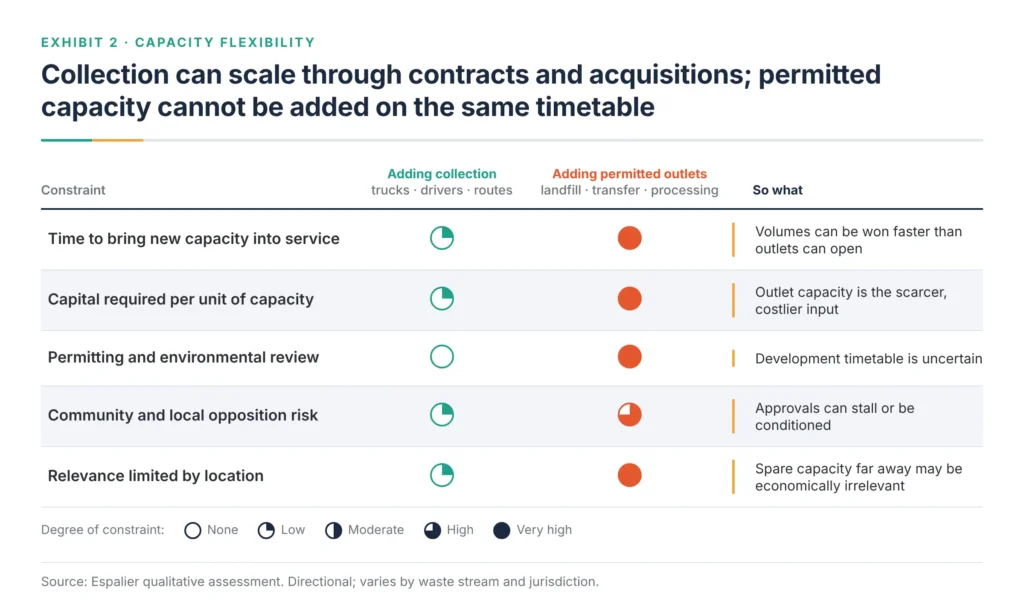
The economics of route density are straightforward. A collection truck has a fixed operating day, and every additional stop that can be served without proportionately increasing driving time or labor improves utilization. This is why geographic concentration has long been central to acquisition strategies.
But the route does not end at the last collection. Material must reach a transfer station, recycling facility, landfill, organics processor or other approved destination. That second movement introduces haul distance, transfer costs, receiving fees, permitted waste types and available capacity. A dense route can be a weak business if disposal options are distant, expensive or controlled by competitors. A less dense network can have better economics when it has dependable nearby outlet access.
The relevant network is not simply the collection route. It is the complete path from the waste generator to the final permitted outlet.
Permitted capacity is less flexible than collection capacity
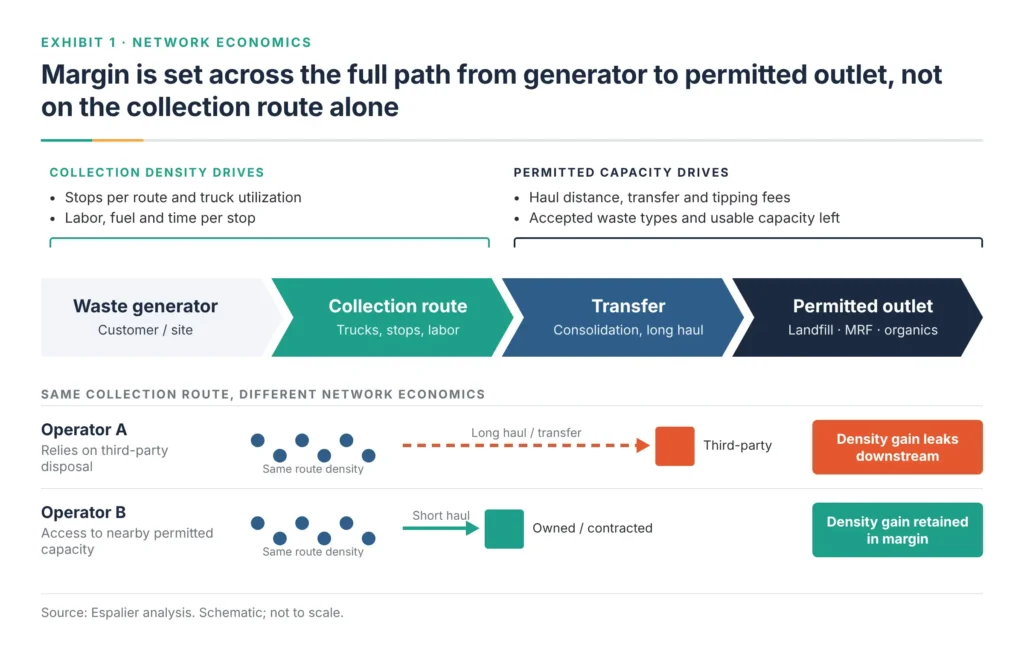
An operator can add trucks, acquire routes or hire drivers, subject to ordinary operating constraints. Developing a landfill, transfer station or specialized processing facility is a different undertaking. Land, engineering, permits, environmental review, community acceptance and capital can make the development timetable uncertain.
Collection volumes can therefore grow through contracts and acquisitions faster than permitted outlets can be brought into service. The resulting scarcity is local. A facility with available capacity far from the customer may not be economically relevant once transportation and transfer costs are included. A smaller facility closer to the route can be more strategically important.
WM and Republic Services describe large integrated collection, transfer and landfill networks in their 2025 annual filings. Those disclosures demonstrate how leading operators invest beyond collection, although facility counts alone do not measure usable spare capacity or establish pricing power in a particular market.
The same facility can create different value for different buyers
A landfill has standalone economics: tipping fees, operating costs, airspace consumption, environmental obligations and capital expenditure. Its strategic value also depends on the collection and transfer network around it. An operator acquiring a facility near existing routes may avoid third-party fees, shorten haul distances and gain control over the destination for recurring volumes. A buyer without nearby collection operations may primarily value third-party disposal revenue. The physical asset is identical; the economic contribution to each buyer is not.
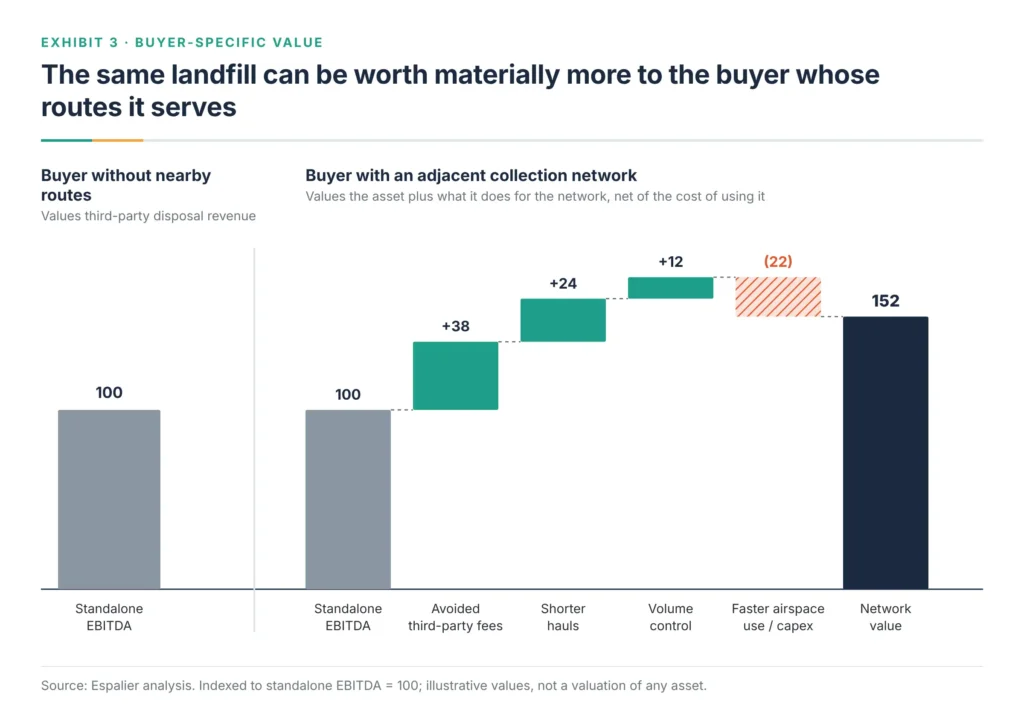
That is why permitted capacity cannot be valued solely on its standalone EBITDA. The buyer must quantify the network benefit, net of airspace depletion, environmental liabilities, required capital and the opportunity cost of reserving capacity for internal waste.
Permitted capacity can set the ceiling on organic growth
Collection acquisitions are often underwritten on the assumption that additional customers can be absorbed into an existing footprint. That works only if the network can handle the incremental waste. A platform may have available truck capacity but limited economically reachable disposal options. New volume may then require longer hauls, higher third-party fees or additional transfer infrastructure. Revenue grows, while incremental margins disappoint.
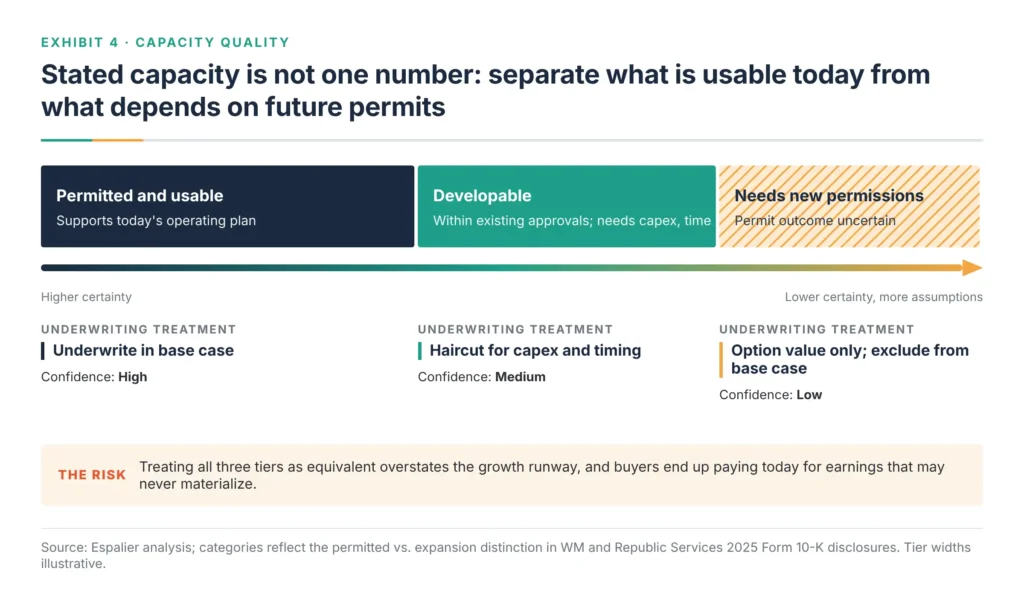
Public filings distinguish currently permitted capacity from potential future expansion. That distinction matters because capacity supporting today’s operating plan is not equivalent to capacity dependent on future permits, investment or other assumptions.
For investors, the right question is not how much volume a collection business can win, but how much incremental volume its existing outlet network can absorb at attractive economics.
A simple margin bridge shows why location matters
Consider a hypothetical acquisition that brings 100,000 additional tons per year into an existing collection network. If a nearby permitted facility can manage that material at an all-in incremental cost of $55 per ton, while the best practical alternative costs $75, the apparent network benefit is $20 per ton, or $2 million annually.
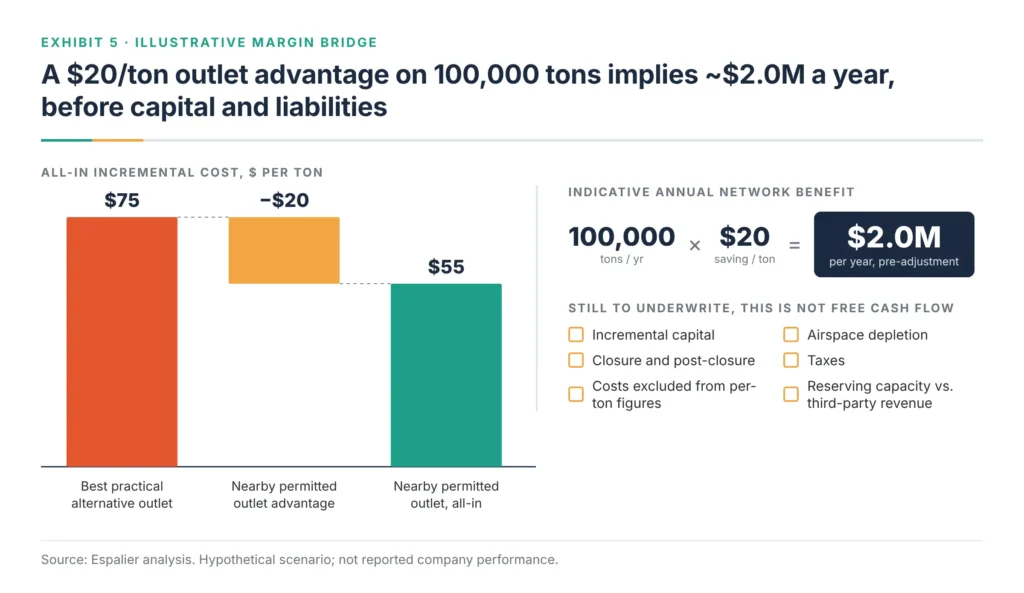
Illustrative scenario, not reported company performance. The benefit is not free cash flow: actual underwriting must account for incremental capital, airspace depletion, closure and post-closure obligations, taxes and any costs excluded from the assumed per-ton figures.
The calculation shows why an outlet can create value beyond its standalone income statement and why that value depends on the network it serves.
Scarcity can support pricing, but it does not eliminate risk
Limited nearby alternatives can support disposal pricing, but scarce capacity is not automatically a superior investment. A landfill with limited remaining life may require significant expansion capital. A processor may have unused nameplate capacity but lack permission to accept the waste streams customers need to place. Environmental liabilities, local opposition, permit restrictions and competing outlets can offset the benefit of scarcity.
Buyers should distinguish capacity that is currently permitted and usable, capacity that can be developed within existing approvals, and capacity that depends on new permissions. Treating those categories as equivalent can overstate the growth runway and lead buyers to pay today for earnings that may never materialize.
M&A diligence should start with the next incremental ton
Traditional screens begin with route overlap, market share and customer density. A stronger approach traces acquired volumes through the complete network: which facilities receive the waste, who controls them, what acceptance conditions apply, how much usable capacity remains and what happens if the preferred outlet becomes unavailable.
This also requires separating ownership from access. A long-term third-party agreement can sometimes provide attractive economics without the capital intensity and environmental obligations of owning a landfill. The question is whether the business has sufficient control over economically viable capacity to support its forecast.
Two collection companies with similar reported revenue and margins may have very different risk if one has dependable local outlet access and the other relies on short-term arrangements and longer hauls. Applying the same valuation multiple without examining the disposal network treats different operating positions as equivalent.
ESPALIER VIEW
The most valuable waste network is not necessarily the one with the most collection customers. It is the one that can convert the next incremental ton into the strongest sustainable margin.
Collection density remains an important source of operating efficiency. But its value is conditional. Incremental volume improves earnings only when the business can collect, transfer and dispose of the material at an attractive cost. That changes the acquisition question from how much route overlap a deal creates to how the acquired volumes alter the utilization, economics and remaining life of the facilities the combined business can actually access.