
The contract can be national; the economics stay local. The best programs are nationally governed and locally engineered — and a decision system is what makes each market’s real supply curve visible before the bid, not after.

Waste is sold as a service but delivered through physical infrastructure. Every pickup begins on a local route and ends at a local or regional transfer station, recycling facility, organics processor, landfill, or specialized outlet. The customer may sign one master agreement; the material still has to move through a market-specific network operating under different capacity, permitting, labor, and competitive conditions. As large operators put it in their own filings, waste is “largely a local business.”
The trouble starts when procurement treats national waste like a standardized indirect-spend category — aggregate the locations, compare unit rates, pick one supplier. That improves control, but it misreads the cost base. The invoice can be centralized; the service cannot be detached from local geography.
A national contract standardizes governance. It cannot standardize the supply curve. The invoice is centralized; the service never leaves local geography — and that gap is exactly where a national program creates value or quietly destroys it.
A national contract sits on top of local operating systems
Five local variables determine the delivered cost of a site. A national bid can compare them; it cannot make them disappear.
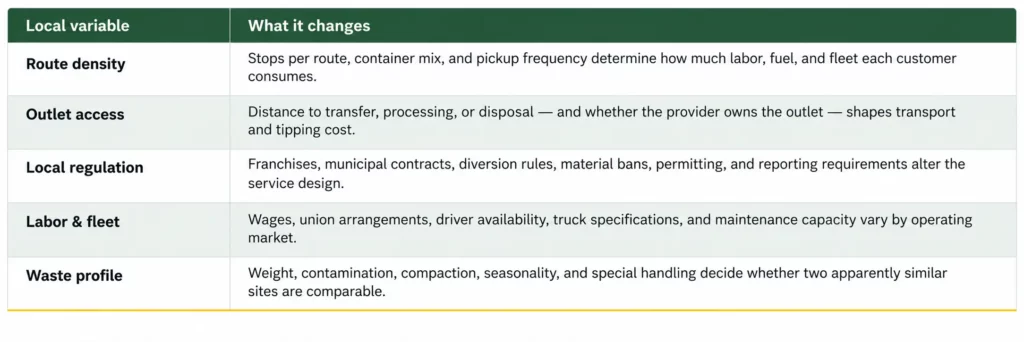
The national price is an allocation — not a market price
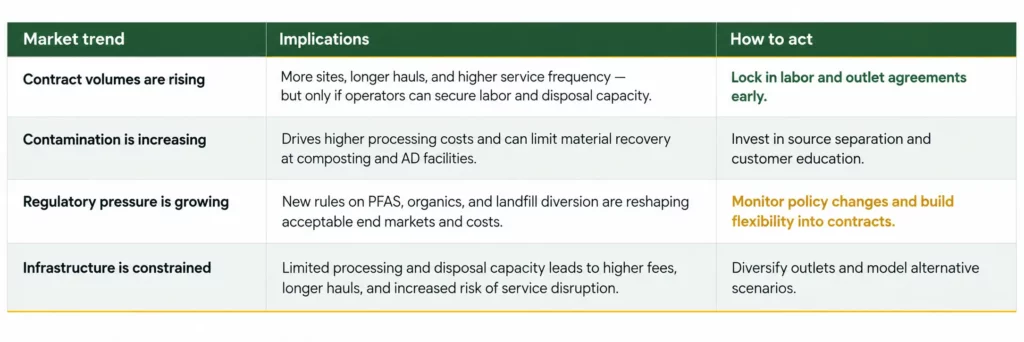
A supplier can present one national rate card, but the price is still assembled from local economics. Some markets have dense routes and nearby owned disposal; others require long hauls, third-party tipping, or subcontracted collection. A blended rate redistributes those differences — it does not eliminate them. That creates a familiar trap: the buyer celebrates a low national average while high-cost sites are underpriced, low-cost sites subsidize the portfolio, and exceptions surface after implementation. The savings were visible in the bid model but not durable in the operating model.
The variation is material. EREF’s 2024 analysis of 351 landfills reported a national average tip fee of $62.28 per ton — but the report exists precisely to show how that number differs by region, facility size, and ownership. Disposal is only one component of price; adding route and service variation widens the gap further.
Scale helps — but only where it changes the local economics
National scale is real value: it standardizes contract language, consolidates invoices, sharpens reporting and escalation discipline, and gives the customer one governance structure. But it is most valuable when it is backed by local integration. One national operator reported that roughly 67% of the solid waste it collected in 2025 was disposed at landfills it owned or operated; the advantage comes from controlling more of the local material flow, not from a national logo. Where the prime supplier lacks local routes or outlets, coverage is created by subcontracting — which can be the right answer, but changes the economics: another operator performs the service, the prime adds governance and margin, and visibility can weaken. That structure should be priced consciously, not treated as equivalent self-performance.
How a decision system builds this view
This is where a national-accounts provider wins or loses. The asset-light orchestrators, whose edge is coordinating local networks rather than owning trucks and landfills — do not compete by claiming universal self-performance. They compete by knowing, market by market, where the network is genuinely strong, where partners are required, and how to price and govern both honestly. That knowledge is a data problem — and it is exactly what a decision system is built to solve.
The inputs are public, but they do not sit in one place. Franchise ordinances, hauler and transfer-station permits, landfill ownership and tip fees, diversion rules and material bans, and municipal contract terms and expirations are scattered across thousands of county and municipal systems, in inconsistent formats and on different cadences. Access is not the barrier; assembly is. A decision system connects them into a single, continuously current view of each local market — turning the abstract claim that “economics are local” into a specific supply curve a provider can price against.
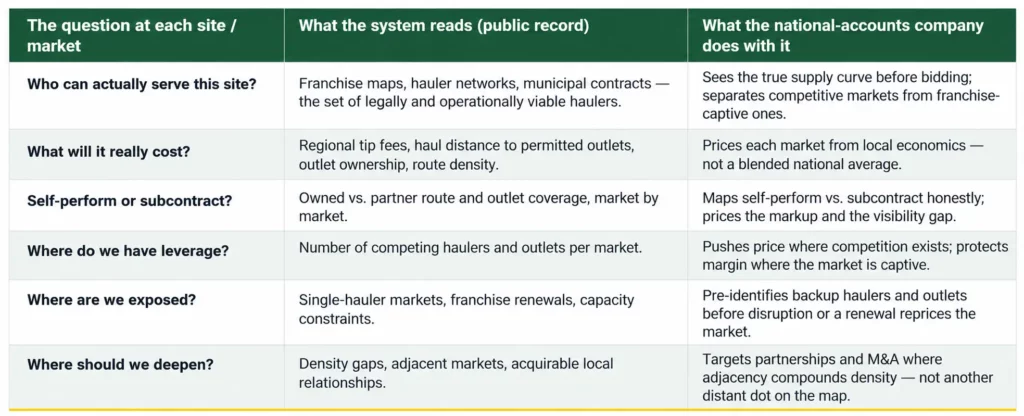
With that view, the national-accounts model inverts. Instead of quoting a blended national rate and discovering the exceptions after implementation, the provider prices each market from its true supply curve, bids to win where it has real operating advantage, governs the subcontracted markets transparently, and pre-positions backup capacity where a single hauler or a franchise renewal is the risk. The differentiated capability is not the broadest map — it is the best-understood one.
What the view has to answer
- Self Performance: Identify which sites are served directly and which rely on subcontractors.
- Network Fit: Measure each site’s distance from the route base, transfer station, and final outlet.
- Outlet Control: Determine whether disposal or processing is owned, contracted, or open market.
- True Unit Economics: Calculate the actual cost per lift, ton, and site after all additional fees.
- Service Design: Optimize pickup frequency, container size, and compaction before negotiating rates.
- Local Resilience: Identify backup haulers and alternative outlets before disruptions occur.
What this means for investors and operators
The same logic that complicates procurement explains where strategic value sits. Route density lowers collection cost; transfer stations extend the economic radius of disposal; permitted capacity protects the outlet; local relationships stabilize volume — and a platform is worth more when these reinforce one another within a market. For consolidators, that means geographic adjacency can matter more than adding another distant dot to the map. For national-accounts businesses, the differentiated capability is not claiming universal self-performance — it is knowing where the network is strong, where partners are required, and how to price and govern both. That is precisely the view a decision system produces.
THE ESPALIER VIEW
The best national waste programs are nationally governed and locally engineered. They run on one data model, one performance framework, and one commercial architecture — while letting the provider mix and the price mechanism reflect the operating reality of each market.
That is only possible if the local reality is legible. A decision system that assembles the scattered public record — franchises, haulers, permits, tip fees, and contracts — into a live, market-by-market supply curve is what lets a national-accounts provider price honestly, govern transparently, and win where it is genuinely strong. The map is national; the advantage is built market by market.
THE BOTTOM LINE
National procurement creates value when it makes local economics visible. It destroys value when it replaces them with a blended average and calls the result a market price. The winning national-accounts provider is not the one with the broadest map — it is the one with the best-understood local network behind it, and the decision system that keeps that understanding current.