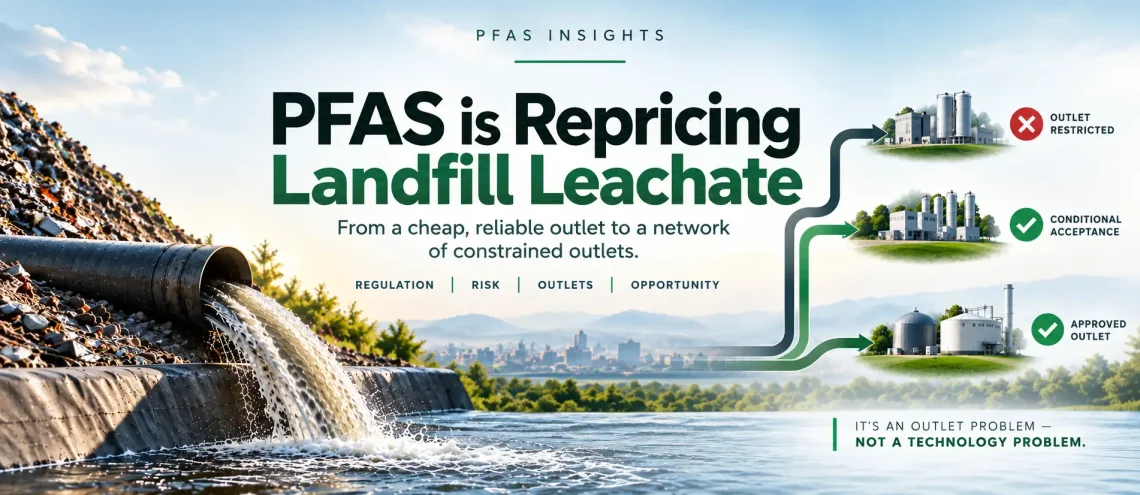
PFAS is changing who can accept leachate, what treatment it needs, and where cost and liability sit. That makes leachate an outlet problem, not a treatment-technology problem — and the winner is whoever controls the network of outlets the stream can still reach.

For decades, leachate worked as a quiet secondary stream: collect it, connect to a sewer or haul it to a publicly owned treatment works, and rely on the wastewater system’s existing infrastructure. The economics were compelling because liquid is expensive to move and dedicated onsite treatment demands capital, operators, and residual expertise. The outlet absorbed the complexity — and it was cheap.
PFAS breaks that model. Conventional biological wastewater treatment was never designed to destroy persistent fluorinated compounds, so PFAS passes through into effluent or partitions into sludge — linking the landfill’s incoming waste to the utility’s pretreatment program, to drinking-water protection downstream, and to the fate of biosolids. A low-cost outlet becomes a compliance and reputational exposure for whoever receives it. The consequence is not a new piece of treatment equipment. It is a reprice: the outlet that was cheap and reliable is becoming scarce, conditional, and expensive.
This is not a treatment-technology story — it is an outlet story. PFAS doesn’t require every landfill to build a plant; it changes who will still accept the stream, on what terms, and at what price. Value accrues to whoever controls the outlets, not whoever owns the equipment.
The chain PFAS forces on every stream
Once PFAS is in scope, every gallon of leachate has to run the same five-step chain. Each step is a distinct service, and a distinct place value can be captured — and the platform that spans the chain, rather than selling one box in it, is the one that holds the customer.

Exhibit 1 — Characterize → separate → move → destroy or dispose → prove closure Regulation is closing the outlet from several directions
There is no single PFAS-leachate rule. The commercial signal is strongest when the regulatory actions are read together: each touches a different point in the chain, but collectively they raise the value of characterization, source control, pretreatment, and defensible final disposition.

Exhibit 2 — Five regulatory routes, one direction of travel Regulatory status as of September 2026. Proposed actions are not final requirements.
Federal rulemaking sets direction; state programs decide where spending starts. Maine now requires landfills that manage leachate to sample and report PFAS (beginning 2026) and, separately, PFAS characterization of treatment sludge before disposal or reuse (sampling by January 2027). Michigan sampled 32 active MSW landfills and found most were not major contributors to their wastewater plants — but a small number of high-load sites had to implement treatment through industrial pretreatment. The lesson: the market will not develop uniformly. High-load sites, sensitive receiving utilities, and constrained-outlet regions move first.
The Espalier framework: map the constrained outlets, not the landfills
Because the market is regional and site-specific, the right unit of analysis is not the number of landfills or the installed base of treatment equipment. It is the regional outlet network. The first attractive markets emerge where high PFAS mass load intersects constrained outlet access — the one quadrant where urgency and willingness to pay arrive together.
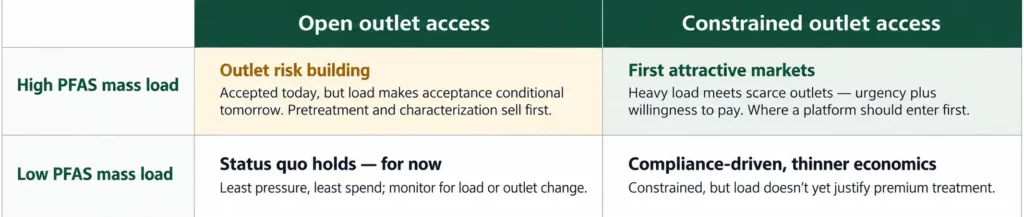
Exhibit 3 — The leachate constraint map: where the first markets form. Position on this map is set by four variables: PFAS mass load (not concentration alone) · outlet scarcity · the receiving utility’s POTW and biosolids constraints.
The economics reinforce the point. Minnesota estimated that removing and destroying PFAS from wastewater and biosolids could cost $14–28 billion over 20 years, with per-pound costs materially higher at smaller facilities and short-chain PFAS up to 70% more expensive to treat. That is not a leachate forecast, but it shows why dilution at a municipal plant will not become a universal solution — and why concentrated-stream treatment, tied to a secured outlet, is where the economics concentrate. Technology without an outlet is incomplete; an outlet without characterization is exposed.
Where the value pools are — and how mature
The most investable near-term opportunities sit upstream of the uncertain numeric limits. A customer can defer a full-scale destruction plant; it cannot defer understanding its PFAS profile, retaining an outlet, or documenting where its residuals went.
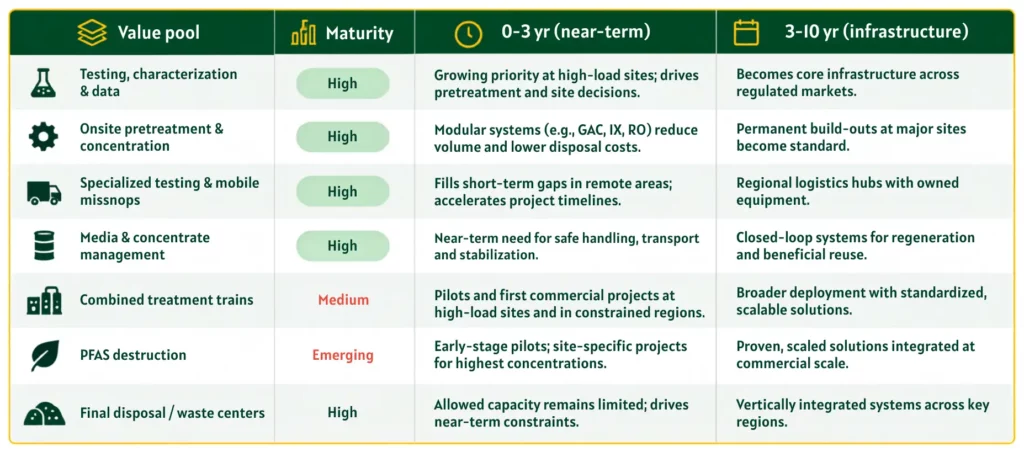
Exhibit 4 — Value pools: near-term service and recurring vs. longer-term infrastructure
THE INVESTMENT THESIS
The winning business does not need to own every asset in the network. It needs to own the data, the decision rights, the customer relationship, and residual accountability — the ability to keep a landfill compliant and operating when the outlet requirements change, and to prove where the PFAS ultimately went. Assets can be rented; the customer outcome cannot.
Six underwriting lenses

Four moves operators should make now
1. Characterize now, on a mass-load basis — baseline your leachate with Method 1633 — total PFAS mass, not just concentration — before numeric limits arrive. You can defer a plant; you cannot defer knowing your profile.
2. Treat outlet access as a strategic asset — lock acceptance contracts, map alternates and hauling radius, and price the risk of losing your primary outlet before the utility reprices it for you.
3. Own the residual and its paper trail — map every spent medium, concentrate, and sludge stream to a defensible final disposition, with chain-of-custody data that survives a CERCLA look-back.
4. Buy optionality, not stranded capital — deploy modular pretreatment where mass load and outlet risk are highest; wait on full-scale destruction until performance and permitting are validated.
THE ESPALIER VIEW
The PFAS-leachate opportunity is not a market of landfills, and it is not a market of treatment equipment. It is a network of constrained outlets — and it can be mapped. PFAS mass load, permitted acceptance capacity, POTW and biosolids limits, hauling radius, and residual-path cost are all knowable, region by region.
Map it that way and the first markets, the durable value pools, and the acquisition targets all resolve out of the same picture. The winner owns the data and the decision rights across that network — not every asset in it.
THE BOTTOM LINE
PFAS is repricing landfill leachate — turning a cheap, reliable outlet into a scarce, conditional one. The near-term value is already forming around testing, pretreatment, logistics, and residual management, because those address outlet risk today, before any federal numeric discharge limit is final. Over time it migrates to regional platforms that integrate characterization, treatment, destruction assurance, and reliable disposition. The winning position is not a piece of equipment — it is control of the outlet network, and the data that routes every gallon through it.