Espalier’s Quarterly M&A Insights for Waste Management Industry
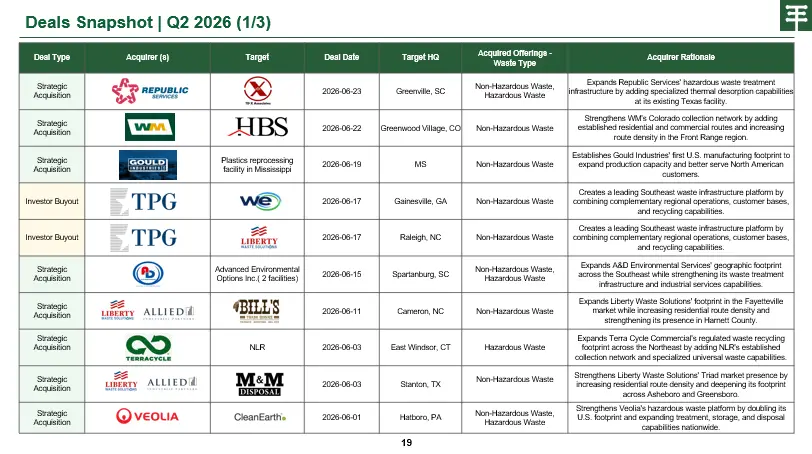
Espalier publishes its M&A Insights Report for the Waste Management Industry every quarter. The report provides detailed intelligence on M&A, financing, and investment activity across the U.S. waste sector, with granular breakdowns by industry segment, geography, investor type, and more. All insights are sourced from Espalier’s proprietary Waste Industry Knowledge Asset, built with AI and refined by experts.
Report Features
- Waste Management M&A Trend
- Leading Acquirers in the Waste Sector
- Geographic Hotspots for M&A Activity
- High-Growth Segments in Waste Sector
- Largest M&A Deals and Strategic Rationale
- Industry Growth Drivers
Key Highlights
Waste Management M&A Trend
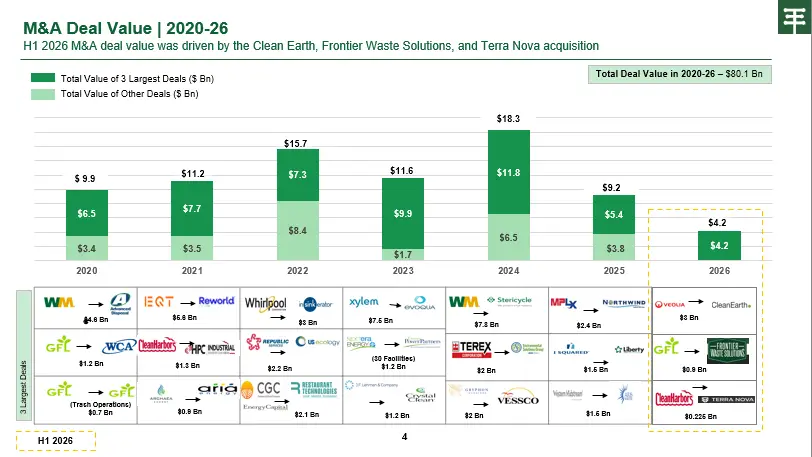
M&A activity in the U.S. waste management sector accelerated in Q3 2025, with 70 deals announced versus 65 in Q2, reflecting continued consolidation across hazardous and non-hazardous segments. By 2025 YTD, total deal count reached 202 transactions with disclosed value of $5.7 billion. Q3 contributed a substantial share of this value, driven by major transactions including Northwind Midstream, Aris Water, and Radius Recycling.
Strategic and Private Equity Investments in Waste Sector
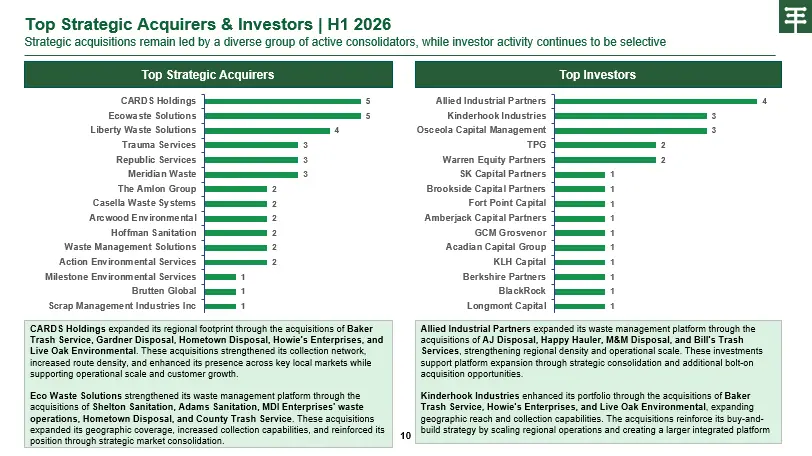
Corporate acquirers continued to dominate, accounting for nearly 90% of deal flow. Strategics such as GFL Environmental, Waste Connections, Republic Services, and Environmental 360 focused on route density, post-collection capabilities, and regional scale. Private equity activity, though selective, targeted hazardous waste logistics, sustainability services, and specialized treatment technologies, with firms like Apollo Global Management and Berkshire Partners pursuing focused investments.
Geographic Hotspots for Waste Sector M&A
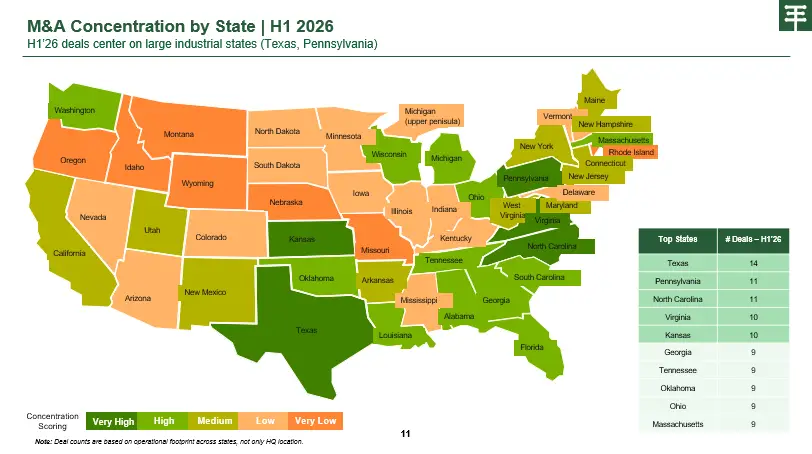
M&A activity in U.S waste Industry concentrated in the South and Midwest, led by Texas, Pennsylvania, and Illinois. These states remained top consolidation hotspots due to strong industrial markets and favorable regulatory environments. Q3 witnessed 21 corporate cross-regional deals, reflecting ongoing strategic expansion beyond core markets.
High-Growth Waste Segments for Investment
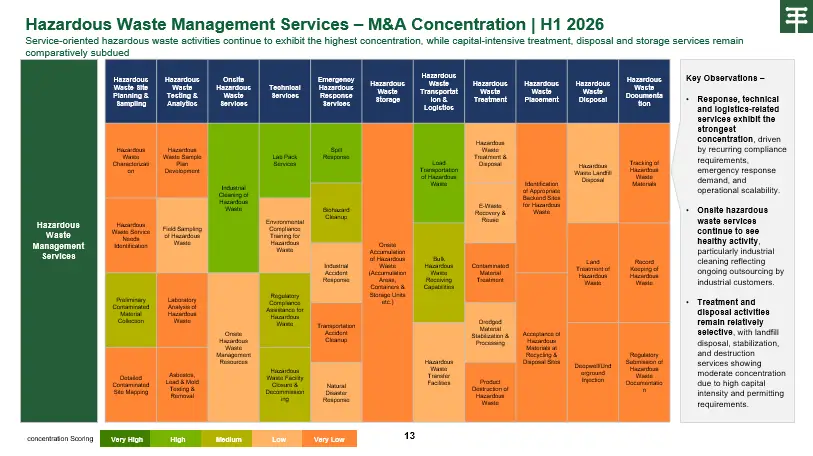
Non-hazardous waste services led Q3, driven by heightened activity in industrial and field services, collection, and recycling. Industrial field operations accounted for a major share of deals as demand for compliance support and on-site services stayed strong. Recycling M&A also accelerated, with over half of 2025 YTD deal value occurring in Q3. Hazardous waste deals gained momentum in on-site services, physical and chemical treatment, and reclamation. Contaminated materials M&A remained active in testing, certification, and risk-mitigation, reflecting rising regulatory scrutiny and liability concerns.
Largest M&A Deals in US Waste Industry
Q3 2025 was the strongest quarter of the year, marked by high-value platform transactions in Texas and a surge of serial acquirers expanding aggressively across Georgia, Oklahoma, and New Jersey. Large-scale hazardous and non-hazardous waste deals dominated the quarter, reinforced by corporate strategies focused on regional densification, integrated service expansion, and advanced treatment infrastructure. Below is an analysis of the key transactions that defined Q3 2025:
1. MPLX acquires Northwind Midstream Partners (TX)
- Deal Value: $2.3 B
- Why it matters: This was the largest disclosed deal of Q3, significantly expanding MPLX’s sour gas and waste-adjacent capacity in the Delaware Basin. The acquisition deepens its Permian footprint and integrates environmental handling capabilities directly into midstream operations.
- Industry implication: Reinforces the trend of infrastructure-linked environmental deals, illustrating how energy–waste convergence is reshaping hazardous waste and by-product management in growth basins.
2. Western Midstream Partners acquires Aris Water Solutions (TX)
- Deal Value: $1.5 B
- Why it matters: This acquisition strengthened Western Midstream’s water infrastructure network across Texas and New Mexico, integrating treatment, reuse, and large-scale non-hazardous water operations.
- Industry implication:Highlights the growing role of water recycling and resource recovery assets in the waste ecosystem, driven by compliance, drought conditions, and industrial sustainability mandates.
3. Goldman Sachs acquires Liquid Environmental Solutions (TX)
- Deal Value: Undisclosed
- Why it matters: Provides Goldman Sachs with a national non-hazardous liquid waste platform across grease, wastewater, and environmental services - key elements of the U.S. circular economy infrastructure.
- Industry implication: Demonstrates accelerating private capital deployment into compliance-driven, recession-resilient liquid waste niches with stable recurring revenue.
4. GFL Environmental completes 3 multi-state acquisitions of X-Waste (IL), Riverline Transfer (GA) and Superior Waste Industries (OK)
- Deal Value: Undisclosed
- Why it matters: Strengthened GFL’s MSW, hauling, recycling, and transfer-station presence across three states.
- Industry implication:Confirms GFL’s continued role as the most active consolidator, executing targeted tuck-ins to build vertically integrated regional dominance.
5. Valicor Environmental Services acquires NewGen Resources (OK) and Eco-First (WV)
- Deal Value: Undisclosed
- Why it matters: Extends Valicor’s sustainable wastewater, industrial residuals, and non-hazardous liquid waste capabilities.
- Industry implication:Highlights rapid consolidation in industrial wastewater and oil recovery, driven by environmental compliance and circular-economy alignment.
6. Interstate Waste Services acquires Seaside Waste Services (NJ) and North Atlantic Waste & Recycling (CT)
- Deal Value: Undisclosed
- Why it matters: Enhances IWS’s integrated hauling, recycling, and contaminated materials capabilities across NJ and CT.
- Industry implication:Reflects rising demand for multi-service operators capable of managing MSW + contaminated material streams under one regional platform.
7. Eazy Grease acquires Green Nature Recycling (NJ) and Liquid Recovery Solutions (GA)
- Deal Value: Undisclosed
- Why it matters: Expands UCO collection across nine states, boosting fleet capacity and circular-economy feedstock supply.
- Industry implication:Demonstrates rapid professionalization and consolidation in the UCO market, driven by renewable fuels and ESG-linked demand.
Key Industry Growth Drivers
ESG metrics, digitization, and compliance mandates shape the next wave of industry evolution, M&A will continue to be a central tool for innovation, operational synergy, and regional expansion. Strategic buyers are prioritizing comprehensive capabilities, while private equity firms seek scalable platforms aligned with sustainability goals.
View Prior Reports
Related Insights >
- Newsletter
- Case Study
- Report
- Back
Client Overview A leading provider of liquid waste and wastewater infrastructure services sought to ...
Espalier’s M&A Quarterly delivers data-driven insights on the latest mergers and acquisitions shapin...
Subscribe
Receive email updates with our proprietary data, reports, and insights for the Waste Management Industry as they’re published.


