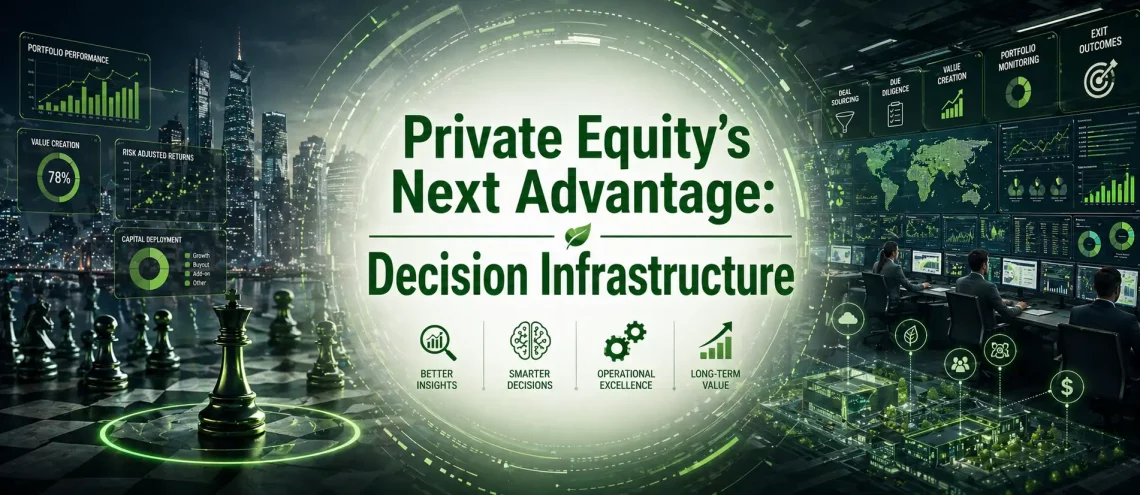
Why the next competitive edge in private equity will come from always-on intelligence systems, not more tools.
Executive Summary
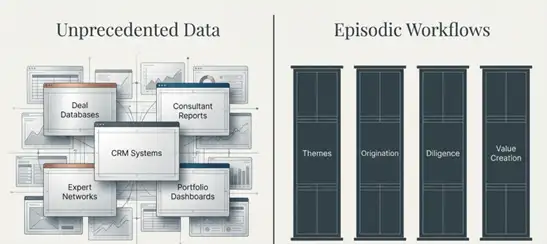
Private equity firms today have access to unprecedented amounts of data—CRM systems, deal databases, consultants, expert networks, and portfolio dashboards. Yet investment decisions are still built through episodic workflows:
- Themes refreshed annually
- Origination driven by relationships
- Diligence compressed into short sprints
- Value creation managed through dashboards
Each stage relies on different datasets and teams. Institutional knowledge is rebuilt deal by deal. The next competitive advantage in private equity will not come from additional tools. It will come from Decision Infrastructure—an always-on intelligence layer spanning:
Theme Creation → Origination → Diligence → Value Creation → Exit
Firms that institutionalize this architecture through a Private Equity Analytics Platform will compound information advantage across deals, funds, and portfolios.
The Structural Problem: Fragmented Intelligence
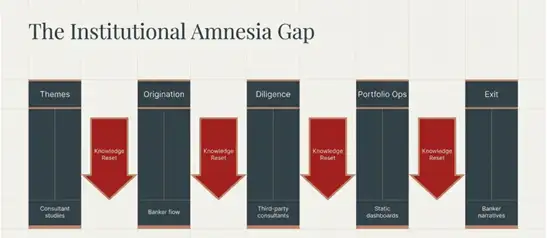
The absence of a unified Private Equity Analytics Platform means most firms operate with fragmented, disconnected intelligence sources across every deal stage. So, private equity firms do not lack data; they lack integration.
Most firms operate with:
- Themes — Consultant studies, sector reports
- Origination — Relationships, banker flow
- Diligence — Third-party consultants
- Value Creation — Portfolio dashboards
- Exit — Banker narratives
These systems rarely connect. This creates structural inefficiencies:
- Missed proprietary opportunities
- Reactive pricing decisions
- Incomplete diligence signals
- Under-optimized assets
- Limited cross-portfolio intelligence
In effect, the firm restarts its knowledge every time a deal begins.
The Shift: Decision Infrastructure
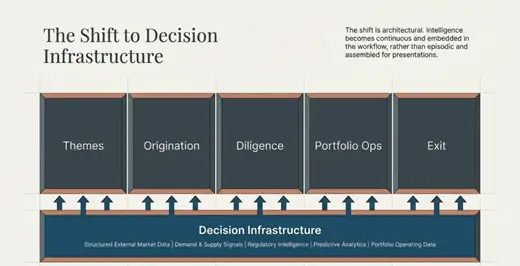
Forward-thinking private equity firms are beginning to implement decision infrastructure – essentially a Private Equity Analytics Platform that makes intelligence continuous rather than episodic.
Instead of episodic analysis, intelligence becomes continuous. The infrastructure integrates:
- Structured external market data
- Demand and supply signals
- Regulatory and permitting intelligence
- M&A activity and valuations
- Portfolio operating data
- Predictive analytics
The shift is architectural. Information becomes embedded in the workflow rather than assembled for presentations.
How Decision Infrastructure Changes the PE Lifecycle
1. Continuous Theme Development
Traditional theme development is periodic. Decision infrastructure enables real-time monitoring of:
- Subsegment demand
- Infrastructure capacity
- Regulatory developments
- Competitive density
- Capital flows
Themes evolve from static hypotheses into continuously validated investment theses.
Impact:
- Earlier identification of emerging sectors
- Faster conviction on adjacencies
- Stronger sourcing focus
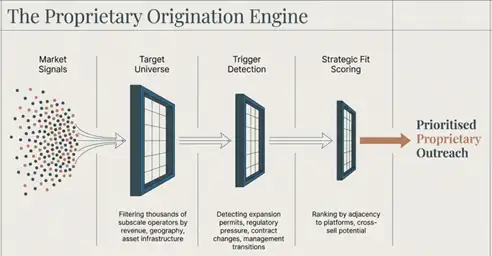
2. Systematic Proprietary Origination
Most firms want proprietary deal flow. Few institutionalize it. With a structured intelligence infrastructure, firms can:
- Monitor thousands of subscale operators
- Detect expansion permits and capex signals
- Map adjacency fit to portfolio companies
- Rank targets based on strategic alignment
With a Private Equity Analytics Platform, origination becomes anticipatory rather than reactive.
3. Forward-Looking Diligence
Traditional diligence validates history. Decision infrastructure models the future. By combining external signals with operating data, firms can:
- Stress-test pricing assumptions
- Analyze demand-supply dynamics
- Benchmark customer profitability
- Identify cross-sell opportunities
Diligence becomes predictive rather than confirmatory.
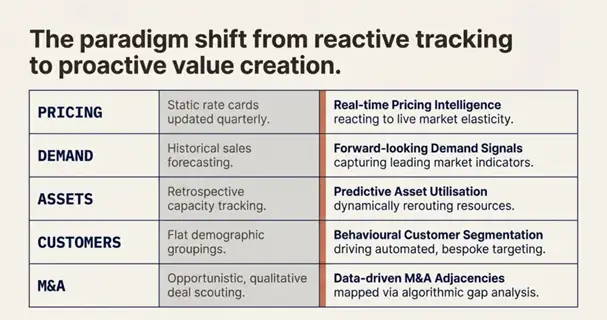
4. Revenue Intelligence in Portfolio Companies
The greatest impact occurs during ownership. Instead of static dashboards, firms deploy systems that enable:
- Localized pricing optimization
- Customer segmentation
- Asset utilization analysis
- Cost-to-serve modeling
- Add-on acquisition targeting
In one environmental services platform, a localized pricing system increased expected pricing uplift from 7% to 10% in a single metropolitan market. That improvement translated directly into EBITDA expansion. This was not a consulting study.
It was embedded intelligence driving operational decisions.
Intelligence Compounds Across the Portfolio
Most PE firms operate portfolio companies independently. Decision infrastructure allows intelligence to compound across assets.
Examples:
- Shared regulatory monitoring
- Shared supplier leverage
- Cross-portfolio adjacency mapping
- Demand forecasting
The firm evolves from owning assets to operating an intelligence network. Over time, this knowledge compounds.
Strategic Implications for PE Leaders
Private equity leaders should begin asking three questions:
- Do we have continuous visibility into our investment themes?
- Are we systematically detecting market signals before competitors?
- Is intelligence compounding across our portfolio?
If the answer to these questions is no, the firm is still operating in an episodic model. And episodic intelligence struggles to compete with continuous systems.
Firms that invest in a Private Equity Analytics Platform today will compound their information advantage across every deal, fund, and portfolio for years to come.