
Transaction value turns disproportionately on what was agreed, what is intended and what people are capable of — and none of it is written down anywhere a model can read. The risk is not that AI misses these questions. It is that it answers them anyway, with no signal that it has run out of evidence. This is where our evidence stops, why, and what should take over.
The dangerous answer is the fluent one
Every firm selling analytical capability into M&A — ours included — has an incentive to describe what its system can do and say nothing about what it cannot. The category is saturated with the first kind of claim. This piece is the second kind: a precise account of where records, and the models built on them, stop being evidence.
The failure mode is not the one people expect. AI rarely fails in diligence by returning nothing. It fails by returning something — a renewal probability, a switching risk, a read on management — assembled from adjacent data and delivered in the same tone as a verified fact. McKinsey’s comparison of LLM-generated research against expert-interview reports found the generated output more optimistic in seven of ten industries, and roughly 40% of the important data points surfaced by experts absent from the LLM answers and unrecoverable by further prompting. The missing items were not obscure. They included contract structures, unit economics and regulatory hurdles: the variables a deal is priced on.
AI does not fail in diligence by answering badly. It fails by answering at all — fluently, completely, and in the same voice it uses when it is right.
Records show what happened. Value turns on what was agreed, intended and believed
The industry graph at the center of this series is built from records: permits, manifests, filings, transactions, facility data. Records are behavior, observed after the fact. They are very good at establishing what exists, where, at what scale, and who has served whom. They are structurally silent on three things: what parties agreed privately, what they intend to do next, and what the people running a business are actually capable of.
Consider a chemical plant that has shipped spent solvent to the same receiving facility, through the same transporter, for six years. The graph can show all of it: volumes, frequency, routing, the competing facilities within haul radius. It cannot show that the plant’s new owner has put the contract out to tender, or that its environmental manager is costing on-site recovery. Either fact takes the account’s value to zero within two years. Neither appears in any record until after it has happened.
No better model closes that gap. A model reasoning over records inherits the boundary of the records; a model reasoning over the open web inherits a worse one, plus everything the web says that is not true. Exhibit 1 sets out six questions that routinely decide value in environmental services transactions, and exactly where the evidence stops on each.
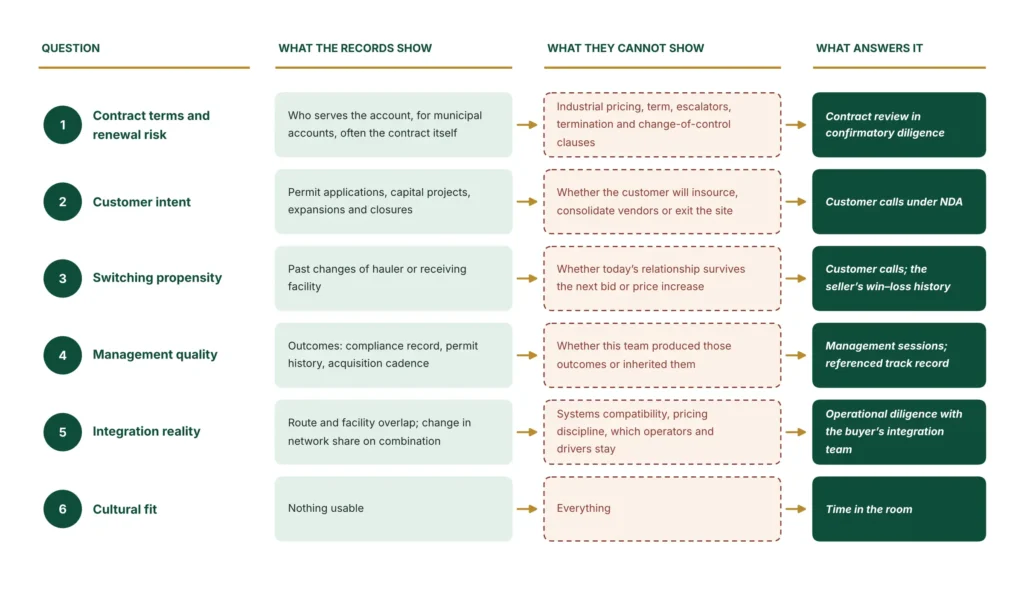
EXHIBIT 1: Six questions that move value and the point at which records stop answering them. Source: Espalier. Records include permits, regulatory manifests, facility filings, and transaction data.
Inference is most dangerous where it is most plausible
Inside the hard boundary sits a softer one: places where the data invites a conclusion it cannot support. These are the failure modes we design against, and each of them looks like rigor from the outside.
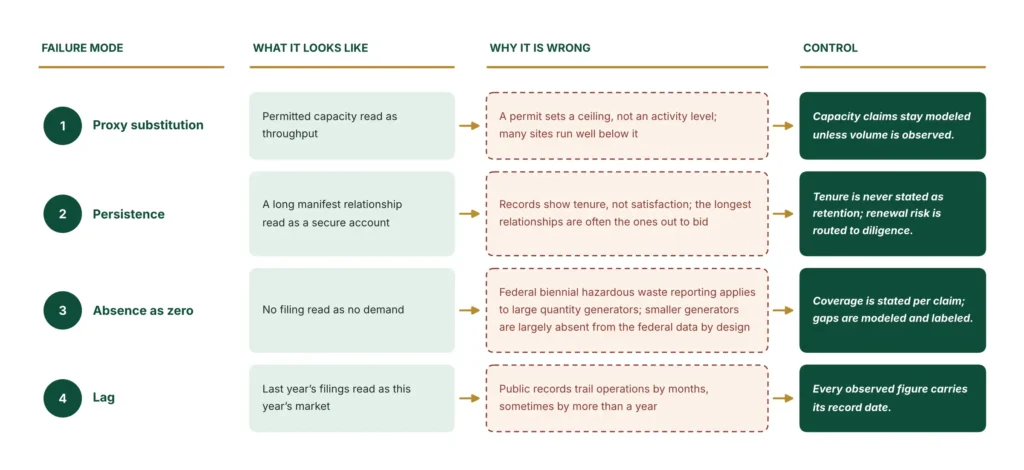
EXHIBIT 2: Four ways a record-based build overreaches and the control that stops each one. Source: Espalier; US EPA, RCRA biennial reporting requirements (40 CFR 262.41).
The common thread is that each error converts a property of the reporting regime into a claim about the market. A model will make that conversion every time unless the system forbids it, because the converted claim is always the more complete-looking answer.
A missing record tells you about the reporting threshold, not about the market. Treat it as zero and the build looks most complete exactly where it is weakest.
Coverage is incomplete by design. Publish where, and by how much
No record-based build covers a market completely, and any build that implies otherwise should be discounted on that basis alone. Reporting thresholds, state-by-state variation in what is filed, and private-pay streams with no regulatory footprint all leave holes that are structural, not accidental.
The response is not to paper over them. It is to make coverage a stated property of every claim. Each assertion carries a confidence tier — Observed where the record set supports it directly, Modeled where it is extended under published assumptions, Strategic where it rests on judgment — and the share of the denominator that sits in each. A network share figure that is 80% Observed is a different claim from one that is 80% Modeled, even when the headline is identical. A buyer is entitled to know which one they are being shown.
Where a gap is material, the build also names what would close it: a state records request, a structured sample of customer calls, the seller’s own invoice data released in confirmatory diligence. A gap with a named remedy is a diligence item with a cost and a date. A gap without one is a discount, applied by the buyer at a number the seller never sees.
The questions in Exhibit 1 need a status of their own
Confidence tiering covers claims the evidence can carry at some level of confidence. The questions in Exhibit 1 cannot be carried at any. We mark them Outside the record: material to value, unanswerable from data, and routed by name to the instrument that can answer them. That status completes the division of labor.
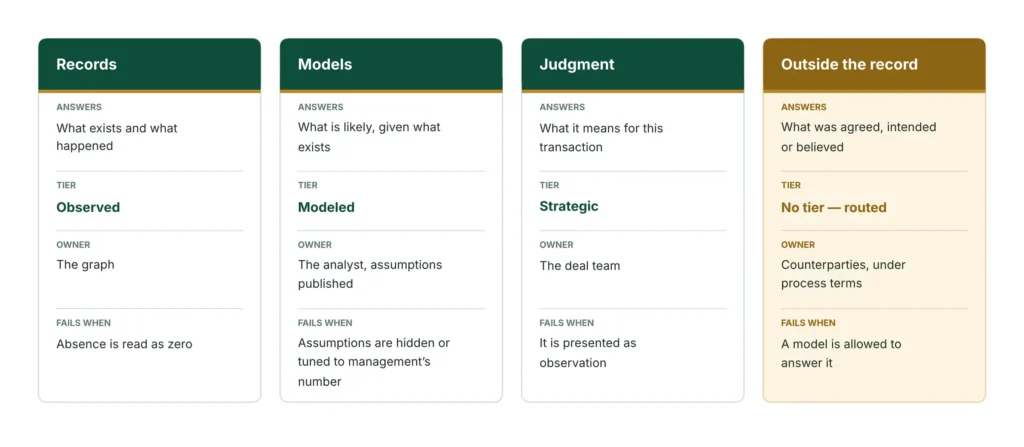
EXHIBIT 3: Each instrument answers one kind of question and fails in a predictable way when asked another. Source: Espalier. Tier definitions as introduced in Piece 3 of this series.
The rule the exhibit enforces is simple: no question moves to a cheaper instrument than the one that can answer it. AI belongs heavily in the first two columns — resolving entities, reading filings at scale, running the models. It has no role in the last column, however well it writes.
The boundary page belongs in the book, beside the reconciliation page
In the sell-side framework, the reconciliation page shows where the bottom-up build diverges from management’s forecast, proving the system can produce an inconvenient answer. The boundary page is its counterpart: one page in the evidence book listing every material question the evidence cannot settle, why it cannot, and where in the process it will be answered.
Each entry carries four fields: the question, the value it puts at stake, the reason the record set cannot reach it, and the process phase and instrument that will. The page is deliberately short. If the list of material unknowns runs long, the evidence base is not ready for market, and the page has done its job by saying so before a buyer does.
It does three things for a seller. It pre-empts the buyer’s analyst, who will find the gaps regardless and price them silently if the seller has not named them. It points the buyer’s diligence budget at the questions in Exhibit 1 rather than at rebuilding the market. And it makes every claim the book does make more credible, because the reader can see the system was prepared to say no.
The reconciliation page proves the build can disagree with management. The boundary page proves it can disagree with itself.
A firm that cannot state its limits should not be trusted with its claims
A buyer pricing a case cannot audit everything. They extend trust to a source in proportion to how precisely it has described its own reliability. A source that marks nothing as uncertain is asking for every claim to be priced at the confidence of its weakest one — and a careful buyer will do exactly that.
This piece sits where it does in the series for that reason. Before arguing what complete evidence makes possible, we want the reader to know exactly where it ends — and to hold every later piece to the boundary drawn here.
THE ESPALIER VIEW
Records can tell a buyer what a business is. They cannot tell a buyer what it has promised, what its customers intend or what its people can do. We mark that boundary on every claim, publish it on its own page, and route what lies beyond it to the people who can answer. Anything less is a model talking past its evidence.