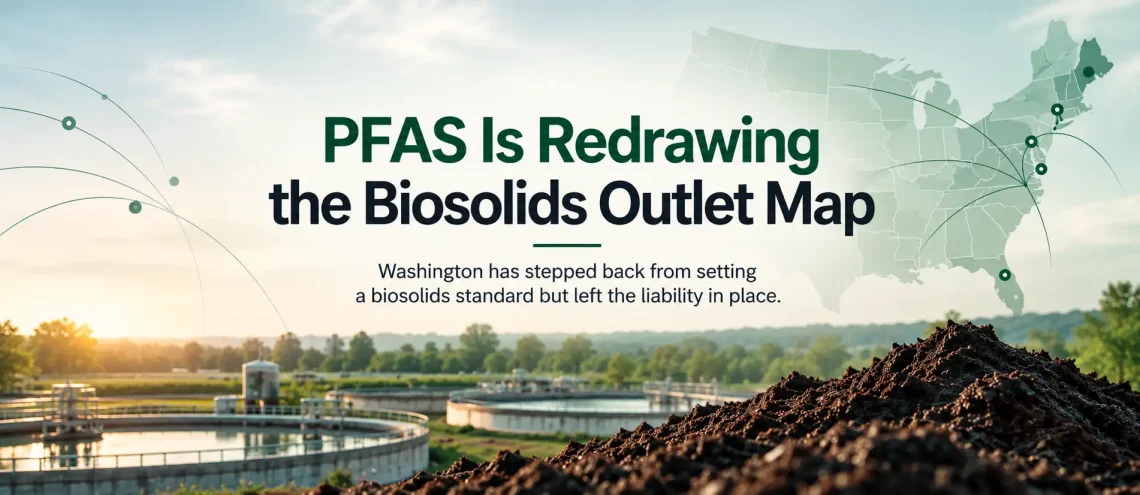
Washington has stepped back from setting a biosolids standard but left the liability in place. States, landfills, farmers and courts are now closing outlets on their own timetables — and their deadlines converge in 2028. The question is no longer how much material a platform handles, but how many places it can still send it.
THE OUTLET MAP, IN FOUR NUMBERS
- 59.5% : share of U.S. sewage sludge land-applied in 2024 (EPA). The largest outlet is also the most exposed.
- 35% : share of Virginia’s land-applied sludge that came from out of state, almost all from Maryland and D.C.
- ~90% : share of Maine’s sludge going to one landfill since its 2022 ban; one district’s tip fee rose from $80 to $120–170 a ton.
- 2028 : the year Florida’s Class AA requirement, Maryland’s 50 ppb prohibition and Maine’s landfill capacity limit all arrive.
IN BRIEF
- Federal retreat, federal liability: No national limit, but the CERCLA designation stands so every receiver now prices PFAS risk for itself.
- Outlets rarely close by ban: Acceptance limits, farmer withdrawal and litigation give far less warning than statutes.
- The binding rule is often a neighbor’s: Virginia’s limits reach Maryland’s sludge fifteen months before Maryland’s own.
- 2028 is the convergence year, and contracts signed today run straight through it.
- Underwrite placement, not tonnage: Seven measurable dimensions separate durable platforms from fragile ones.
1. Washington has withdrawn the rulebook but left the liability
EPA’s July 2026 draft guidance on PFOA and PFOS in biosolids sets no concentration limit, carries no force of law, and replaces the January 2025 draft risk assessment the agency now calls flawed. Its comment period was extended to October 5, 2026. In August, EPA also rescinded its 2022 memo on addressing PFAS in wastewater permits.
Liability moved the other way. On August 18, 2026, the D.C. Circuit upheld EPA’s designation of PFOA and PFOS as CERCLA hazardous substances, preserving strict, joint and several, retroactive liability. EPA’s protection for passive receivers such as utilities remains a policy, not a statute, and utility groups are still asking Congress for a fix. Industry petitioners had until October 2 to seek rehearing; for now, the designation stands nationwide.
A federal number would have told landfills, farmers and neighboring states what acceptable material looks like. Without one, and with liability intact, each sets that line privately. The effect is not deregulation. It is regulation by the receiving gate.
2. Outlets rarely close by ban — they close by acceptance
Statutes are the most visible way an outlet narrows and the most forgiving: the three enacted this year give 15 to 30 months of notice. The other mechanisms give far less, and all are operating now.
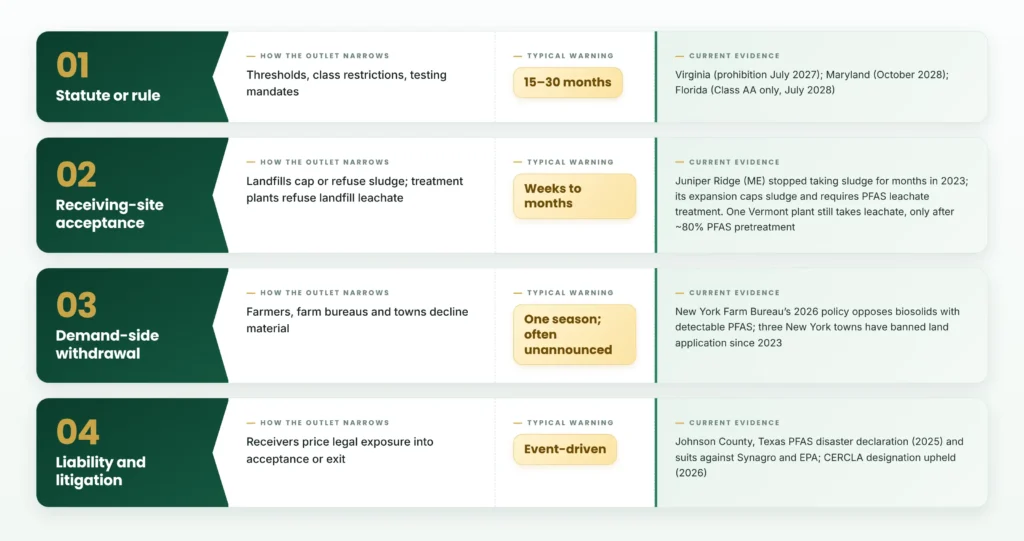
The landfill mechanism is circular. Landfills that take sludge generate PFAS-bearing leachate, which treatment plants receive and send back out in their own sludge. As plants refuse or condition leachate, the landfill outlet gets costlier and its appetite for wet sludge falls. Maine has now made PFAS leachate treatment a condition of expanding its largest landfill, and EPA has signaled that federal leachate effluent guidelines could follow in 2027. An outlet’s durability depends on the outlet’s own outlets — and diligence that stops at the landfill gate misses half the chain.
3. The binding constraint is often in a neighbor’s statute book
Maryland generates about 600,000 wet tons of sludge a year and hauls roughly 56% out of state, mainly to Virginia and Pennsylvania. Virginia’s 2026 law applies its monthly testing and 50 ppb prohibition to out-of-state suppliers. For a Maryland utility spreading in Virginia, the operative deadline is therefore July 2027, not Maryland’s October 2028. Seen from the other bank of the Potomac, a Potomac Riverkeeper Network study found that 35% of the sludge land-applied in Virginia came from out of state. The receiving state’s rule bites first because it is enforced at the point of placement.
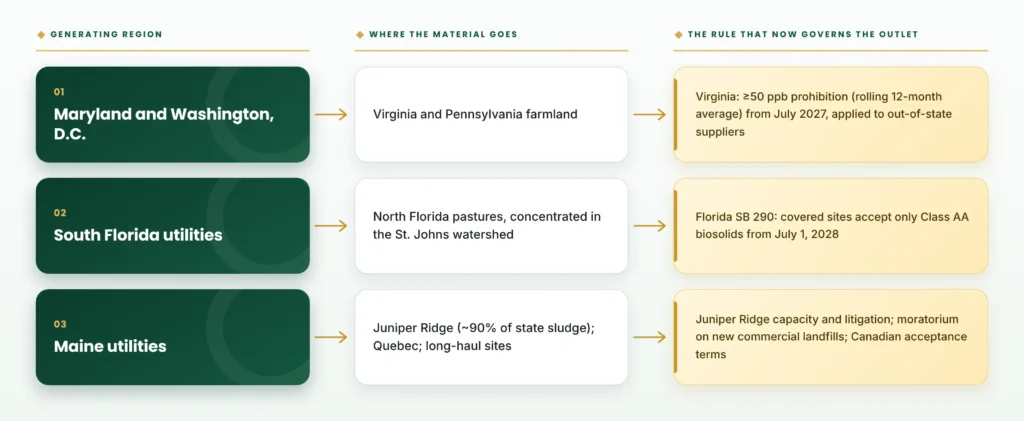
The same pattern runs elsewhere: South Florida’s Class B sludge has long gone to North Florida pastures that close to it in 2028, and Sanford, Maine already hauls its biosolids more than 140 miles. A generator’s outlet-risk register must therefore track every legislature its material reaches, not just its own. Harmonization cuts both ways: Maryland and Virginia aligned at 50 ppb, which eases compliance but compresses the cross-border routing arbitrage we described in August. That value now survives mainly at the seams between corridors.
4. 2028 is the convergence year
Florida, which produces about 340,000 dry tons a year, restricts covered land-application sites to Class AA material from July 2028. Maryland’s prohibition starts that October. Juniper Ridge fills around 2028 unless its expansion — approved twice and challenged again by the Penobscot Nation — proceeds. Much of the replacement capacity — Sedron’s Indiantown facility in Florida, York Sewer District’s supercritical water oxidation pilot in Maine — is scheduled for the same year. Taken one at a time, each deadline looks manageable; plotted together, they cluster.
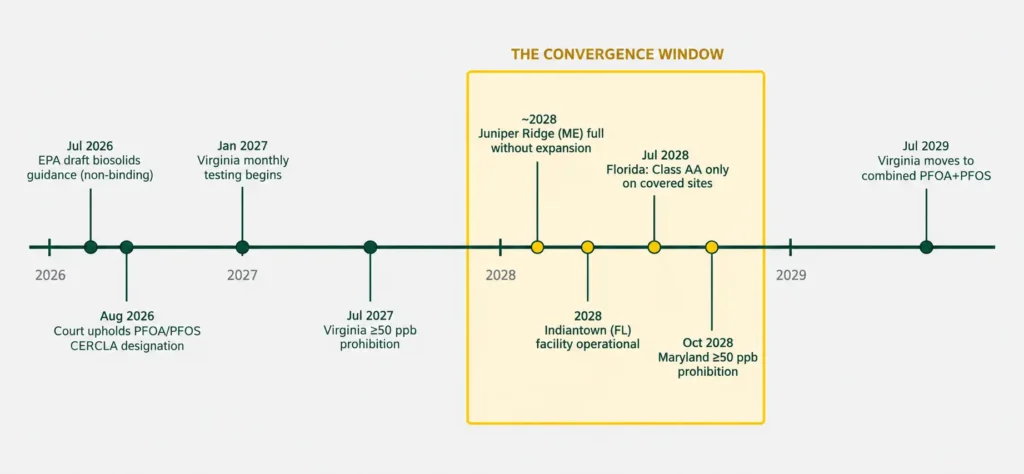
creates procurement crowding, as utilities in several states seek capacity at once; contract exposure, as agreements priced on 2026 costs cross the window without change-in-law pass-through; and concentrated execution risk, since one slipped project leaves little slack elsewhere. A five- or ten-year municipal agreement signed this year will live through all three.
5. Losing an outlet multiplies cost — but the curve can bend back
When an outlet closes, tonnage reroutes and the remaining outlet sets the price. A Brunswick, Maine district saw landfill costs rise from about $80 a ton to $120–170. Some Michigan utilities went from about $20 to $120 per wet ton after the state’s PFAS strategy took hold. Across utilities surveyed by CDM Smith with NACWA, WEF and NEBRA, PFAS policy raised average management costs by about 37%, with some facilities seeing costs double or more. The Brunswick district’s general manager’s advice to other states: “Expect a ban to be coming one way or another.”
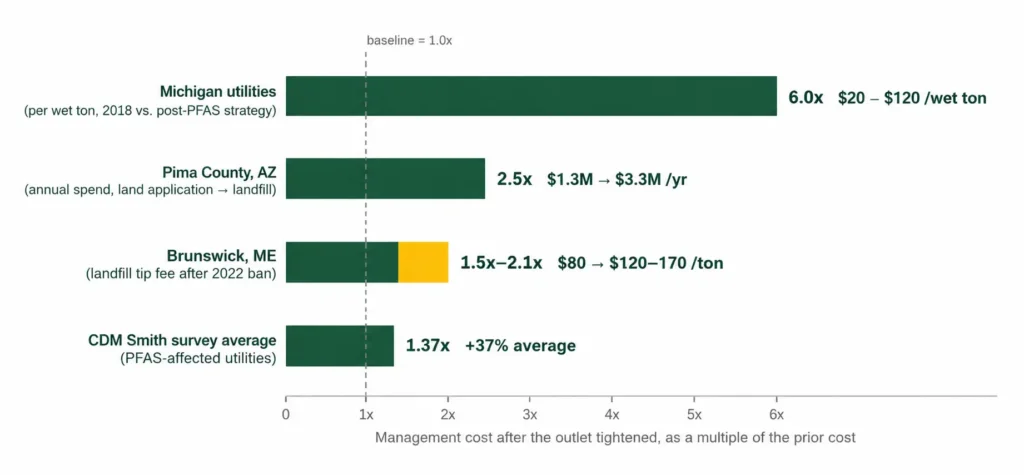
Pima County, Arizona shows the reverse. A 2020 moratorium raised its annual cost from $1.3 million to $3.3 million; site testing with the University of Arizona found low PFAS levels, and the moratorium was rescinded. Maine’s own 2024 waste plan contemplates a cautious return to land application if PFAS-destruction technology matures. Site-level evidence is an option on reopening the cheapest outlet — which makes source tracking a strategic asset rather than a compliance cost.
6. Replacement capacity is late, lumpy and contested
Capital is arriving — Ara Partners has committed up to $500 million to Sedron — but delivery is uneven. Maine’s Crossroads dryer slipped from 2025 into 2026. The Aries gasifier proposed for Sanford is in contested review, and the company’s New Jersey plant was idled in 2025. Utilities are responding by building their own: Portland Water District is studying digestion, drying and pyrolysis, and Orlando is commissioning a plant-scale dryer. On destruction, a 2025 UK Environment Agency review found high-temperature incineration is still the only proven large-scale method, and new incinerators are hard to permit. During the gap between closure and replacement, value transfers to whoever holds permitted capacity.
Martin County, Florida moved early. In January 2026 it approved a 10-year contract with Synagro for transport and processing at Sedron’s Indiantown facility, due in 2028, with no upfront county capital. Florida’s Class AA bill was then moving through the legislature. We don’t claim it drove the decision, but the sequencing is the lesson: the county secured capacity while it was being sold to anchor customers, not rationed among late arrivals. Expect this capacity-for-commitment model to recur.
7. For investors: underwrite placement, not tonnage
Volume, contracts and route density describe a platform’s size, not its durability. The diagnostic below turns outlet resilience into questions diligence can answer with data.’
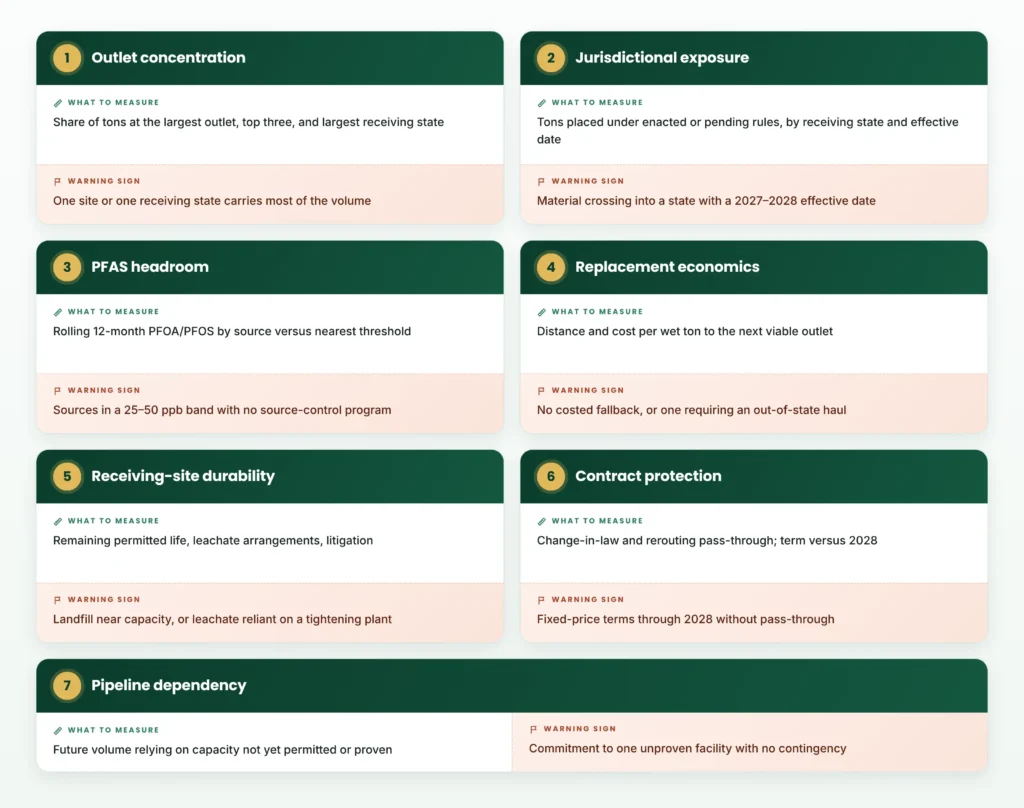
The same lens applies to consolidation. Synagro has added land-application networks through its acquisitions of Dahm Enterprises in Illinois and Wisconsin and Nutri-Blend in Virginia and Washington, D.C. We make no judgment on those deals; the point is analytical. The value of an acquired land-application network is now partly a function of the receiving state’s threshold and the PFAS profile of its sources — and neither shows up in a tonnage count.
THE ESPALIER VIEW
“Outlet resilience” sounds like a narrative. It is a measurement, built from public records: biosolids annual reports, state permits, landfill capacity filings, leachate arrangements and legislative calendars. Espalier’s industry graph links each generator to its outlets and each outlet to the rules and capacity that govern it — turning placement capacity into a score before capital commits, and re-scoring it when a neighboring legislature moves.
THE BOTTOM LINE
PFAS is not reducing how much sludge America produces. It is reducing the places that sludge can go — through acceptance limits, neighbors’ statutes and courtrooms as much as bans. With deadlines converging in 2028, the winners will be those who count the doors before the next one closes.