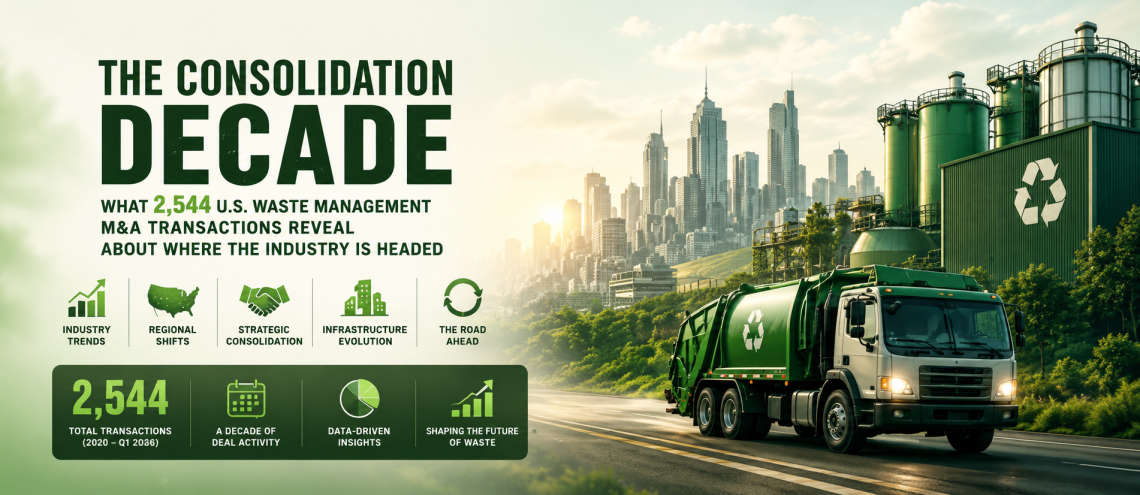
What 2,544 U.S. Waste Management M&A Transactions Reveal About Where the Industry Is Headed
The U.S. waste management industry has been one of the most active M&A arenas in American business over the past six years. Between 2020 and Q1 2026, 2,544 transactions were completed across the full spectrum of waste management — from municipal solid waste and hazardous materials to liquid waste, food waste, and specialty environmental services.
That volume is not accidental. It reflects a sector mid-transformation, driven by capital availability, regulatory pressure, demographic tailwinds, and the logic of scale in a historically fragmented industry. The dealmakers at the top of the league tables are not simply buying revenue — they are assembling infrastructure systems.
Understanding the M&A patterns of 2020–2026 is, in large part, understanding where the industry is going.
This article draws on Espalier’s proprietary transaction dataset — the most comprehensive tracking of U.S. waste management M&A available — to examine the forces shaping deal activity, the strategic logic of the most active acquirers, and what the next phase of consolidation will look like.
The Volume Story: An Industry That Did Not Slow Down
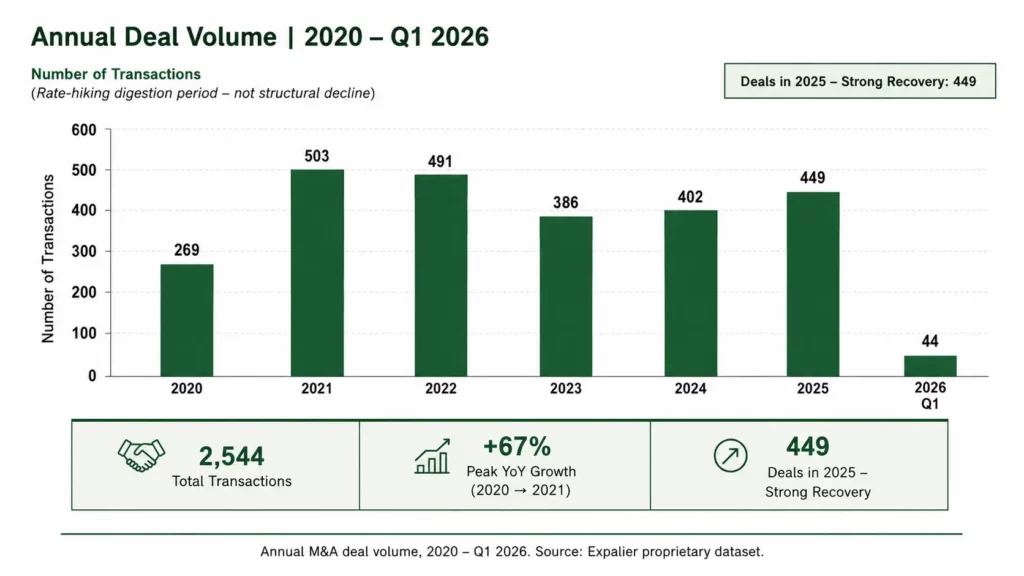
At the aggregate level, the data tells a story of sustained, high-intensity deal activity interrupted by a single-year digestion period — not a structural decline.
Deal volume rose sharply from 269 transactions in 2020 to a peak of 503 in 2021 — a 67 percent increase driven by pent-up demand from the pandemic pause, historically low interest rates, and significant PE capital deployed at scale. 2022 held near that peak at 491 deals. The rate-hiking cycle of 2023 produced a pullback to 386 transactions, the only year of genuine deceleration.
But the industry found its footing quickly: volume recovered to 402 in 2024, and 2025 returned to 449 deals, signaling the consolidation logic remains intact as financing has normalized.
The waste sector does not behave like a cyclical industry in M&A terms. It behaves like an infrastructure-assembly market — steady, directional, and compounding.
Investors and operators who interpret the 2023 dip as a cooling thesis are reading it wrong. The thesis — fragmented local markets, aging owner-operators, compelling unit economics at scale — has not changed. What changed temporarily was the cost of capital.
The Strategic Logic: Geographic Expansion Above All Else
Behind the volume numbers lies a more revealing insight: why these deals are being done. Across the full dataset, geographic expansion or geographic strengthening is the primary deal rationale for 52 percent of all transactions — more than 1,300 deals in six years. No other single rationale comes close. Services expansion accounts for 13 percent, investor buyouts for 11 percent, and technical expertise, customer access, vertical integration, and scale synergies together account for less than 10 percent.
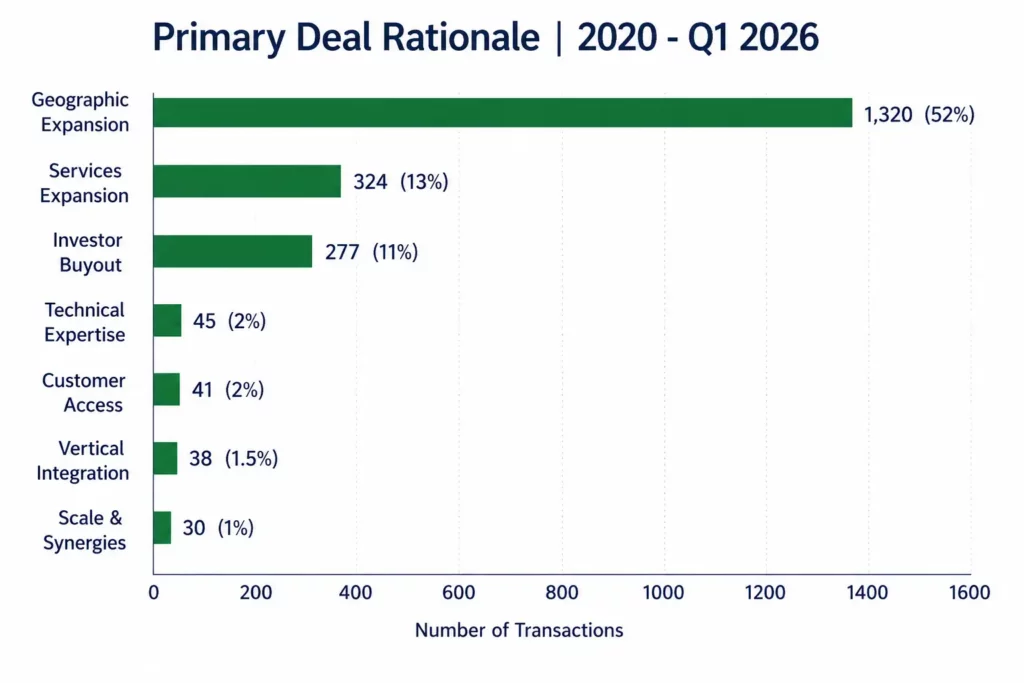
The dominant competitive strategy in U.S. waste management is not product differentiation, technology deployment, or vertical integration. It is geographic density — the disciplined, sequential acquisition of local operators to build defensible regional networks too expensive and operationally complex to replicate from scratch.
This mirrors the logic that built the large publicly traded waste companies over prior decades. What is different now is that the model has been adopted at scale by mid-market private equity and by a new generation of regional operators executing the same playbook in markets the national platforms have not fully penetrated.
The industry is not converging toward a handful of national players. It is consolidating into a tiered structure of regional networks — some PE-backed, some corporate — each defending distinct geographic positions.
The Buyer Landscape: Corporates Lead, PE Deepens
Corporate acquirers account for 55 percent of all acquirer participations, with PE/buyout firms representing 30 percent. At the top of the corporate league table, GFL Environmental leads all acquirers with 86 transaction participations — a reflection of the company’s aggressive North American roll-up strategy. Waste Connections (56 deals) and Republic Services (55 deals) follow closely. Lakeshore Recycling Systems (41), Wind River Environmental (38), and Waste Pro (38) round out a tier of highly active regional consolidators.
The PE landscape is anchored by Kinderhook Industries, which leads all financial sponsors with 73 transaction participations — a remarkable number reflecting a deliberate, high-frequency platform-build strategy. Gryphon Investors (39), Warren Equity Partners (29), Platinum Equity (24), and Aurora Capital Group (23) complete a group that has made waste and environmental services a genuine institutional priority.

What makes PE activity particularly notable is its durability. Investor-led buyouts held between 43 and 60 deals per year from 2020 through 2025, even as broader deal markets contracted. Platform strategies — acquiring a foundational business and building density through tuck-ins — proved resilient because the underlying economics are driven by route density and disposal infrastructure, not leverage-dependent financial engineering.
The PE firms that have stayed active through the cycle are not simply financial buyers. They are building infrastructure companies.
The Sub-Sector Breakdown: Non-Hazardous Dominates, but Complexity Plays Are Growing
Non-hazardous waste management is, by volume, the engine of M&A activity — accounting for 54 percent of all deals, or roughly 1,372 transactions. The economics of scale are well understood: denser routes, owned transfer stations and landfills, bundled service contracts. The consolidation logic is straightforward and the transaction velocity reflects it.
But the more strategically interesting story is in the adjacent segments. Liquid waste services — septic pumping, grease trap cleaning, hydrovac excavation, sewer line services — produced 551 deals, representing 22 percent of total volume. The liquid waste sub-sector is arguably the most actively consolidated specialty segment in the market, combining geographic density logic with higher service complexity, recurring commercial relationships, and a lack of national competitors. Hazardous waste services generated 468 transactions, with regulatory barriers and technical infrastructure requirements justifying durable consolidation premiums — validated by the $1.178 billion 3E Company acquisition in 2022. Food waste and FOG services represent a smaller but growing share as operators recognize the co-processing economics alongside biosolids and traditional organic streams.
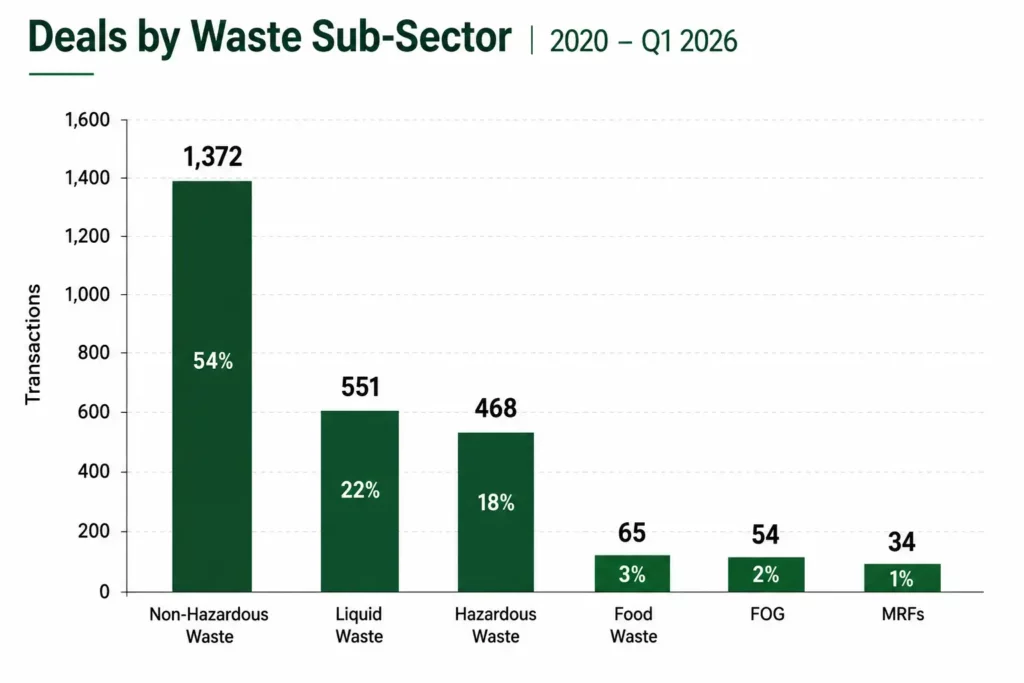
The sub-sector mix reveals an industry consolidating across multiple fronts simultaneously — each front driven by distinct economics but unified by the same underlying logic of route density and infrastructure control.
The Geography of Consolidation: South and Central Lead, but the Northeast Is Resurging
The Southeast leads all regions with 701 target acquisitions — driven by population growth, business formation, and fragmentation in states like Florida, Georgia, Tennessee, North Carolina, and South Carolina. The Central region (614 deals) and South West (582 deals) follow, with Texas alone accounting for 274 target acquisitions — the single most contested state in the dataset, and nearly 50 percent more than second-ranked California.
The Northeast (515 deals) shows an important dynamic: it was the only region to show meaningful year-over-year deal growth in 2025, suggesting the next phase of consolidation in denser, more complex markets is now underway. North West markets, at just 112 target deals across six years, remain the least consolidated geography — early-mover advantage there is still available.
Eighty-eight percent of targets are classified as local players; regional players account for 8 percent; national-scale targets represent just 3 percent of deal volume. This is the structural reality of waste M&A: sophisticated, well-capitalized acquirers purchasing small, locally-rooted businesses. The real competitive moat is not deal access — it is integration at scale.
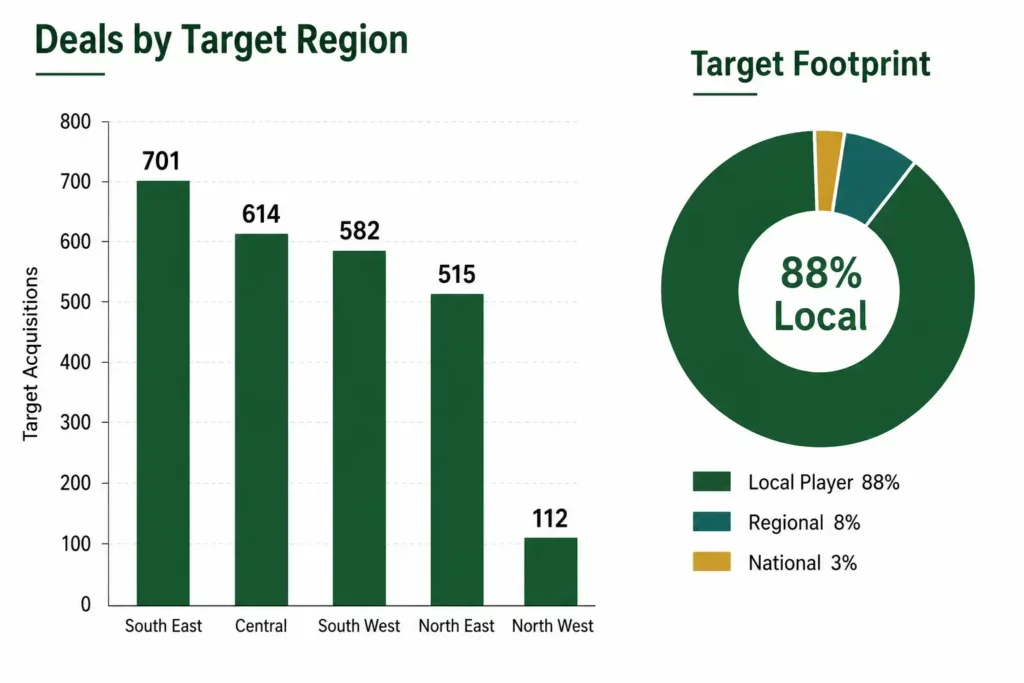
The geographic data also reveals that 43 percent of deals involve an acquirer and target in the same region, while 41 percent are cross-regional — indicating the most sophisticated acquirers are managing multi-regional build-outs simultaneously, not simply optimizing a single geography.
The Valuation Picture: A Mostly Private Market
Of 2,544 transactions, only 231 (approximately 9 percent) have disclosed deal values — reflecting the deeply private nature of the industry.
Among deals with known sizes, the distribution skews heavily toward sub-$50 million transactions, consistent with the prevalence of small local operators as targets.
At the upper end of the market, 24 transactions exceeded $1 billion in disclosed value. The largest disclosed transaction was The Carlyle Group’s $2.4 billion acquisition of 48forty Solutions in 2024, while the $1.178 billion acquisition of 3E Company in 2022 reinforced institutional appetite for scaled hazardous and EHS platforms.
The undisclosed 91 percent of deals likely represents total market value of $150 to $200 billion across the six-year period — materially larger than the disclosed aggregate.
What the Next Phase Looks Like
The 2020–2026 data establishes the foundation. But the more important question is what comes next.
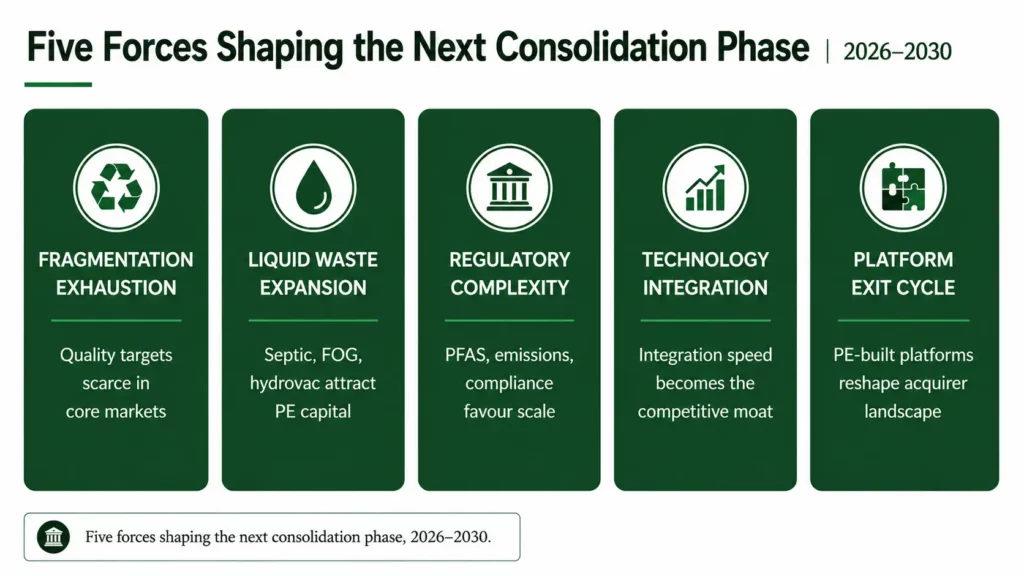
Five forces shaping the next consolidation phase.
1. Fragmentation runway is shortening in core markets
The Southeast, South West, and Central regions have absorbed significant consolidation. In the most active states — Texas, Florida, California — the supply of independent local operators is meaningfully smaller than in 2020. The Northeast, upper Midwest, and Northwest remain relatively fragmented and represent the most compelling geographic opportunities over the next three to five years.
2. Liquid waste and specialty services will attract increasing capital
Liquid waste deal activity grew from 71 transactions in 2020 to over 100 per year by 2022–2025. As the major PE platforms — Gryphon/Wind River, Kinderhook, Warren Equity — continue their build-outs and approach exit, they will catalyze a second wave of interest from larger sponsors seeking to acquire scaled platforms rather than assemble them.
Liquid waste is becoming the most compelling sub-sector in environmental services for mid-market private equity. That dynamic has further to run.
3. Regulatory complexity will drive M&A in hazardous and environmental services
PFAS standards, emerging contaminant classification, greenhouse gas emissions reporting, and extended producer responsibility frameworks are all adding compliance complexity that benefits scale. Large, diversified operators absorb compliance costs more efficiently and develop systems smaller competitors cannot replicate economically.
4. Technology integration will become a differentiator
Route optimization, asset tracking, customer management, and regulatory compliance platforms are increasingly table-stakes. More importantly, the ability to integrate acquisitions onto shared operational and data platforms determines how quickly efficiency gains can be extracted — the primary determinant of returns in a high-volume tuck-in strategy.
5. The platform exit wave will reshape the acquirer landscape
Many PE-backed platforms assembled between 2020 and 2023 will approach exit readiness between 2025 and 2028. These exits — to strategic buyers, to larger sponsors, or via public markets — will represent some of the most significant transactions in the industry’s history and will leave the acquirer landscape looking meaningfully different by decade’s end.
The consolidation decade is not over. It is entering its most consequential phase.
The Intelligence Imperative
The most successful acquirers in waste management are not simply better at identifying deals. They are better at understanding markets systematically: where fragmentation creates opportunity, which operators are approaching succession, how route density maps to profitability, and how regulatory changes will reshape competitive dynamics in specific geographies.
That kind of advantage cannot be built from periodic market research or reactive deal sourcing. It requires continuous, structured intelligence that compounds over time.
This is precisely the problem that Espalier was built to solve. Our proprietary waste management M&A database — the source of the analysis in this article — tracks transactions, acquirers, targets, geographies, deal rationales, and sub-sector dynamics in real time.
We combine transaction intelligence with broader market intelligence, regulatory monitoring, and company-level data to give operators and investors the continuous, contextual understanding the market increasingly requires.
The question for every operator and investor in this market is not whether consolidation will continue. It is whether they will be the architects of that consolidation — or be consolidated by someone who is.
Espalier is an enterprise AI company powering M&A, growth, and strategy decisions for environmental services firms, private equity investors, and investment banks. Our proprietary waste management intelligence platform tracks deal activity, market dynamics, and competitive positioning across the full U.S. environmental services landscape. Visit espalier.ai or contact our team to learn more.