Why permitted hazardous waste infrastructure is repricing into one of the most valuable asset classes in environmental services
The bottom line
The U.S. hazardous waste market is undergoing a structural repricing, not a cyclical one. For two decades, gate rates tracked the industrial cycle — volumes rose with output, fell with contraction, and capacity absorbed the swings. That mechanism is breaking. A durable gap is opening between regulatory obligation and physical treatment capacity, and it cannot be closed on any commercially relevant timeline.
Three forces drive the shift: PFAS remediation converting into permanent treatment demand; a permitting regime that prevents supply from responding; and consolidation that concentrates control of the scarce assets that remain. Together they form a self-reinforcing loop — scarcity confers pricing power, pricing power reprices the asset, and the repriced, un-buildable asset makes acquisition the only path to growth, which concentrates capacity further.
The consequences run well past disposal pricing. They reshape capital allocation, M&A, and commercial strategy across environmental services. For operators and investors, the question is no longer where are we in the cycle, but who controls the permits, and who can see the market clearly enough to use them.
PFAS rewrites the demand curve — permanently
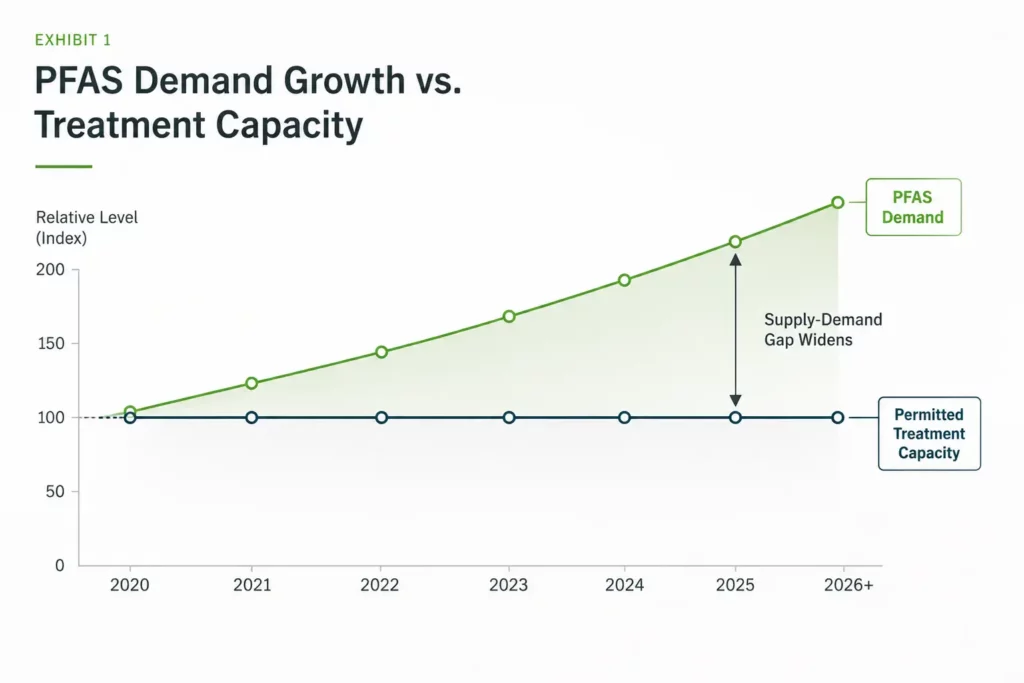
The treatment pathways are narrow. EPA’s 2026 interim guidance recognizes only a handful of routes that minimize environmental release: high-temperature thermal destruction, generally above 1,100°C; Class I underground injection at a small number of licensed wells; and lined hazardous waste landfill for certain solids. Each depends on infrastructure that already exists. Almost none is arriving soon.
The demand behind those pathways is vast and durable. The Department of Defense has identified more than 700 installations contaminated by decades of AFFF firefighting foam. In December 2025, Clean Harbors secured $110 million over three years for PFAS water filtration at a single site — Joint Base Pearl Harbor–Hickam. Municipal leachate, industrial sites, and new effluent limits represent demand layers that have barely begun to convert into disposal volume.
This is the defining feature: PFAS does not peak and normalize. Once contamination is identified, the obligation survives any downturn. The demand is durable. The infrastructure is finite. PFAS is not building a new market beside the existing one — it is competing for the same constrained capacity already serving industrial generators.
Supply cannot answer — the permitting moat
In most capital-intensive industries, sustained high returns attract entrants, capital flows in, and prices normalize. In hazardous waste, that mechanism is largely broken — by design. The binding constraint is not capital. It is the permit.
A new TSDF, incinerator, or hazardous waste landfill must clear federal RCRA permitting — a three-year minimum, including trial-burn testing and MACT compliance under 40 CFR Part 63 Subpart EEE — alongside a parallel state authorization track, air permitting, environmental-justice review, community opposition, and frequent litigation, all before committing hundreds of millions in capital. The process routinely runs five to ten years, and approval is never assured.
The evidence is in what little new supply exists. Fewer than two dozen commercial hazardous waste incinerators operate in the United States. Clean Harbors’ Kimball, Nebraska unit — the most significant new commercial capacity added in North America in years — only came online in late 2024 and is still ramping. Veolia’s roughly $300 million Gum Springs, Arkansas incinerator, originally slated for 2025, has slipped toward 2027. New supply consistently arrives years behind demand.
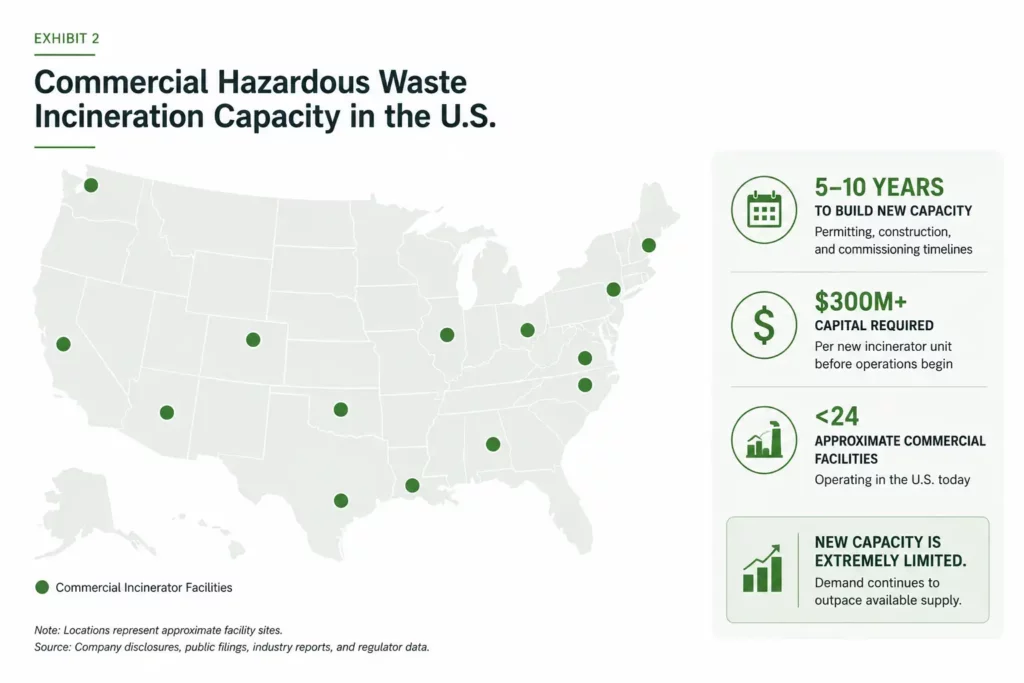
The consequence reframes how these assets should be valued. Many of the most valuable facilities operating today could not be replicated within a commercially relevant timeframe at any price. The permit matters more than the equipment.
Scarcity reprices the asset — the permit, not the equipment
When an asset cannot be reproduced, its price reflects scarcity rather than cost of construction. Hazardous waste infrastructure is now repricing accordingly.
Historically, treatment facilities were valued on throughput and EBITDA. Increasingly, the market values the embedded permit — an irreplaceable, multi-year, multi-agency entitlement that confers the economics of an infrastructure business: high barriers to entry, limited competition, recurring demand, long asset life, and durable pricing power. The discipline of the major operators makes the repricing visible. Clean Harbors, the dominant North American platform at roughly $5.9 billion in 2024 revenue and largely recurring volume, executed mid-single-digit price increases in 2025 — not during a demand spike, but as the normalized management of a constrained asset base.
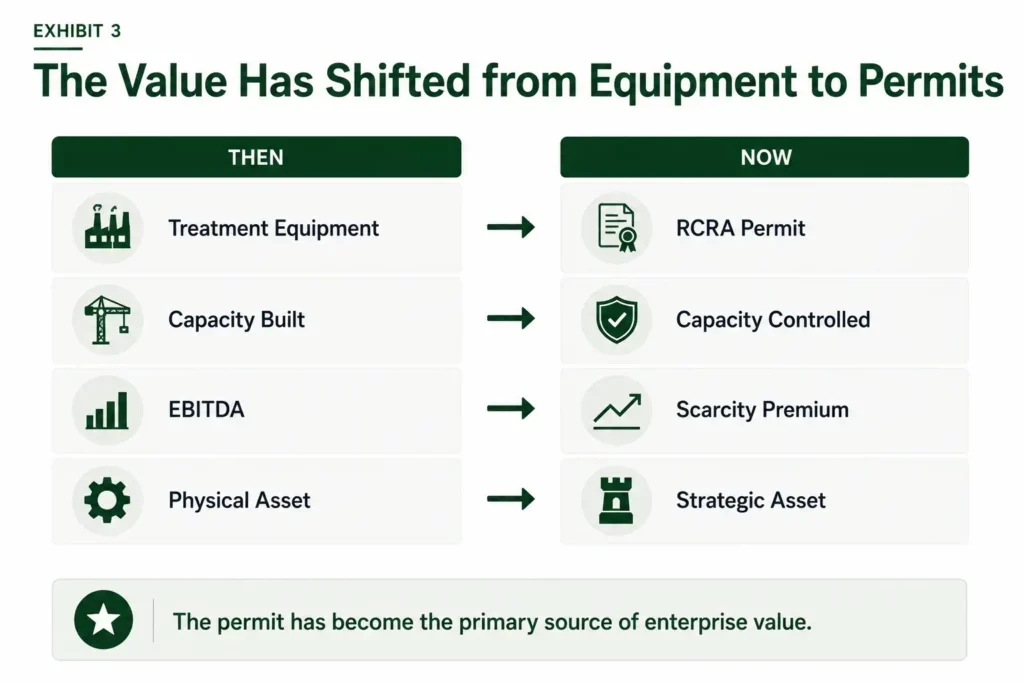
For investors, this is the value proposition rather than a risk. M&A multiples for specialty hazardous waste platforms increasingly reflect the scarcity value of permits, not just EBITDA run-rate. The moat is regulatory, geographic, and temporal — and it cannot be purchased in a single transaction, built on a short timeline, or replicated by a well-capitalized new entrant.
Acquisition becomes the only growth lever — and consolidation compounds the moat
If capacity takes a decade to permit and build, then acquiring existing capacity becomes the only practical way to grow. This is where the loop closes. Scarcity reprices the asset; the repriced, un-buildable asset forces growth through acquisition; acquisition concentrates control of scarce capacity in fewer hands; and concentrated control reinforces the pricing power that started the cycle.
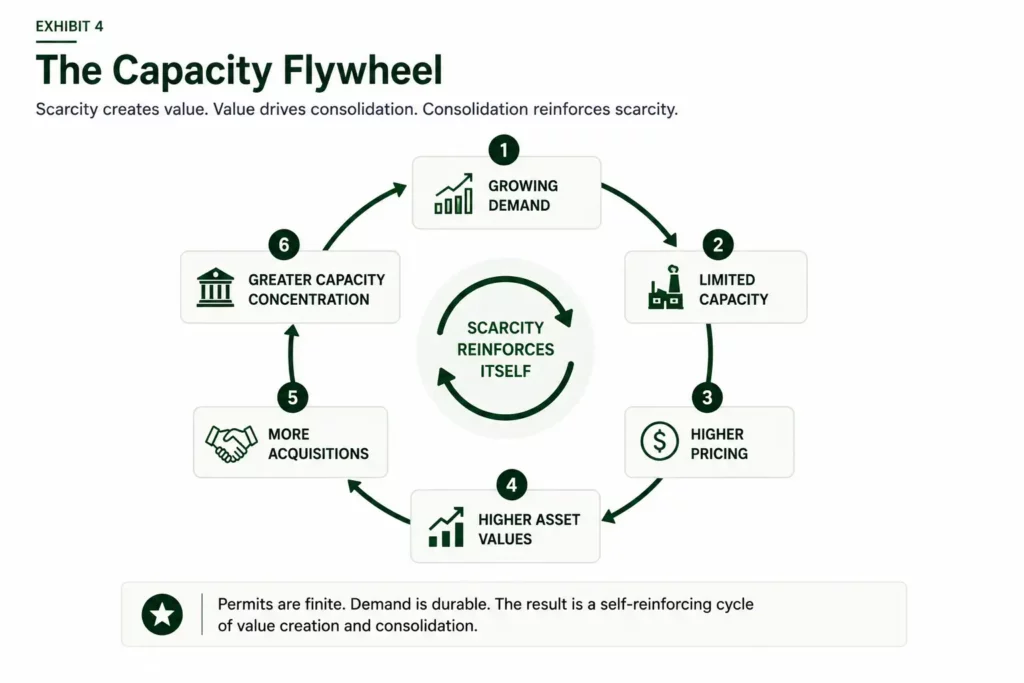
That dynamic is already visible in the most consequential relationship in the sector. In 2024, Clean Earth signed a first-of-its-kind, five-year guaranteed-access agreement for incineration capacity at Veolia’s Gum Springs facility — an explicit acknowledgment that capacity had become a strategic asset rather than a commodity. By early 2026, that arms-length relationship had become an outright acquisition: Veolia is buying Clean Earth, internalizing the very capacity the agreement had reserved. A contract to secure scarce capacity resolved into ownership of it. That is the flywheel in a single deal.
Buyers in this market are no longer acquiring EBITDA. They are acquiring permits, treatment capability, geographic coverage, customer relationships, and — above all — scarce capacity that cannot be built. As the supply-demand gap widens, the strategic value of those assets rises, and the only practical way to acquire the moat is to acquire the asset.
Winners and losers — where the value accrues
Structural shifts create beneficiaries and casualties, and this one sorts cleanly.
The value accrues to owners of permitted infrastructure — incineration, hazardous waste landfill, injection wells, and specialized treatment. They gain sustained pricing power and rising asset scarcity; their investors capture both earnings growth and asset revaluation.
The pressure falls on everyone downstream. Industrial generators face rising and less negotiable disposal costs. Municipalities confront expanding PFAS obligations against fixed budgets. Remediation contractors compete for the same constrained slots. For all of them, securing disposal access is shifting from a transactional purchase to a strategic procurement decision — reserved, contracted, and planned years in advance, exactly as Clean Earth did before its capacity partner became its acquirer.
Intelligence becomes the operating edge
Owning capacity will matter. Knowing how to deploy it will matter more. The next phase of competition will not be won on infrastructure alone — it will be won on intelligence.
The reason is concentration. Manifest data shows a market defined by a small number of high-volume accounts. In Indiana — a representative mid-tier industrial state — 354 large-quantity generators control 95.4% of regulated volume, while the remaining 2,526 registered sites, nearly 88% of the total, represent under 5%. Equivalent commercial effort against those two populations produces radically different returns. Growth therefore comes less from new logos than from wallet share within the LQG segment, competitive displacement of incumbents, and aligning permitted capability to specific waste streams.
This is the shift the sector is making: from relationship-based selling to data-driven targeting; from volume growth to margin optimization; from reactive operations to proactive capacity allocation; from static market knowledge to dynamic competitive intelligence. In a capacity-constrained market, information becomes an operating asset — and the operators who can see where demand is emerging, where capacity is constrained, and where competitors are exposed will compound their advantage faster than those relying on relationship history.
The next decade — a structural market, not a cyclical one
The capacity cliff is not a disruption the market will price through and normalize. It is a structural feature of an industry whose regulatory architecture was built for a different era — one of stable volumes, well-understood streams, and a more accommodating environment for new facilities. None of those conditions holds today, and none is returning. PFAS has created a vast new category of regulated material with minimal treatment infrastructure; Superfund, Brownfields, and industrial reshoring are activating remediation and complex chemical waste the network was never sized to serve; and permitting is not getting easier.
The implications compound. Permits become strategic assets. Capacity becomes more valuable each year. Acquisition becomes the default expansion strategy. And intelligence becomes the competitive edge.
The leaders of the next decade will not be defined by the infrastructure they own, but by how precisely they understand, allocate, and monetize it in a market where capacity is becoming permanently scarce.