A buyer discounts what cannot be checked, and checking requires that each assertion resolve to something specific — a confidence tier, an evidence section, a query, a set of records. That address space is the decision system. Without it, a CIM is a hundred and twenty claims priced on trust.
The discount is a mechanism, not a verdict
It is tempting to read a buyer’s markdown as skepticism about the business. Usually, it is nothing of the kind. The buyer has read the same CIM, met the same management team and reached broadly the same view of the company. What they lack is any means of testing the parts of the case that matter most.
A claim that can be tested gets argued about. A claim that cannot be tested gets priced. That is the whole mechanism, and it explains the feature of the process sellers find most frustrating: the discount is never raised in a meeting. There is nothing to raise. An assertion the buyer cannot verify does not generate a question — it generates a number in a model that the seller learns about only as a revised letter.
Buyers are not skeptical. They are under-instrumented. Give them an instrument other than price and they will use it.
Uncertainty does not arrive as one discount. It lands in four places
Sellers tend to think of the gap as a single number applied to the headline. Buyers do not work that way. Different kinds of doubt attach to different instruments, applied by different people at different points in the process.
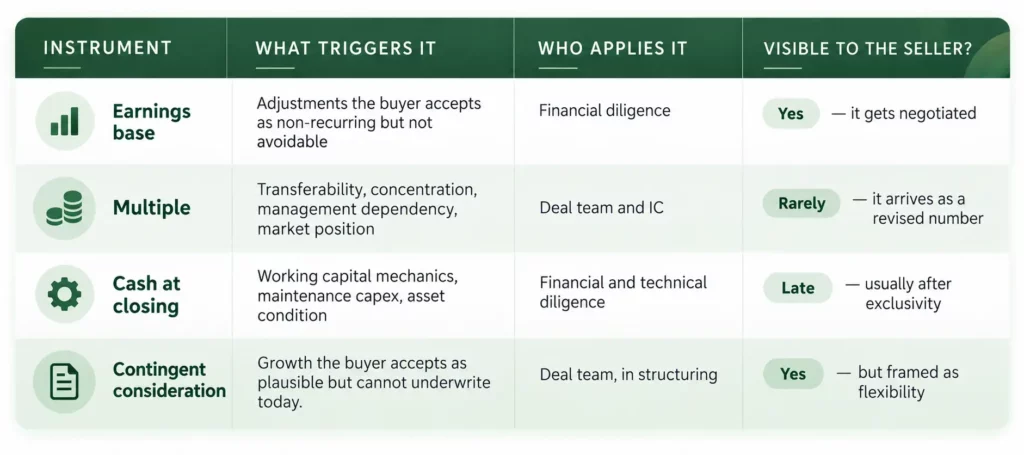
EXHIBIT 1: Four instruments, four kinds of doubt — and only one of them is ever visible to the seller: Earnouts appeared in 24% of deals in SRS Acquiom’s 2026 study of more than 2,300 private-target transactions. Structure is where unverifiable growth goes when it cannot be priced.
Each adjustment is separately defensible. Together they compound, and the compounding happens without a single fatal flaw ever being identified.
The unit of underwriting is the claim, not the document
A CIM is usually read as a narrative. It is underwritten as a list. Somewhere between a hundred and a hundred and fifty discrete assertions sit inside a typical document — about market size, share, retention, pricing headroom, contract duration, capacity, capex, win rates — and a buyer’s analyst works through them one at a time, sorting each into what can be tested and what has to be taken on trust.
That sorting is the whole of diligence, and the seller has no visibility into it. Which means the question in sell-side preparation is not whether the document is persuasive. It is whether each claim inside it resolves to anything.
A claim resolves when it carries an address: a confidence tier, a section of the evidence layer, a query against the market graph, and the record set that query returns. Four things, attached to the assertion itself rather than held in a separate appendix nobody opens. A claim with that address can be interrogated, disputed and corrected. A claim without one can only be believed or discounted, and buyers are not paid to believe.
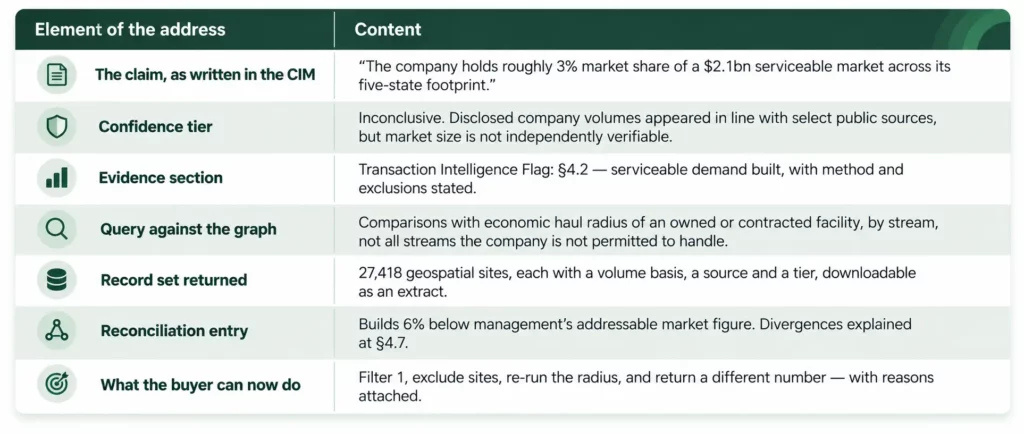
EXHIBIT 2: What an addressed claim looks like — one sentence from a CIM, resolved end to end: Structure is real; figures are illustrative. The point is that seven lines replace a sentence the buyer would otherwise have had to take on trust — and that the last line is the one that changes the price.
Note what the last row does. It does not defend the number. It hands the buyer the means to attack it, which is the opposite of what sell-side instinct suggests and considerably more valuable. A denominator that survives the buyer’s own filtering is worth more than one they were asked to accept, because they have priced it themselves.
Most claims are addressable, and the addresses sit in nameable layers
The categories buyers discount are not diffuse. Each corresponds to a specific question, and most of those questions have an observable answer in a specific layer of the graph — demand, supply, commercial, network, assets, ownership, technology, signals.
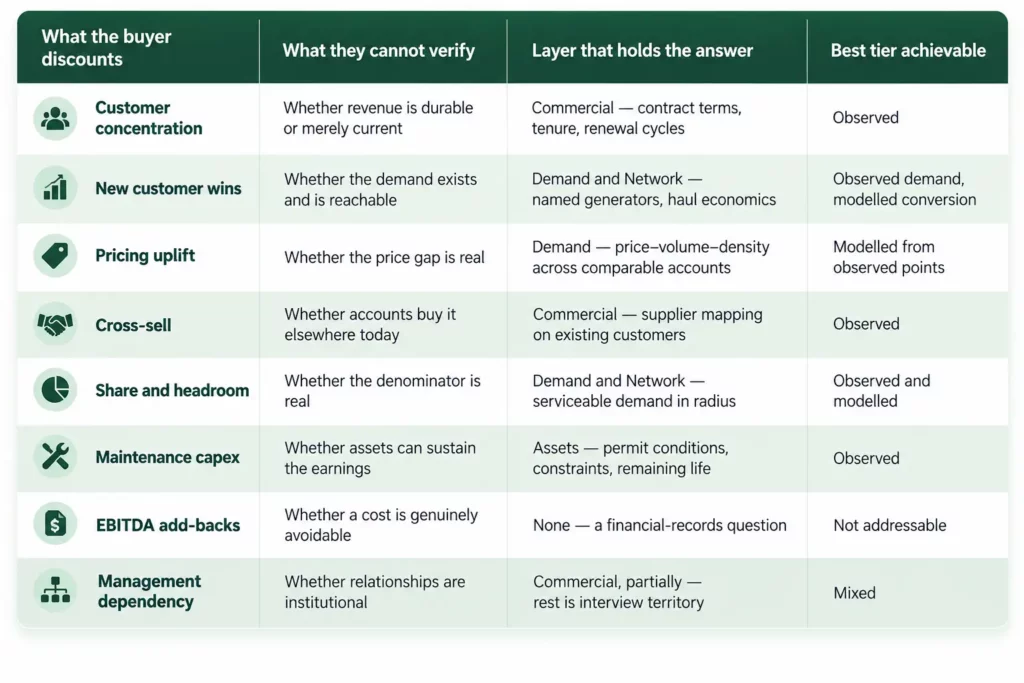
EXHIBIT 3: Most of the discount maps to evidence that exists and was not assembled: Two rows are deliberately negative. A system that claims to address every claim is being described as a product rather than a build.
The same logic explains the pattern in how buyers treat a growth bridge. They rarely reject a driver outright; they cut each line in inverse proportion to how much of it is addressable today. Existing customer growth survives nearly intact because it resolves to the company’s own trading history. Pricing and cross-sell are cut harder. New wins are cut hardest, because nothing in the document establishes that the demand exists, let alone that it is reachable. The buyer is not discounting the driver. They are discounting the tier.
Where the address space ends
Two categories resist this treatment, and a seller is better served by hearing it now than by discovering it in week six.
Add-backs are a financial-records question. Whether a restructuring cost is genuinely non-recurring, or simply this year’s version of a cost that recurs in another form, is settled in the accounts and in the buyer’s judgement about the operating model. No market evidence touches it. The narrower discipline that helps: distinguish adjustments that are economically credible from those that are merely technically defensible and drop the second category before the buyer has to.
Management dependency is half observable. Whether contracts sit with the institution or the individual is a matter of record. Whether the relationship survives the individual leaving is a matter of judgement, and it belongs in a conversation with the customer rather than in a data set.
The obvious objection: this opens the evidence layer to competitors
Any banker reading this reaches the same place. Half the bidders in a process are strategics, and the serviceable demand build is a map of their customers as much as the seller’s. Handing over a downloadable generator extract in the first round is not preparation, it is a gift.
Addressing solves this rather than creating it, because an address is a permission as well as a pointer. Every claim already carries the section and query it resolves to, so access can be gated claim by claim and phase by phase without rewriting anything.
In practice that means three gates. At first-round marketing, claims resolve to method and tier — the buyer sees how the denominator was built and can test the logic, not the underlying list. After indication and NDA, claims resolve to aggregated evidence: counts, distributions, density by geography, named facilities but not named accounts. In confirmatory diligence, with the shortlist, claims resolve to the record set itself, under the access terms the process demands. The buyer’s confidence rises at each gate; the seller’s exposure rises only for the bidders who have paid to be there.
Traceability and confidentiality are usually treated as opposites. They are the same mechanism. You cannot stage disclosure of a claim that has no address, which is why the undisciplined CIM ends up disclosing either too much or nothing checkable at all.
The reconciliation entry is part of the address, not an admission
The instinct in preparation is to align everything: management’s forecast, the market build and the investment case are made to agree, on the assumption that consistency reads as rigour.
It reads as the opposite. A bottom-up build that arrives at exactly management’s number tells a buyer one of two things — that it was reverse-engineered, or that it was never independent. Both cost the seller more than the disagreement would have.
So divergence is carried in the address itself, as it is in Exhibit 2. Where the build departs from management’s forecast, the claim says so, by how much and why. In practice the gaps are small and sit in predictable places: new-win timing, pricing realization, the pace of cross-sell. Publishing them demonstrates that the system could produce an inconvenient answer, which is the only evidence of independence that carries weight. It also moves the conversation from whether the seller is credible to which of two specific numbers is right, which is a far better argument to be having.
What changes in the process
None of this makes the CIM longer or more cautious. It stays the narrative case for value, argued as well as it can be argued. What changes is that the document stops being the evidence and becomes the interface to it.
The effect is specific and it shows up in week four. The buyer’s analyst who would have spent a month rebuilding the market instead spends it testing the seller’s build. Disagreements become concrete — eleven sites out of scope, four double-counted, a haul radius the buyer reads differently. Those are arguments a seller can win, or lose on the merits, or settle in the price. They are not the silent discount, which cannot be argued with at all.
The gap between the seller’s case and the buyer’s underwriting is not a judgement about the company. It is the accumulated price of every claim that had nowhere to resolve to — and most of them had an address all along.