
When a seller brings a genuine evidence layer, the buyer’s diligence scope does not shrink. It narrows onto the assumptions that actually move value—and gets harder in a more useful way.
PE deal teams, corporate development and commercial due diligence providers still spend much of a process rebuilding the market the seller already had. The underwriting question is not how large the market is. It is how much of it this platform can convert into a business—and that is a question a seller can put on the table on day one.
Buyer diligence still starts by rebuilding the seller’s market
A growth story opens with market size: a fragmented sector, thousands of potential targets, a long consolidation runway. The buyer’s response is just as predictable. The deal team commissions commercial diligence, the CDD provider runs its interview program, corporate development rebuilds the target list from its own CRM, and each arrives at a market estimate that is directionally similar and irreconcilable in the detail.
That work is not wasted, but most of it answers the wrong question. A market estimate describes what exists. An investment case depends on what can be captured—how many businesses fit the strategy, can be reached, can be acquired at the assumed price and can be operated profitably inside the network. The gap between the two is where underwriting actually happens, and it gets the least time because the budget went to re-establishing the denominator.
“A market estimate can include every business in a sector. A build can include only the ones that fit, can be reached, can be acquired and can be run at a profit.”
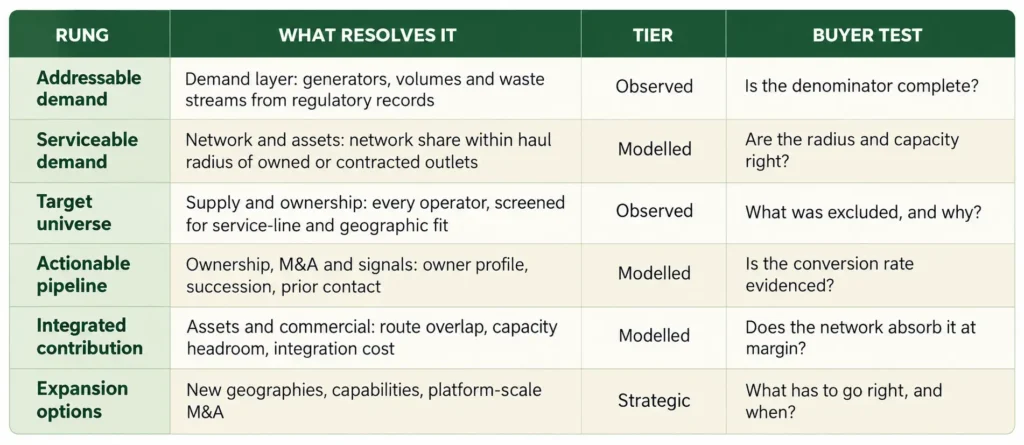
The build is a conversion ladder, and every rung carries its own evidence
The useful unit of analysis is not the market but the conversion from market to build. In route-based sectors such as waste, that conversion has identifiable rungs, and each resolves to a different layer of the market graph. A target list can be long without being actionable: a business may fit the sector but not the service line, sit outside economic haul radius of the platform’s outlets, need capital that breaks the acquisition math, or have an owner with no reason to sell.
An identified target is not an engaged target, an engaged target is not an actionable opportunity, and an actionable opportunity is not a closed acquisition. A credible build keeps those states separate instead of letting every name contribute equally to the forecast. Its revenue then comes from an explicit equation rather than a single bridge bar:

Each term is a separate diligence question. How many transactions can this team close a year? What revenue profile do the reachable targets carry? How long before acquired revenue arrives at platform margins?
Geography decides what acquired revenue is worth
The same dollar of acquired revenue can be worth very different amounts depending on where it sits. A tuck-in that densifies existing routes and fills idle processing capacity creates value beyond its standalone P&L. One that needs a new yard, new trucks and a long haul to the nearest permitted outlet can dilute margin while adding revenue. That is why network share—the share of economically serviceable demand within haul radius—is the right lens for a roll-up, not national market share. A footprint that looks attractive at national scale can demand a different operating model at county level.
The build therefore carries every acquisition through to service mix, EBITDA margin, integration cost, capex, working capital, transport and processing cost, and capacity, with each synergy stated alongside its evidence. Revenue is the output of the build. The operating model decides what it is worth.
An evidence layer narrows buyer diligence to three jobs
When the seller arrives with the conversion ladder already built and every rung traceable to records, the buyer’s scope changes shape. Reconstruction falls away and three harder jobs remain: verify the build, test the assumptions that move the answer, and form an independent view on what the seller cannot evidence—management quality, customer intent, renewal risk and integration reality. Each buyer experiences the shift differently.
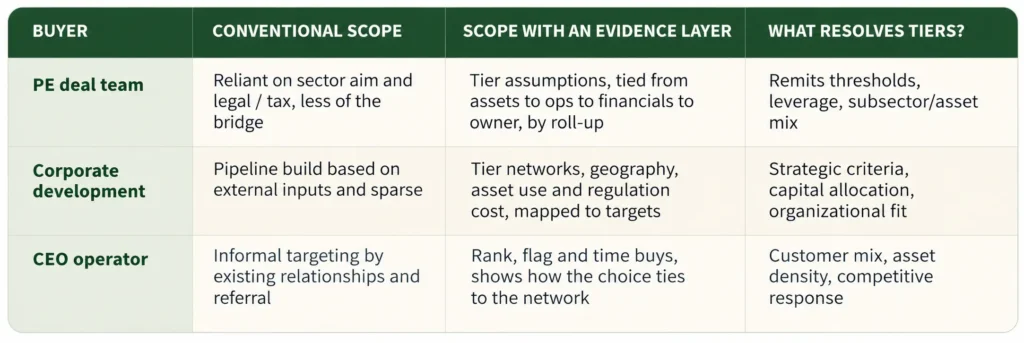
For the CDD provider in particular, the shift is from evidence assembly to interpretation—the part of the engagement that was always worth paying for.
Stress-testing finds the assumptions the value rests on
A stress test is often mistaken for a haircut. Its purpose is to locate dependence: which assumptions the build rests on, and how far the outcome moves when they move. What if deal pace is half the plan? If entry multiples rise a turn? If conversion from actionable to closed falls below the historical record? If acquired sites ramp slower, or processing capacity binds first?
Run against the ladder, the answers sort the growth case into growth supported by existing evidence, growth dependent on testable assumptions, and growth that requires future execution or a strategic trigger. The reconciliation page then shows where the bottom-up build diverges from management’s plan and which driver accounts for the gap. A plan does not become weaker because its assumptions are visible. It becomes harder to misunderstand.
Seller-selected evidence should be audited, not trusted
The legitimate objection is that seller-produced evidence is seller-selected evidence. It is. The answer is not to ask buyers for trust but to hand them the tests that would catch a weak build. An evidence layer that fails any of these should be discounted accordingly.
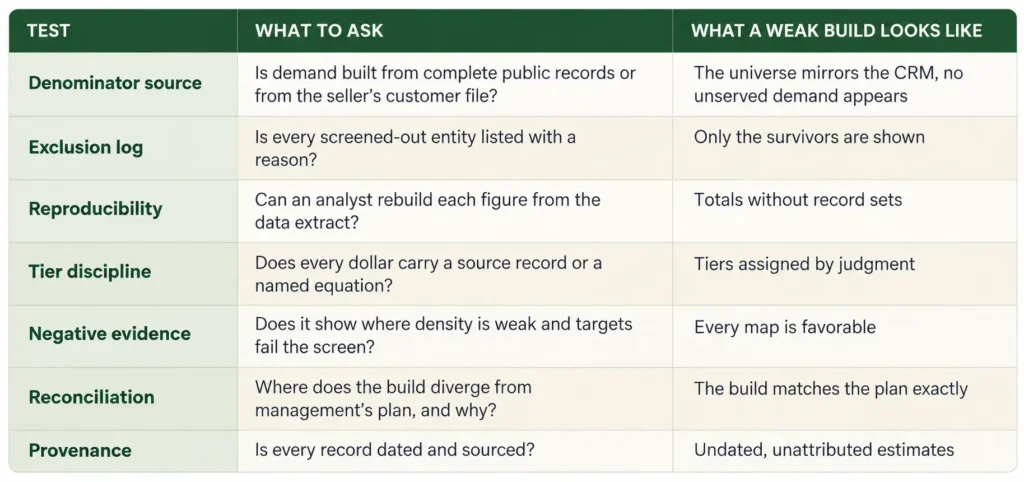
Buyers should welcome diligence that gets harder in a more useful way
A genuine evidence layer does not remove diligence; it relocates it. Buyers spend fewer weeks re-establishing facts the seller already held and more on the handful of assumptions that change price. Disagreements arrive early and specific—forty targets outside haul radius, a capacity constraint read differently—rather than late and diffuse. The seller gains as well: a build the buyer can audit is a build the buyer can credit.
ESPALIER VIEW
The question in a growth-led process is not whether the market is big enough to support the story. It is whether the build is specific, evidenced and auditable enough to earn buyer confidence. Sellers who put that build in the dataroom change what diligence is for—from sizing the market to stress-testing the plan, which is where value is actually decided.