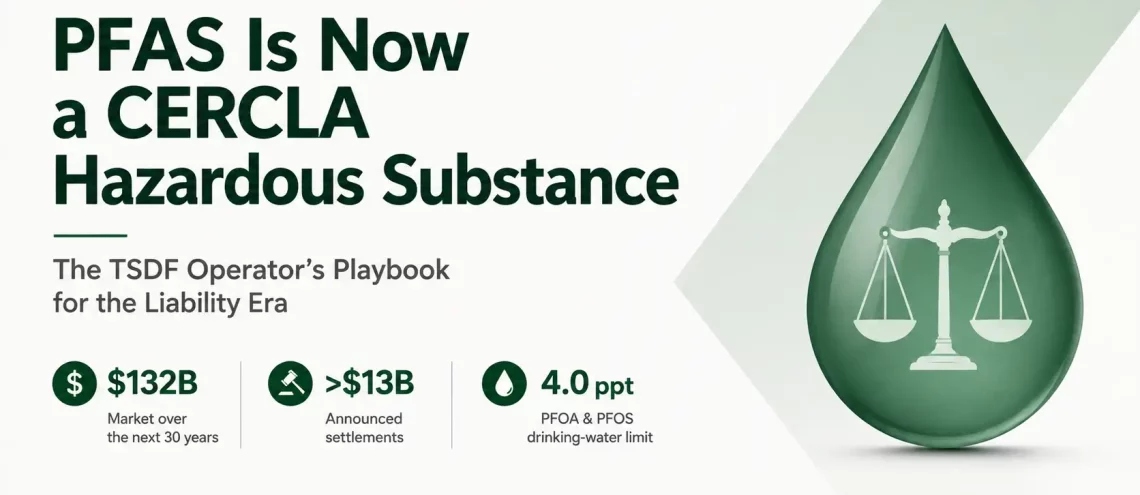
Designation turned every disposal decision into a balance sheet decision. The operators who win the next decade will be the ones who can price a thirty-year liability tail against a near-term revenue surge — and who already hold the permits.
WHAT CHANGED, IN THREE NUMBERS
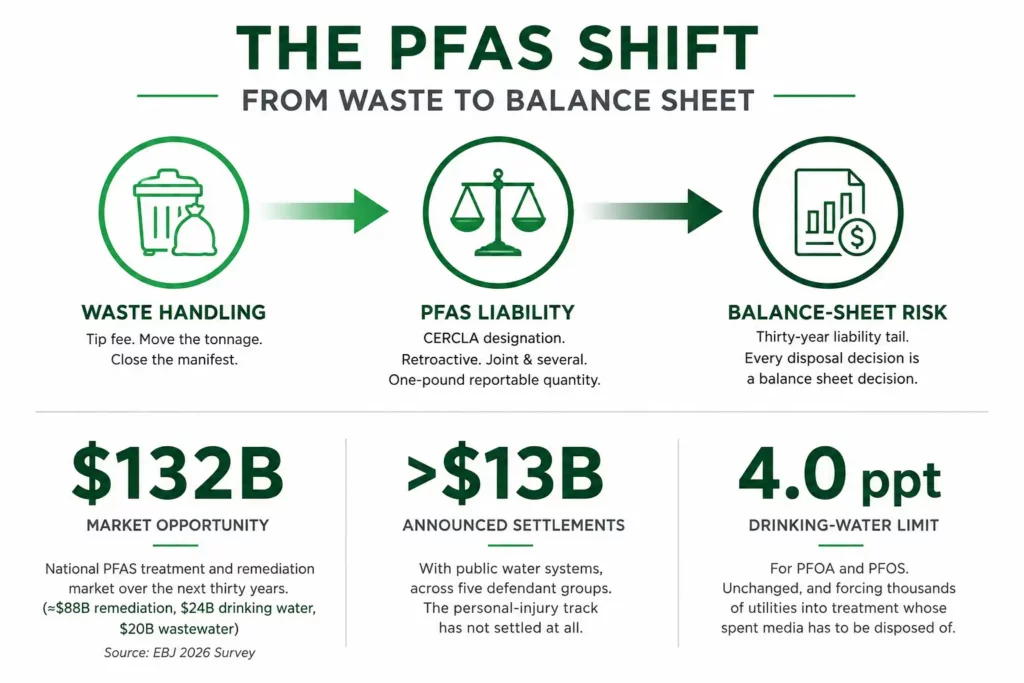
$132B — the national PFAS treatment and remediation market over the next thirty years, per the Environmental Business Journal’s 2026 survey: roughly $88B remediation, $24B drinking water, $20B wastewater. Revised down from $230B a year earlier as federal restrictions eased.
>$13B — announced settlements with public water systems, across five defendant groups. The personal-injury track has not settled at all.
4.0 ppt — the drinking-water limit for PFOA and PFOS. Unchanged, and forcing thousands of utilities into treatment whose spent media has to be disposed of somewhere.
THE PROBLEM
The ground under the waste business just moved
For thirty years, per- and polyfluoroalkyl substances moved through the waste system as chemistry nobody had to name. They arrived in firefighting foam, plating baths, textile finishes, food-packaging coatings and municipal sludge, and they left as landfill leachate, incinerator ash and spent filter media. There was no reportable quantity, no cleanup standard, no line on the balance sheet. A treatment, storage and disposal facility priced the tip fee, moved the tonnage, and closed the manifest.
That model ended on July 8, 2024, when the U.S. Environmental Protection Agency’s designation of PFOA and PFOS as hazardous substances under the Comprehensive Environmental Response, Compensation, and Liability Act — Superfund — took effect. The rule was signed on April 17, 2024, announced two days later, and published in the Federal Register on May 8. For the first time, two of the most widespread PFAS carry the full weight of CERCLA: strict, retroactive, joint-and-several liability, with a one-pound reportable quantity attached.
The significance is not that a chemical was added to a list. It is that CERCLA reaches backward. Liability attaches to material a facility accepted years ago, under permits that were valid at the time, at concentrations no one was required to measure. A single documented receipt of PFOA- or PFOS-bearing waste can make an operator a potentially responsible party in a cleanup it did not cause and cannot undo.
The obvious question in 2024 was whether the designation would survive a change of administration. It has. On September 17, 2025, EPA — the same agency then actively loosening other PFAS rules — announced it would keep the CERCLA designation for PFOA and PFOS and defend it in court. What has not been answered is the judicial question. The industry challenge, Chamber of Commerce v. EPA (No. 24-1193), was argued before a D.C. Circuit panel on January 20, 2026 and remains undecided; a parallel challenge to the drinking-water standards is pending in the same court. The honest position for an operator is therefore not that this liability is permanent. It is that the political off-ramp has closed, the judicial one is narrow and slow, and no capital allocation decision made between now and the ruling can sensibly assume the designation disappears.
THE INSIGHT
PFAS stopped being a waste-handling problem and became a balance-sheet problem
The instinct across the industry is to treat PFAS as an operational challenge — a question of which technology removes it and at what throughput. That framing misses where the value is actually moving. The CERCLA designation converts every disposal decision into a long-dated financial position: the operator books a tip fee today and absorbs a contingent liability that can surface decades later, denominated in remediation costs and contribution claims.
Environmental services is shifting from a disposal business to a liability-underwriting business. The winning operators over the next decade will not be the ones with the most capacity. They will be the ones who can price a thirty-year liability tail against a near-term revenue surge with better information than anyone across the table — and who hold the scarce permits that let them act on that view. What follows is the playbook that shift demands.
THE STRUCTURAL SHIFT
1 · Three things the CERCLA designation changes for every TSDF operator
Liability now attaches to waste you have already buried
CERCLA liability is strict, joint and several, and retroactive. A facility does not have to have been negligent, and it does not get to apportion its share downward at the outset — any potentially responsible party can be pursued for the full cost of a cleanup and left to chase contribution from others. Because the statute reaches backward, the exposure sits in the historical record: every manifest, every profile, every drum of AFFF-impacted media a facility accepted is now a potential anchor for a claim. The waste did not change. Its legal character did.
Every transaction and permit now surfaces PFOA and PFOS
Designation pulls the two compounds into the machinery that runs off the CERCLA hazardous-substance list. Releases at or above the one-pound reportable quantity must be reported within 24 hours. Less visibly, the designation rewired property diligence. ASTM E1527-21 — the standard EPA recognizes for satisfying “all appropriate inquiries” — treats emerging contaminants as non-scope items only until they are designated under CERCLA; Appendix X6.10 provides that once they are, they must be evaluated within the scope of the practice. PFOA and PFOS crossed that line on July 8, 2024, and EPA confirmed the consequence in its December 2025 Brownfields FAQs. Other PFAS remain non-scope unless a client requests them or a state requires them.
The practical exposure runs backward as well as forward: Phase I reports commissioned since mid-2024 that treated all PFAS as non-scope may not support the innocent-landowner or bona fide prospective purchaser defenses they were bought to secure. For an acquisitive operator, this is not a diligence footnote. It is a valuation input on both sides of every deal — and a re-underwriting question on deals already closed.
The “passive receiver” carve-out is a policy, not a shield — and TSDFs are not on the list
Alongside the rule, EPA issued a PFAS enforcement-discretion and settlement policy (April 2024) stating it does not intend to pursue farmers, community water systems and publicly owned treatment works, municipal separate storm sewer systems, publicly owned landfills, publicly owned airports and local fire departments — the so-called passive receivers. Commercial treatment, storage and disposal facilities are conspicuously absent from that list.
Two cautions follow. First, enforcement discretion is a statement of intent, not a change in the statute: the underlying liability remains, and a private party filing a contribution claim is not bound by EPA’s discretion at all. Second, discretion can be rewritten administration to administration — EPA itself has said durable passive-receiver protection would require new statutory language from Congress, which is a candid admission that the current policy is not one. An operator that treats a carve-out it was never named in as protection is mispricing its own risk.
2 · Liability tail versus revenue opportunity — how operators are pricing the new risk
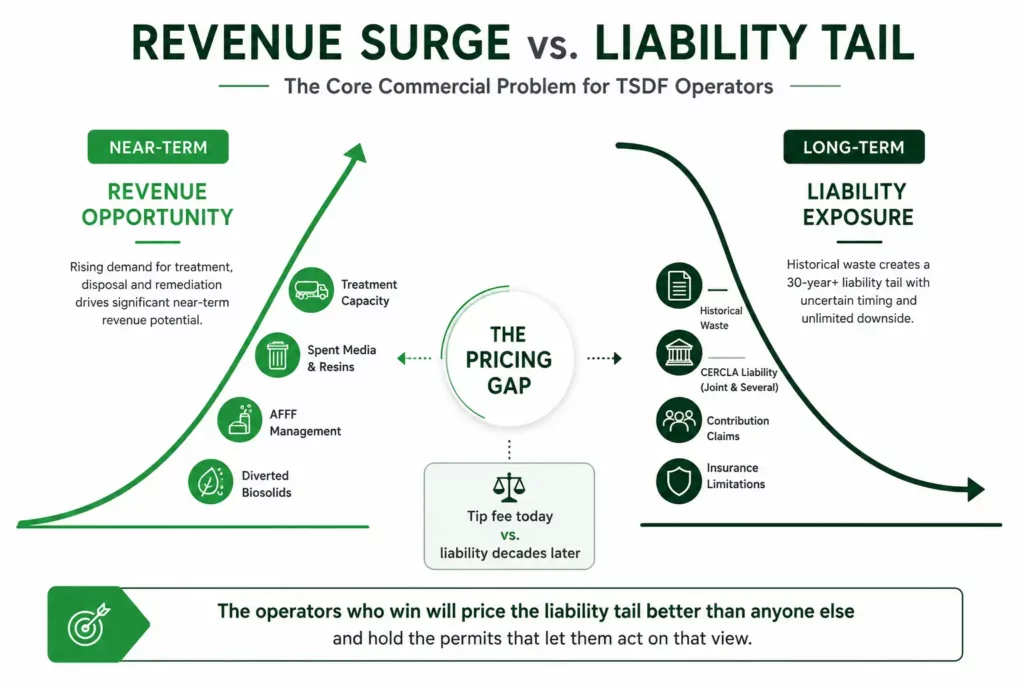
The designation opens a genuine revenue surge and a genuine liability tail at the same time, and the two are not symmetric. Getting the spread between them right is the core commercial problem of the next decade.
On the revenue side, the drinking-water rule is the engine, and it is intact. In April 2024 EPA set enforceable maximum contaminant levels of 4.0 parts per trillion each for PFOA and PFOS. Those limits still stand. What EPA has proposed to change is the schedule and the scope around them: on May 20, 2026 it proposed an opt-in exemption allowing individual systems to move compliance from April 26, 2029 to April 26, 2031 on request, with requests due by November 16, 2026, and a companion proposal would rescind the determinations for PFHxS, PFNA, GenX and the hazard-index mixture. Neither is final — comment closed on July 20, 2026 and EPA has targeted final action in the second half of the year. Narrower and slower, then, but not smaller in the dimension that matters to a TSDF. Thousands of public water systems still have to install granular activated carbon, ion exchange or reverse osmosis, and every one of those installations produces spent media and concentrate that has to go somewhere. A two-year slip changes when the tonnage arrives, not whether.
The Environmental Business Journal’s 2026 survey sizes the national PFAS treatment and remediation opportunity at roughly $132 billion over thirty years — about $88 billion of it remediation — after cutting its own prior $230 billion estimate as federal restrictions eased. Even the reduced number is the largest single demand event the hazardous waste sector has seen in a generation.
On the liability side, the numbers are concrete and the largest piece is still unpriced. Announced settlements with public water systems now exceed $13 billion across five defendant groups: 3M ($10.3 billion in present value, up to $12.5 billion nominal, paid from 2024 through 2036), DuPont, Chemours and Corteva ($1.185 billion), Tyco and Chemguard ($750 million), BASF ($316.5 million), and Carrier through Kidde-Fenwal (roughly $730 million). States are running a parallel track — New Jersey settled with Chemours, DuPont and Corteva for $875 million in August 2025, following Minnesota’s $850 million from 3M in 2018. But every one of those deals resolves water-provider claims. The AFFF multidistrict litigation in South Carolina held 15,244 pending actions as of July 1, 2026 out of 19,819 filed since 2018, and its personal-injury docket — firefighters, service members, residents of contaminated communities — has no global resolution with any defendant group. Bellwether outcomes are still ahead. Every ton of PFAS-bearing material an operator accepts today is a potential line in a future contribution complaint drawn against that unsettled backdrop.
Priced correctly, this is an underwriting question, not a throughput question: what is the expected present value of the liability tail on a given waste stream, and does the tip fee cover it? Operators that have understood this are already repricing. They are raising gate rates on the streams that carry the heaviest tail, demanding tighter waste profiling and generator indemnities, and hardening chain-of-custody so they can prove what they did and did not receive.
What they can no longer reliably do is insure the problem away. ISO PFAS exclusion endorsements are now standard on general liability, business owners and umbrella forms; environmental and pollution legal liability lines increasingly sublimit or schedule PFAS rather than cover it, and the site-pollution market has lost capacity to insurer exits. Coverage remains negotiable for operators who can document their controls in underwriting — which is itself an argument for holding better data than the market. But the base case is that the tail stays on the balance sheet. That is precisely why the choice between containment and destruction is a pricing decision rather than an engineering one: destruction retires the tail at a premium, while landfilling is cheap today and contingent tomorrow.
PFAS treatment and disposal economics — indicative ranges
EPA sharpened that choice in April 2026 with the third edition of its interim guidance on PFAS destruction and disposal. The document is non-binding, but it is the one counsel and customers cite. It again identifies three pathways with the capacity and evidence to matter at scale: thermal destruction under controlled conditions, RCRA Subtitle C landfills, and Class I underground injection wells. Emerging routes — supercritical water oxidation, pyrolysis and gasification, mechanochemical degradation — are treated as promising but data-limited. Two consequences follow for operators. The incineration question has moved: EPA’s joint testing with Clean Harbors at Aragonite, Utah and Veolia’s own testing at Port Arthur, Texas each demonstrated destruction of certain PFAS up to 99.9999%, and the Defense Department’s moratorium on AFFF incineration has ended. And every pathway EPA endorses is one that requires a permit almost nobody can obtain quickly.
3 · Which waste streams reclassify first — and who already holds the permits
Reclassification does not arrive evenly. It follows regulatory and litigation pressure, and the order can be read in advance. Reading it correctly is the difference between building capacity ahead of a wave and buying it at the top.
The likely sequence begins with AFFF concentrates. They carry the hottest litigation exposure, and the volume is scheduled rather than speculative: the Defense Department is working through a congressionally mandated phase-out with an October 2026 deadline, holding more than two million gallons of legacy foam plus roughly 1.5 million gallons of contaminated rinsate, alongside the FAA-driven transition away from fluorinated foam at civilian airports. Next comes spent treatment media — the GAC, ion-exchange resin and RO reject produced by the drinking-water build-out, a volume that scales directly with every utility that comes into compliance.
Then biosolids and sludge, which deserve to be ranked higher than most industry commentary places them, because the diversion is already being written into state law rather than waiting on EPA. Maine and Connecticut have banned land application outright. Virginia’s April 2026 legislation requires biosolids at or above 50 ppb of PFOA or PFOS to be landfilled or incinerated instead of land-applied, effective January 1, 2027, with restricted application between 25 and 50 ppb. Michigan and New York operate tiered thresholds of their own. EPA’s federal track is slower and softer — a draft sewage-sludge risk assessment from January 2025 and draft voluntary guidance issued in July 2026 — but it is the states that are actually moving tonnage from fields into permitted disposal, on dates an operator can plan against. After that come landfill leachate, where PFAS is pervasive and publicly owned treatment works are increasingly refusing to accept it, and finally industrial sludges from chrome plating, textiles, and pulp and paper.
THE RCRA TRACK IS OPEN, NOT CLOSED
One point is widely misreported and worth getting right, because a good deal of strategy is being built on the wrong version of it. EPA did withdraw a RCRA proposal on May 8, 2026 — but the rule it withdrew was the corrective-action proposal, which would have broadened the definition of hazardous waste applicable to cleanups at permitted facilities. The separate February 2024 proposal to add nine PFAS to the Appendix VIII list of hazardous constituents is still live: EPA’s July 2026 Unified Agenda targets a final rule in January 2027.
That listing would reach nine compounds rather than two, including short-chain PFBA, PFBS and PFHxA that the CERCLA designation does not touch, and it would place them squarely within corrective action at RCRA-permitted TSDFs. Reclassification pressure is therefore arriving on three tracks at once — CERCLA today, state programs already ahead of Washington, and a federal hazardous-constituent listing plausibly inside eighteen months. Operators who read the May withdrawal as the RCRA track closing read the wrong document.
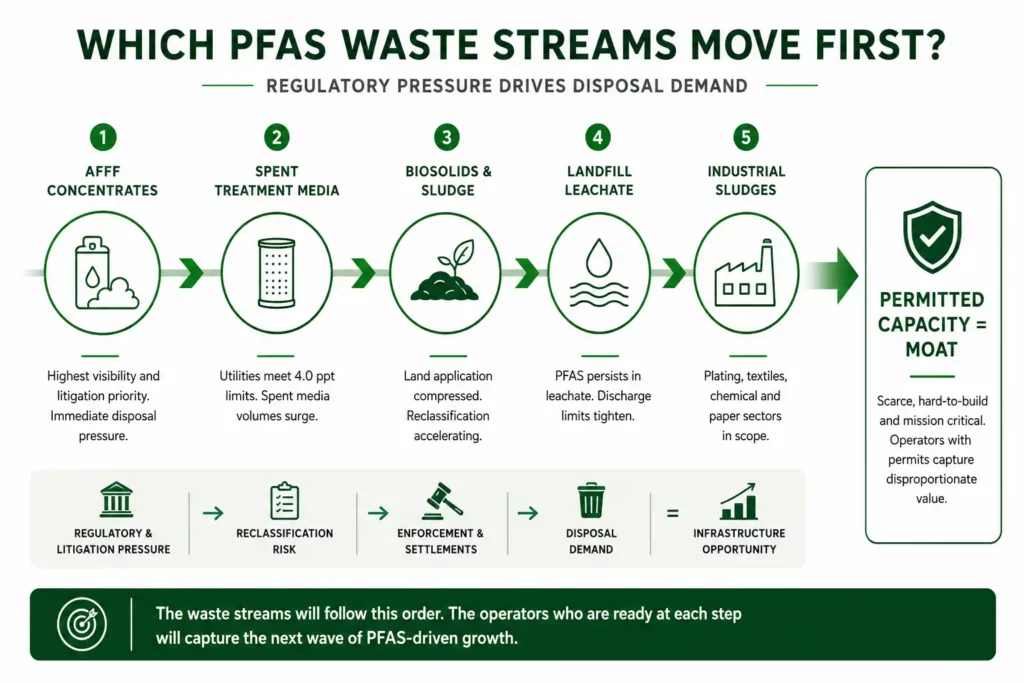
The scarce asset in all of this is permitted destruction and disposal capacity, and it is concentrated in a short list of incumbents that is getting shorter. Clean Harbors remains the largest holder of RCRA Subtitle C treatment and disposal capability in North America. Veolia moved into second position by acquiring Clean Earth and its nineteen TSDFs from Enviri, cleared and closed in early 2026 — a deal premised explicitly on internalizing waste that Clean Earth had been routing to third-party incinerators and landfills it did not own. Republic Services’ Environmental Solutions segment, built on the 2022 US Ecology acquisition and extended since, holds Subtitle C landfills and Class I injection capacity. Below those three sits a thin field of specialty destruction and deep-well providers. Permits of this kind take years to secure and are effectively impossible to replicate at speed. In a market where volume is about to surge and disposal outlets are refusing streams they used to accept, incumbency in permitted capacity converts directly into pricing power — and every consolidation step concentrates it further.
THE NEW MODEL
From “do we have capacity?” to “is it the right capacity, in the right place, priced for the risk?”
The operators pulling ahead have stopped treating their permitted network as a set of assets and started treating it as an intelligence asset. The distinction is where value now accrues, and it maps to a handful of capabilities.
• Decision intelligence — modeling the liability tail against the revenue on each waste stream, so tip fees reflect the risk actually being absorbed rather than last year’s gate rate.
• Infrastructure intelligence — a live picture of where permitted Subtitle C, incineration and Class I injection capacity sits, how utilized it is, and where gaps are opening as streams reclassify and owners consolidate.
• Opportunity mapping — identifying which secondary markets reclassify next, and where local disposal capacity will fall short of the coming volume.
• Network optimization — routing material to minimize combined cost and liability, not cost alone.
• EBITDA intelligence — understanding how a reprice, a new permit or an acquisition changes the value of the platform, not just the margin on a load.
This is the discipline environmental services has historically lacked and infrastructure investors take for granted: a systematic view of where value is created across a network, updated as the regulatory map moves.
IN PRACTICE
What this looks like on the ground
The clearest signal that the industry is heading this way came from an operator, not a consultant. In April 2026 Clean Harbors published a concentration-based routing framework for PFAS-bearing material — broadly, two to twenty parts per billion to Subtitle D landfills with enhanced liners and leachate collection, up to one part per million to Subtitle C, above that to hazardous waste incineration — and offered it to customers as decision guidance. Read commercially, that is an operator converting its own disposal intelligence into a standard the market gets used to, and into a reason to route material through its network rather than a competitor’s. The framework is the product.
The same logic applies on the buy side. For a private-equity-backed platform weighing where to add capacity, mapping a permitted Subtitle C footprint against projected volumes of spent treatment media, AFFF concentrate and diverted biosolids across secondary markets surfaces two things at once: acquisition whitespace in regions where reclassifying streams are set to outrun local disposal capacity, and a repricing opportunity on the specific streams carrying the heaviest liability tail. The analysis that protects the platform from underpricing its own risk also points to where the next permitted asset is worth the most. Capacity and liability, read together, become a growth map rather than a compliance burden. Building that view is what Espalier does.
CLOSING INSIGHT
The permit is the moat; the intelligence is the edge
The CERCLA designation did not simply add PFOA and PFOS to a regulatory list. It attached a thirty-year horizon to every disposal decision and turned tonnage into a financial position. In a market of that shape, the leaders will not be defined by how much they can take in or how many trucks they run. They will be defined by two things that compound together: the permitted capacity others cannot easily build, and the intelligence systems that let them price liability others cannot yet see. The waste has not changed. What it is worth to handle — and what it costs to get wrong — has changed completely.